
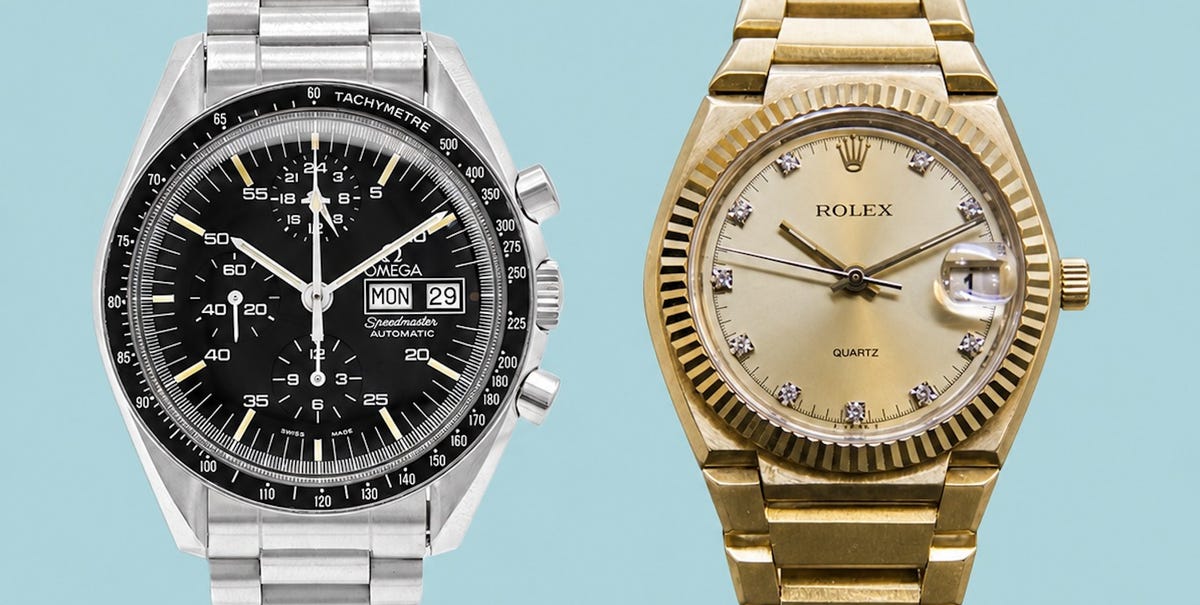
12 min readA few weeks ago, Casio unveiled a new range of fully analogue G-Shock watches, billed as its biggest launch in decades. But what immediately caught collectors' imaginations wasn't the technology inside the new 2500 Series. It was the shape of the cases, whose rounded rectangular outlines bear more than a passing resemblance to the Patek Philippe Nautilus.There’s precedent here. When Casio’s eight-sided GA-2100 appeared in 2019, enthusiasts immediately clocked its likeness to Audemars Piguet's Royal Oak and christened it the 'CasiOak'. The nickname stuck and has since become shorthand for the entire family. (Perhaps this is what happens when you launch watches with names like GA-2100.)So what to call the new Nautilus lookalike? Suggestions have included “Nauty-Less” and “CasiNau,” but “CasioNaut” seems to have won out.Elsewhere in recent watch news, Seiko has been having fun with another nickname. Most watch fans will be familiar with the term “panda,” used to describe a chronograph with a white main dial and two black sub-dials, an arrangement said to resemble the face of the bamboo-munching bear. Seiko's new Power Design Project Panda takes the resemblance to its logical conclusion, with actual panda eyes, ears and, even a little wagging tail on the case.And next week, Piaget will release a new version of its Andy Warhol watch, a name collectors had been using for decades before the brand finally made it official in 2024, following an agreement with the Andy Warhol Foundation.Clearly, the peculiar business of giving watches nicknames is alive and well. Which gives us an excuse, as if one were needed, to run through a dozen great watch nicknames and the stories behind them.Some are named after astronauts, actors, and models. Others have more unusual stories, involving a collaboration that never happened, a celebrity who almost certainly never wore the watch named after him, and an American president who wasn't even allowed to accept his watch.Piaget/Omega.'Andy Warhol'Piaget ref. 15102 and its modern descendantsIn the 1970s, Piaget was making some of the most extravagant watches money could buy, with chunky gold cases, colorful stone dials, and an impressive list of celebrity customers. Among them was Andy Warhol, who owned at least seven Piagets, including a large, cushion-shaped gold model, reference 15102, which he bought in 1973. (Four of his watches are now in Piaget’s collection.)Six years later, Warhol met Yves Piaget, the founder’s great-grandson, and the two became friends. Warhol joined the Piaget Society, the glamorous circle of artists, designers, and celebrities cultivated by the company.Introduced in 1972, the 15102 was produced for just five years before disappearing from Piaget’s catalogue. The design returned in 2014 under the name Black Tie, although collectors had long since nicknamed the original the “Andy Warhol.” Ten years later, the company finally made the name official, signing a licensing agreement with the Andy Warhol Foundation for the Visual Arts in 2024.Piaget has since developed a collection bearing the artist’s name, with designs that draw on his taste for unconventional colors and materials. Among the first was a Clou de Paris edition featuring a blue meteorite dial surrounded by rows of tiny gold pyramids.Warhol’s association has done vintage prices no harm, either. In May this year, an example resembling his own sold at Sotheby’s in Geneva for CHF166,399 – about $200,000.'Tintin'Omega Speedmaster ref. 311.30.42.30.01.004The Omega Speedmaster “Tintin” takes its name from a collaboration with the Belgian cartoon character that never quite happened.In 2013, Omega released a version of its Speedmaster Professional chronograph (officially called the Racing) with an unusual red-and-white checkered pattern around the edge of its black dial. It was inspired by the rocket in Hergé’s Tintin adventures Destination Moon and Explorers on the Moon.The original plan was to produce the watch in partnership with the owners of the Tintin rights. Early prototypes even featured the rocket on the dial, with a special case back to match. But the deal fell through, and Omega went ahead without the Tintin branding, leaving a rather curious design detail whose inspiration the company couldn't openly celebrate.The story came to light when Robert-Jan Broer, founder of the watch website Fratello, spoke to Omega’s head of product development. Once collectors understood the connection, the “Tintin” nickname stuck. Illustrations from the comics accompanying Fratello’s coverage were subsequently removed at the request of the rights holder.That said, the owners weren't opposed to putting the character on a watch altogether. Omega’s Swatch Group stablemate Swatch had already produced two official Tintin models for the character’s 75th anniversary in 2004, including a Happy Birthday Tintin edition limited to 9,999 pieces. Omega simply never managed to get its own collaboration over the line.Seiko/RolexSeiko ’Pogue’; Rolex Explorer II ’Steve McQueen’'Pogue'Seiko 6139, particularly the yellow-dial 6139-6005Omega may have the Moonwatch, but Seiko can lay claim to the first automatic chronograph worn in space. And unlike the Omegas issued by Nasa, the Seiko in question was bought by the astronaut himself.In June 1972, US Air Force pilot William Pogue paid $71 for a yellow-dial Seiko 6139 chronograph. He was training for NASA’s Skylab program and needed a watch to time engine burns. Like other astronauts, Pogue was due to receive an Omega Speedmaster, the chronograph Nasa had qualified for spaceflight, but his hadn't yet been delivered.By the time his Omega arrived, however, Pogue had become so attached to the Seiko that he decided to take it into space as well.When Skylab 4 launched in November 1973, the Seiko travelled in a pocket of Pogue’s spacesuit. During the mission’s 84 days in orbit, he wore it on his left wrist, with the Omega on his right. (The Seiko remained set to US Central Time.)For years, the Seiko’s part in space history went largely unknown. Then American watch collector David Bruno spotted a reference to it in a mission transcript and contacted Pogue to find out what he'd worn. In 2008, the astronaut consigned the watch through the Astronaut Scholarship Foundation. It sold at Heritage Auctions for a surprisingly modest $5,975, complete with its original receipt and Pogue’s handwritten account.The original Seiko 6139 has long been discontinued, but yellow-dial examples are now widely known as “Pogues.” They're still relatively affordable, too. Seiko has since revisited the look with the solar-powered Prospex SSC947, but it's an interpretation rather than a direct reissue.'Steve McQueen'Rolex Explorer II ref. 1655There is one problem with the Rolex Explorer II colloquially known as the “Steve McQueen.” Nobody has been able to establish that Steve McQueen ever wore one.His Rolex of choice was a Submariner. Yet the Explorer II association has become so firmly established that even Sotheby’s used the nickname when offering an example in May 2022, while the description below acknowledged that no convincing evidence existed for the connection. (Who first decided to attach the actor’s name to the watch remains a mystery.)In fact, the same model has another nickname with an easier-to-fathom explanation. Freccione is Italian for “big arrow,” referring to the whopping orange 24-hour hand that dominates its dial.Introduced in 1971, the Explorer II was designed for cave explorers and others who might spend extended periods without natural daylight. Its extra hand completed one revolution every 24 hours, allowing the wearer to distinguish day from night.With its fixed steel bezel, busy dial, and that unmistakable orange hand, the original Explorer II looks quite unlike most of Rolex’s better-known models. It has since become a firm favorite with collectors.Omega/RolexOmega Speedmaster ’Holy Grail’; Rolex Quartz ’Texano’'Holy Grail'Omega Speedmaster ref. 376.0822In 1987, Omega introduced a Speedmaster that put a new spin on the familiar Moonwatch. The ref. 376.0822 featured an automatic movement, a day and date display, a 24-hour indicator, and an additional hand to count elapsed minutes. It made for a busy, rather technical-looking watch, and one that wasn't destined for a long production run.Its relative scarcity would eventually catch the attention of American collector and Omega expert Chuck Maddox.In 1999, Maddox was offered a 376.0822 in Germany for around $600. At roughly the same time, another Speedmaster appeared for sale in Iowa at a similar price. Faced with a choice, he went for the Iowa watch, reasoning that dealing with a seller he could visit in person was less risky than buying from overseas.Almost immediately, he regretted passing up the German example. Finding another proved far more difficult than he had expected. A watch appeared in Japan with a price tag of more than $10,000. Another opportunity slipped away at auction. Eventually, with help from a fellow enthusiast, he managed to track one down.Maddox later wrote about his hunt on his website and in online watch forums, comparing his obsession with finding the elusive Speedmaster to King Arthur’s search for the Holy Grail. (Watch collectors have never knowingly undersold a story.) He began referring to the watch simply as “the Grail,” and the nickname caught on among fellow collectors.It's a tale that will be painfully familiar to anyone who's ever collected watches: the one that got away, and the lengths you'll go to for a second chance to spend a load of money.'Texano'Rolex Quartz ref. 5100When quartz technology arrived in the late 1960s, its promise was greater accuracy and, eventually, affordable watches for almost everyone. Rolex, naturally, took a different path.Its first quartz watch, launched in 1970, was available exclusively in gold. The white-gold version of the ref. 5100 cost 18,300 Swiss francs before tax. According to Rolex expert James Dowling, that was roughly the price of a Porsche 912 and two-and-a-half times what the company charged for a Day-Date on its President bracelet.Inside was the Beta 21, an early Swiss quartz movement developed jointly by a consortium of manufacturers. The technology was remarkable enough, but the watch looked like no Rolex that had come before it. Its large, angular case, broad bezel and integrated gold bracelet were a world away from the familiar designs of the period.Italian collectors took to calling it the “Texano,” or “Texan,” presumably in recognition of its considerable size and extravagance.Only around 1,000 numbered examples are thought to have been made, mostly in yellow gold. More than half a century later, the “Texano” remains as rare and extravagant as ever.Zenith/Universal Geneve'Cover Girl'Zenith El Primero A3818Nothing to do with glamorous magazine models, as it happens. The nickname comes from a book published in 2009 by Zenith historian and collector Manfred Rössler, who chose a photograph of the El Primero A3818 for the cover of Zenith: Swiss Watch Manufacture Since 1865. His reason for picking that particular watch? He simply liked blue dials. Fair enough.Introduced in 1971, the A3818 was a 37mm steel chronograph with an angular case housing Zenith's celebrated El Primero movement. Its vertically brushed blue dial featured contrasting sub-dials and distinctive shark's-tooth markings around the edge.Only 1,000 examples were made, according to Zenith, and the model had long since disappeared from production when Rössler's book brought it back to collectors' attention. Zenith revived the design in 2020, with a lightweight titanium Airweight edition following in 2022. Both had “Cover Girl” as part of their official names.'Nina Rindt'Universal Genève Compax ref. 885103/02It doesn't get much more ’60s than Finnish fashion model Nina Rindt, married to Austrian Formula One driver Jochen Rindt and a regular fixture in the paddock during the sport's glamorous heyday. Photographs from the late 1960s show her watching races from the pit lane, often wearing a white-dial Universal Genève Compax chronograph on a wide leather cuff. The combination of glamorous wearer, racing connection, and period photographs proved irresistible to watch collectors, who began calling the model the “Nina Rindt.” Its black-dial counterpart acquired the even better moniker “Evil Nina.”The nicknames helped transform the watch's fortunes. In the early 2010s, as collectors became increasingly interested in vintage chronographs with famous associations, prices for the “Nina Rindt” rose dramatically. As Eric Wind, founder of Wind Vintage and a former Christie's watch specialist, recalled: “That watch went from $3,000 ordinarily and was worth $40,000 within a year.” One particularly fine example sold at Christie's in 2015 for $47,500.When Universal Genève relaunched in April this year, the Compax was central to its comeback, with new chronographs inspired by both versions. The watches now have automatic movements but retain the contrasting sub-dials of the originals—and are even offered on the wide leather cuff that helped make Nina's watch so recognizable.Casio/BulovaCasio AE-1200 ’Casio Royale’; Bulova Oceanographer ’Devil Diver’'Casio Royale'Casio AE-1200In the 1983 film Octopussy, Roger Moore's James Bond wore a Seiko G757 Sports 100 that had been given a special upgrade by Q Branch. Its small circular digital display functioned as a tracking screen, allowing Bond to follow a transmitter concealed inside a Fabergé egg being sought by the film's villain, Kamal Khan.Almost 30 years later, in 2012, Casio introduced the AE-1200, an inexpensive digital world timer with a striking resemblance to Bond's gadget. It had a similarly angular case, multiple digital displays and, most importantly, a little circular clock that seemed to recall the tracking screen on Moore's Seiko.Enthusiasts spotted the resemblance and came up with a pun on Casino Royale, the 2006 Bond film starring Daniel Craig. Thus the “Casio Royale” was born, a nickname involving a different watch, a different manufacturer, and an entirely different Bond film.The AE-1200 remains in Casio's catalog today, costing $55 and looking much as it did in 2012. Its miniature world map indicates the selected time zone, while the little circular display shows the time. It also has five alarms, a stopwatch, and a countdown timer. The Fabergé egg tracker is not included.'Devil Diver'Bulova OceanographerBy 1972, Bulova was advertising the water resistance of its Oceanographer dive watch with the words “666 FEET” printed prominently on the dial. That's approximately 203 metres, although quite why the company chose such an oddly specific figure rather than a round 200 meters isn't entirely clear.Given the number's rather ominous biblical associations, it didn't take long for enthusiasts to christen the watch the alliteratively pleasing “Devil Diver.”The Oceanographer had other things going for it, too. The original was a handsome example of early-1970s dive-watch design, with a substantial cushion-shaped case, a rotating bezel, and a dial with extravagantly bold markers intended to be easily read underwater.In 2017, Bulova teamed up with New York vintage-watch dealer Analog/Shift to gauge interest in reviving one of its archive designs. The Oceanographer came out on top. A memorable nickname with a whiff of danger presumably didn't hurt.The watch duly returned in 2018, including an orange-dial edition limited to, naturally, 666 pieces. Since then, Bulova has produced smaller versions and an Oceanographer GMT capable of tracking a second time zone.More than 50 years later, Bulova still prints “666 FEET” on the dial, although its official specifications now give the water resistance as a rather neater 200 meters.Audemars Piguet/OmegaAudemars Piguet Royal Oak Offshore ’The Beast’; Omega Speedmaster Apollo XI ’Nixon’'The Beast'Audemars Piguet Royal Oak Offshore ref. 25721“You have spoilt my watch, you're a murderer!”According to designer Emmanuel Gueit, this was Gérald Genta's reaction when he first saw the Royal Oak Offshore, a considerably beefier version of the Royal Oak he had designed for Audemars Piguet in 1972.AP had been hoping to recapture some of the impact of the original Royal Oak, which had caused a sensation with its unusually large steel case, integrated bracelet, and extravagant price. By the early 1990s, the company wanted something to appeal to a younger audience, and Gueit was given the job.His answer, launched in 1993, was the Royal Oak Offshore. The original's 39mm case grew to 42mm, enormous by the standards of the day. It was thicker, too, with a chronograph movement, rubber-coated crown and pushers, and a conspicuous gasket visible beneath the bezel. The Offshore name came from powerboat racing, a suitably muscular association for such an imposing watch.The industry quickly christened it “The Beast.” Genta himself reportedly compared it to a sea elephant, which, frankly, would have made an even better nickname.Even within Audemars Piguet, enthusiasm was mixed. The company's archive records that some insiders hoped the project would fail, while the first hundred examples had only Royal Oak engraved on their case backs, without the Offshore name. Hardly a ringing vote of confidence.Customers eventually came around, helped by celebrity associations, particularly with Arnold Schwarzenegger. The Offshore went on to help establish the fashion for oversized luxury watches, which must have had Genta sobbing even harder into his fondue.'Nixon'Omega Speedmaster Apollo XI ref. BA145.022-69When Neil Armstrong and Buzz Aldrin landed on the moon in July 1969, Omega had good reason to celebrate. Its Speedmaster chronographs had accompanied NASA astronauts throughout the Apollo program, and the company decided to mark the achievement by making 1,014 special gold editions.These were considerably more luxurious than the steel watches issued to the astronauts, with 18-carat yellow-gold cases, bracelets, and dials, plus burgundy bezels. The first two were intended for President Richard Nixon and Vice President Spiro Agnew, complete with individual engravings.There was just one problem. American rules governing gifts to public officials meant neither man could accept an expensive gold watch from a Swiss manufacturer. Both were returned to Omega, where they remain in the company's museum in Switzerland today.Other recipients were luckier. Astronauts received their watches at a gala dinner in Houston in November 1969, while most of the remaining production was offered for public sale. Collectors subsequently nicknamed the reference the “Nixon,” after the president who never got to wear his.The watches have since become highly collectible, particularly those with a connection to the Apollo astronauts. An example sold at Bonhams in 2024 for HK$384,000 [just under $50K], while Neil Armstrong's own gold Speedmaster, number 17, fetched $2.125 million in April last year.Of course, Omega couldn't resist reviving the design, producing another 1,014 examples in its Moonshine gold alloy in 2019. But the originals have an appeal that can never quite be replicated, combining as they do mid-century space-age glamour with a whiff of Nixonian roguishness.
How 12 Famous Watches Got Their Nicknames
Full Article
Original Source
Read the full article at Esquire →KhanList aggregates and links to publicly available news content. We do not host full articles from third-party sources. Always verify important information with original sources.