
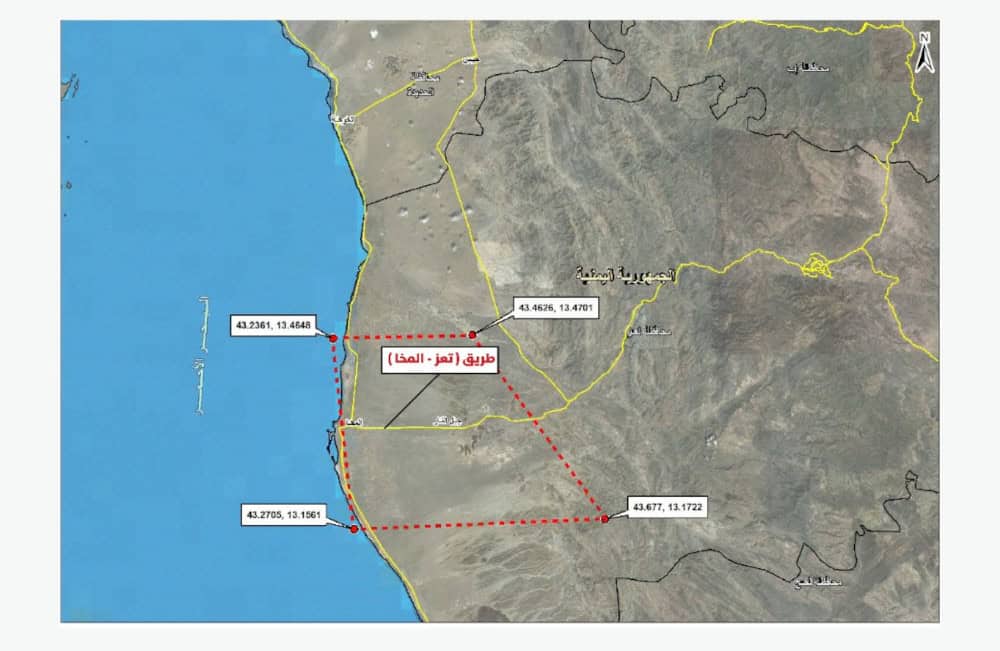
On September 10, the Houthis seized the strategic port city of Mocha on Yemen’s southern Red Sea coast. The next day, the Iran-backed group pushed south, culminating with the capture of the remaining Red Sea coast and Perim Island in the middle of the Bab al Mandeb Strait, the strategic chokepoint at the southern entrance to the Red Sea. The Houthis also seized the Hanish Islands, an archipelago in the southern Red Sea roughly 100 miles north of Bab al Mandeb. Control of the coast and islands would give the Houthis a direct hold on the Red Sea chokepoint through which significant international shipping flows. However, on September 13, the Yemeni Armed Forces media center announced that government troops had recovered some territory near Bab al Mandeb. The Houthis rapid advance down Yemen’s west coast came after the Iran-backed group began a substantial campaign against forces of the internationally recognized government of Yemen on August 6. The southern west coast and islands were held by the National Resistance Forces (NRF), a government-aligned paramilitary organization led by Tariq Saleh, vice president of the Presidential Leadership Council (PLC), Yemen’s eight-man executive body. An NRF statement described the fight as “one of the fiercest and most brutal battles against the Iranian-backed Houthi terrorist militia on the West Coast front.” The Houthis began attacking the west coast on August 9 with a “missile bombardment and attacks by suicide drones and explosive-laden boats.” Then, in early September, the Houthis began ground operations to push through NRF territory, ultimately seizing Mocha and moving south. The NRF said that the Houthis had killed more than 500 militia fighters and injured about 1,500 since August 9. Meanwhile, the NRF statement claimed that its forces killed over 1,000 Houthi fighters and injured thousands more. Yemen analyst Mohammad al Basha identified the confirmed Houthi death toll, based on funeral announcements shared on the Houthi-controlled TV channel Al Masirah, as 332 as of September 13. On September 11, Yahya Saree, the Houthi military spokesman, issued a statement on “the broad, qualitative military operation ‘And Allah is stronger in might and stronger in exemplary punishment,’” which he said began on September 3. Saree described the operation as intended “to expel the Saudi mobilization forces in some districts of the western coast.” Since July, the Houthi narrative has focused on fighting Saudi Arabia, alternately claiming that the group is fighting Saudi forces and accusing opposing Yemeni forces of being Saudi puppets. Saree said that the Houthis seized 5,400 square kilometers of territory on the southern west coast. The Iran-backed group also claimed to have freed 210 of its men from prisons on Yemen’s west coast. A Yemeni source affiliated with the country’s armed forces said that military leaders requested air support from Saudi Arabia, the sponsor of Yemen’s internationally recognized government, to counter the advancing Houthis, but none came. American officials told Axios that Saudi Crown Prince Mohammed bin Salman requested that the United States conduct airstrikes against the advancing Houthis on September 10, but President Trump declined. Instead, the United States is providing Saudi Arabia with intelligence and targeting data. “The Houthis called us, and they don’t want to fight with us,” Trump told reporters on September 12. “They would much prefer not having us involved, and they’re letting most ships go through. There’s just one country that they’re not too happy with, and we’ll get that straightened out,” he added. The Trump administration previously conducted Operation Rough Rider, a roughly seven-week bombing campaign against the Houthis, that struck over 1,000 targets between March and May. Rough Rider ended with a May 6 ceasefire between the United States and the Houthis that amounted to an agreement not to attack each other but failed to protect international shipping. The Houthis attacked two commercial vessels within two months of the agreement. On September 10, Colonel Majid Abdullah Al-Nuzaili, spokesman for the Yemeni Armed Forces, announced that the military would be targeting the Houthis in a “kill box” around Mocha and requested that civilians stay away from any Houthi presence and the main road. On September 13, The Yemeni Armed Forces said that a ground operation with air support retook some territory in the southwestern part of Taiz governorate. The governorate is located on Yemen’s west coast and spans from north of Mocha to the Bab al Mandeb chokepoint. In response, the Houthis claimed a September 14 operation against King Khalid Airbase and King Fahd Airbase in southwest and west Saudi Arabia, respectively, using “dozens of ballistic missiles and drones.” They accused Saudi Arabia of “launching more than 300 airstrikes in the past five days.” Riyadh has not confirmed its participation in air operations to support the Yemeni Armed Forces. The implications of the Houthi advance Mocha’s strategic importance comes from its geography. The port city is roughly 50 miles north of Bab al Mandeb and historically served as an important trade hub. Before the Houthis’ seizure, it was also the headquarters of the NRF, which used the west coast and islands to monitor Houthi maritime activity and conduct major interceptions of Houthi weapons smuggling. Perim Island, also known as Mayun, was also controlled by the NRF and served as a key base for the force to monitor the Red Sea, especially for Houthi smuggling through Bab al Mandeb or across the Red Sea from Africa. Perim sits within the maritime chokepoint, which is only around 20 miles wide. The eastern channel is roughly 2 miles wide and used by local and smaller vessels. The western channel, which is used by international shipping, is roughly 16 miles wide. The Hanish Islands play a similar role by allowing government-aligned forces to monitor Houthi maritime activity and serving as a base for counter-smuggling operations. The UAE previously invested in infrastructure on the islands, including airstrips. Prior to the Houthi campaign against commercial shipping begun in late 2023 over the war in Gaza, over 9 million oil barrels per day (bpd) transited Bab al Mandeb. While the Houthis’ maritime attacks led oil transits to drop by over half in 2024 and 2025, Iran’s closure of Hormuz led to a jump in oil products transiting Bab al Mandeb to over 7 million bpd in June, according to data from the maritime intelligence firm Kpler. Most of this total was Saudi exports rerouted from the Persian Gulf to the Red Sea via the cross-kingdom East-West pipeline. On September 10, Riyadh closed the pipeline after attacks from Iran-backed militias in Iraq, likely conducted in coordination with the Houthis. The Houthis previously announced a maritime blockade of Saudi Arabia on July 20 and have since attacked the kingdom’s oil facilities and ships. Control of the southern Red Sea coast and Perim Island better positions the group to choke off exports via Bab al Mandeb, though Riyadh can route some oil north through the Suez Canal. The Houthi advance has caused a large wave of internal displacement. On September 10, Abdullah al Saadi, permanent representative of the Republic of Yemen to the United Nations, told the UN Security Council that roughly 44,000 people had been displaced by the Houthis’ escalation. By September 13, the International Organization for Migration, a UN arm, reported that displacement in Yemen in September alone exceeded 82,000 people, mostly from the west coast.
Houthis take Yemen’s Red Sea coast and key Bab al Mandeb islands
Full Article
Original Source
Read the full article at Fdd →KhanList aggregates and links to publicly available news content. We do not host full articles from third-party sources. Always verify important information with original sources.