
London; and Basel, Switzerland | Oct. 01, 2026, 2:54 p.m. ET | 5 min read Commentators in Iran’s hard-line media are expressing delight at the lightning offensive of Yemen’s Houthi militia, which has stepped into the Middle East wars by targeting Saudi Arabia and seizing effective control of a second global energy choke point.Fighters of Ansarullah, as the Houthis are formally known, are part of Iran’s regional “Axis of Resistance” alliance. After repeated blows from Israel weakened other key Axis members – Hezbollah in Lebanon and Hamas in Gaza – the Houthis in recent weeks have assumed the mantle of the alliance’s most potent player.While Iran has shut down much of the energy exports that flowed through the Strait of Hormuz, action by the Houthis is also hindering shipments from the Red Sea through the Bab el-Mandeb Strait, as the U.S.-Israeli war against Iran marks seven months. “Ansarullah’s show of force has created a powerful lever for Iran against [U.S. President Donald] Trump,” the hard-line Kayhan newspaper wrote this week. “Whenever Trump considers renewing the war against Iran, he is reminded that, alongside Hormuz, there is a Bab el-Mandeb also within Iran’s sphere of power and action.”Yet even as the Houthis have emerged as Iran’s most powerful regional ally, the militia whose capabilities Iran has done so much to build might be the least responsive to Iranian direction.Iranian officials and state media often describe Houthi gains as though they are owned by Iran, and no doubt they have improved Iran’s bargaining position. But analysts say Iran’s decadelong investment in boosting Houthi missile and drone forces doesn’t mean it can order Houthi actions. The Yemeni militia is far from being a proxy force, and is not beholden to Iran – or as open to Tehran’s wishes – as Hezbollah was, when it served as Iran’s most powerful regional ally.“Iran would have been in a much stronger position had Ansarullah blocked Bab el-Mandeb in February 2026, dealing a major shock to energy markets and to gas prices in the United States,” says Ali Alfoneh, an Iran expert at the Arab Gulf States Institute. Al Joumhouriya TV/ReutersIn an image taken from video, damage from Houthi strikes is seen in the port city of Mocha, Yemen, Aug. 10, 2026. The militia group now controls most of the country's Red Sea coastline. It took Tehran “considerable time and effort” to persuade the Houthis to take action against Saudi Arabia and restrict Red Sea shipping, he says, and “one could argue that, in the end, Ansarullah acted more out of self-interest than to accommodate Tehran.” Indeed, Houthi hesitance to join the war immediately “hampered Iran’s war strategy.”“There appears to be considerable relief [in Iran] that Ansarullah has finally risen to the task,” says Mr. Alfoneh. “But there also must be some disappointment in IRGC [Islamic Revolutionary Guard Corps] circles that for so long it stayed out of the war, limiting itself to symbolic strikes against Israel.”“Strongest Iranian ally in the region”The Houthis’ advance has brought all of Yemen’s western Red Sea coastline under its control and forced Saudi-backed troops of the internationally recognized government to withdraw from Mocha Port and key Red Sea islands. The Houthis declared a blockade of Saudi ships on July 20 and have since targeted seven vessels.“When we talk about their military improvements and weapons, it is always about Iran,” says Maysaa Shujaa al-Deen, a Yemen expert with the Sana’a Center for Strategic Studies, contacted in Manama, Bahrain.“The Iranians improved their capabilities; they trained them how to make and assemble the pieces of the missiles,” she says. “The smuggling networks between the Houthis and Iran never stopped.” The Houthis “are keen to be part of the Axis of Resistance and ... always have that ambition to play a regional role,” says Ms. al-Deen. Seven weeks of American bombing of the Houthis in 2025 – which burned through $1 billion worth of ordnance – failed to lessen the Houthis’ ideological determination or their territorial grip.“The Houthis have geography, they almost have a state, they have a population under their control, they have economic resources,” says Ms. Deen. “They are the strongest Iranian ally in the region right now.”Houthi strikes in recent weeks have damaged the East-West pipeline that Saudi Arabia was using as a workaround to Iran’s control over the Strait of Hormuz. The Houthi blockade of Saudi ships in the Red Sea – vessels of other nations are free to travel, they say – has also restricted that alternative route. Ebrahim Al-Suhaibi/ReutersMembers of the Saudi-backed Yemeni government forces ride on a military vehicle as they patrol a road leading to the front line with Iran-aligned Houthi fighters, in Taiz province, Yemen, Sept. 30, 2026. Gregory Gause, an associate fellow at the Middle East Institute in Washington, makes the case that the Houthis “are ideologically committed to Iran’s project in the region.”“The idea,” he says, “is that, if Iran is defeated, they are defeated.”Appeals in Iran’s mediaStill, if the Houthis have proved themselves especially resilient members of the Axis, they are also particularly independent from Iran. Some Iranian media coverage appears designed to convince the Houthis to be better members of the team.“The solution for Ansarullah is to stop operating as an isolated military and political player, and see itself as part of a larger system, the Axis of Resistance, in which the security and interests of each component are tied to those of the others,” wrote Tasnim, a news outlet linked to the IRGC, in early September. Meanwhile, the benefits of more than a decade of military help and training from the IRGC Quds Force, which manages overseas operations, are clear to the Houthis.“Even in small battles, the Houthis have not hesitated to fire 100 missiles,” says Ms. al-Deen, of the Sana’a Center. “If they can do this in a small battle, it means they are not afraid to lose their stockpile.”And the Houthis have evolved into a sophisticated fighting force. During the latest advance, for example, they used artificial intelligence to imitate the voice of a government commander giving withdrawal orders. The fake orders “caused big chaos in the front lines,” says Ms. al-Deen.But there also appears to be a limit to Houthi intelligence prowess. Saudi targets that have been struck so far are easily visible on Google Maps. “Until now, we have had nothing that [Houthis] have hit that is hidden ... that we can say is based on intelligence information,” she says.Yet there is a result that benefits Iran from the changing battlefield in Yemen. Deepen your worldviewwith Monitor Highlights.Politics with respectGet political stories with respectful analysis.There‘s a world of new ideas in everyBooks newsletter.There‘s more to life, enrich yours withCulture & Learning weekly.Follow humanity‘s discoveries withScience & Nature stories in your inbox.Gain a spiritual perspectivefrom the stories in your inbox.Want to understand the deeper impact of critical events? Learn the Monitor‘s insight.Already a subscriber? Log in to hide ads. “For Iran, Yemen has always been a low-cost, high-yield investment,” says Mr. Alfoneh, the AGSI analyst. The current Houthi offensive “significantly strengthens Tehran’s negotiating position vis-à-vis Washington.”An Iranian researcher contributed to this report. ALREADY A SUBSCRIBER? LoginReal news can be honest, hopeful, credible, constructive.The Christian Science Monitor was founded in 1908 to lift the standard of journalism and uplift humanity. We aim to “speak the truth in love.” Our goal is not to tell you what to think, but to give you the essential knowledge and understanding to come to your own intelligent conclusions. Join us in this mission by subscribing.
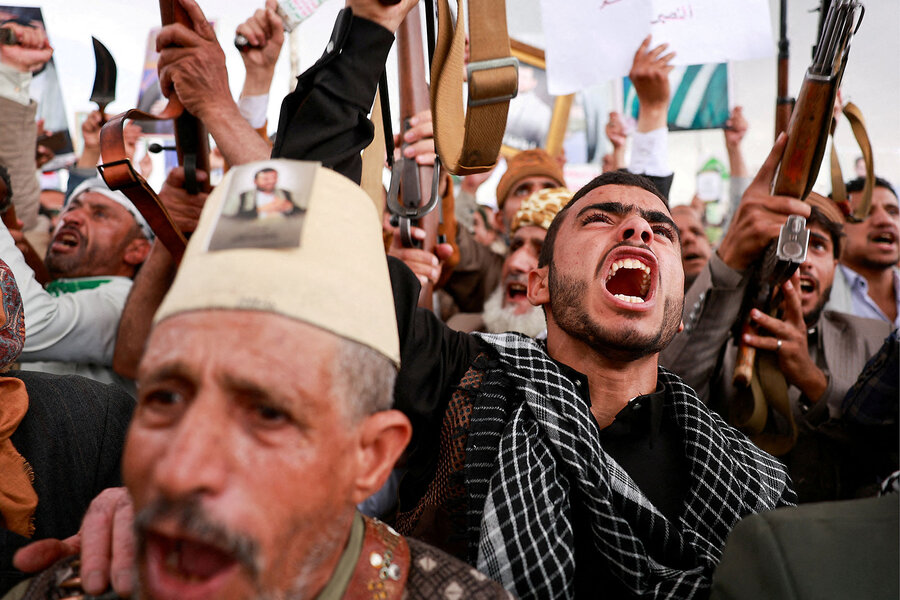
Houthi militia now leads Iran’s ‘Axis.’ But how much can Tehran count on them?
Full Article
Original Source
Read the full article at Csmonitor →KhanList aggregates and links to publicly available news content. We do not host full articles from third-party sources. Always verify important information with original sources.