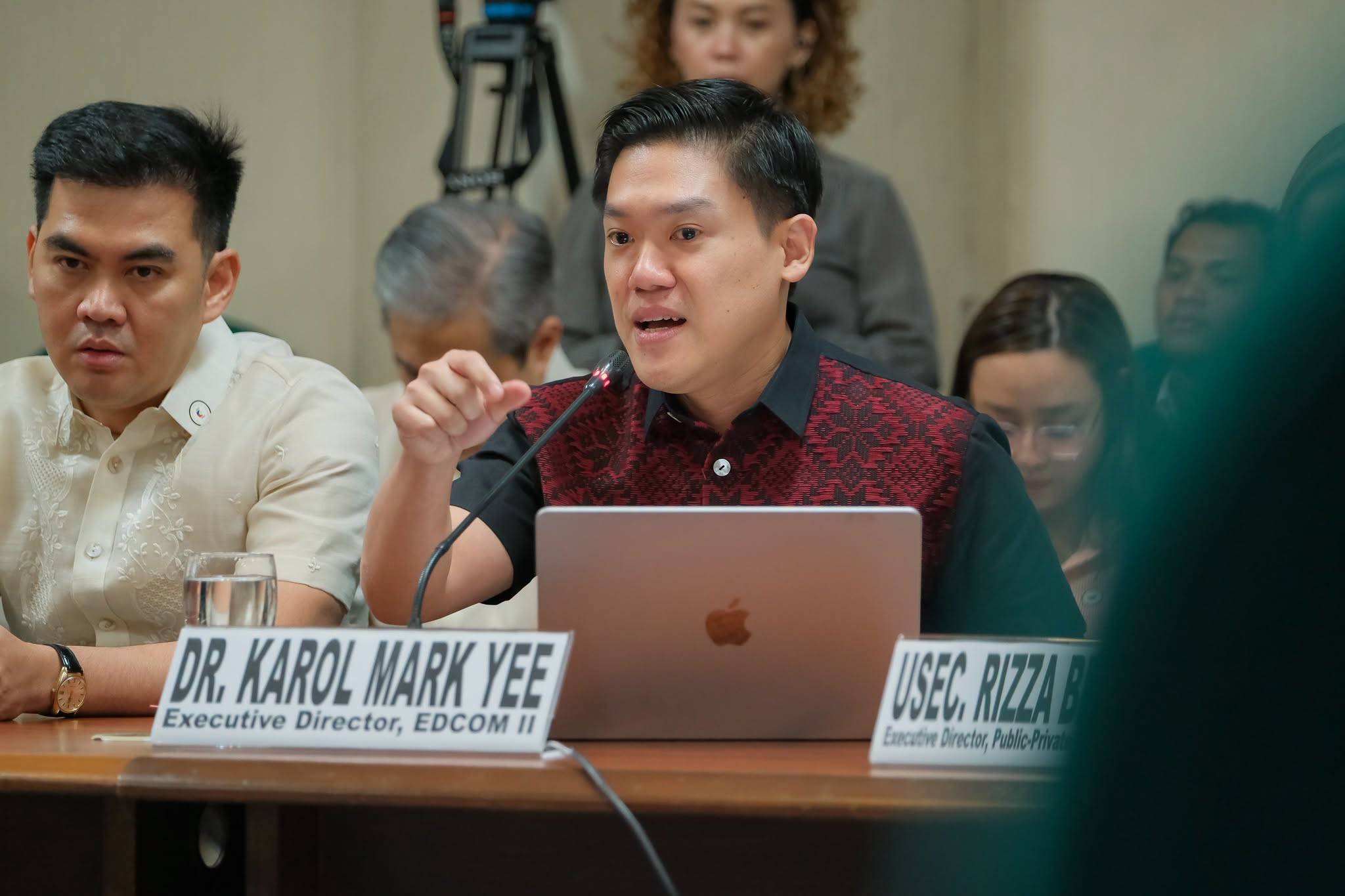
HEARING. Second Congressional Commission on Education Executive Director Karol Mark Yee speaks during a Senate basic education committee hearing on July 23, 2026. EDCOM 2's Facebook page EDCOM 2 urges the Department of Education to address the lack of school facilities in resettlement projects, and prioritize the construction of classrooms in areas with severe congestion and multiple shifts MANILA, Philippines – Housing projects without planned education facilities are compounding the severe shortage of classrooms and contributing to the poor quality of learning in the country, according to the Second Congressional Commission on Education (EDCOM 2). During a Senate basic education committee hearing on Thursday, July 23, EDCOM 2 Executive Director Karol Mark Yee reported that there are 58 housing projects by the National Housing Authority (NHA) that do not have planned school facilities. Yee was citing Department of Human Settlements and Urban Development (DHSUD) data submitted to EDCOM 2. The 58 NHA housing projects, representing over 167,000 units, are located in Bulacan, Rizal, Cavite, Laguna, Pampanga, and Metro Manila. Under the 2008 implementing rules and regulations of Batas Pambansa Blg. 220, education facilities are only required for low-cost developments with 1,500 units and above. “Policies are silent about the cumulative challenges faced by schools when multiple housing sites are set but without any schools to go to,” Yee told senators. He described what the commission found in Naic, Cavite: At least 48 low-cost NHA housing sites there have generated more than 12,000 students that existing schools cannot accommodate. In Yee’s presentation, he said that many live beyond the schools’ two-kilometer catchment area. Yee noted that EDCOM 2 has raised the issue since 2024, with the Department of Education (DepEd) and DHSUD signing a memorandum of understanding to address the matter in July 2025. However, this MOU was only for forthcoming housing projects. Without government action, schools in Naic saw a spike in enrollment figures by 5,405 students between the end of school year 2025-2026 in March and the start of SY 2026-2027 in June. This increase meant the town needed at least 135 additional classrooms to comply with the 1:40 classroom ratio. “Ang tanong po no’ng mayor: ‘Saan po kami kukuha ng espasyo at lugar na pagdadalhan ng lahat ng estudyante?’” the EDCOM 2 executive director said. (The mayor asked: Where will we get the space to put all of these students?) DepEd urged to address issue During the hearing, NHA Region IV Manager Roderick Ibañez said they have sent a list to the DepEd of housing sites that need funds for school facilities. “The NHA only needs P2.8 billion to complete the backlog of classrooms in Region III and in Region IV, which are the priority regions of DepEd. We have been waiting for the budget for two years,” Ibañez said in a mix of English and Filipino. Yee appealed to the DepEd and the DHSUD to immediately address the lack of school facilities in NHA resettlement areas, and to clarify agency roles and coordination mechanisms for school site development. “Consistent with the National Education Plan, we would like to urge DepEd to prioritize construction in areas with the most severe congestion and with triple, multi-shifts, because we saw in the data that these are also the areas with high rates of bullying and school violence,” he said in a mix of English and Filipino. While the DepEd vowed to solve the issue, funding to set up schools in housing projects might not be released this year, and may be considered in 2027 yet. Progress in classroom construction The issue was brought up as Senator Bam Aquino, chairman of the Senate basic education committee, conducted the hearing to get updates regarding classroom construction in 2026. The Philippines is confronted with a 166,000-classroom backlog. As of Wednesday, July 22, over P23 billion out of the P67.9-billion 2026 budget for classroom construction has been released to the DepEd, said Education Undersecretary Filemon Javier. Two other construction modes — local government units (LGUs) and public-private partnerships (PPPs) — were introduced in a bid to plug the gap, as well as move away from depending entirely on the corruption-mired Department of Public Works and Highways (DPWH). The DPWH promised to complete 5,000 classrooms this year using previous budgets. Under the 2026 budget, it targets to start building an additional 6,000 classrooms. Over 200 LGUs have so far signed a memorandum of agreement (MOA) with the DepEd for LGU-led classroom construction. However, the release of funds to LGUs will only be done once there is a resolution to award the first tranche. Not all LGUs are expected to sign MOAs with the education department this year to build classrooms. Meanwhile, the DepEd hopes to issue a notice of award for the winning bidder to set up 3,000 classrooms under the PPP modality by October. At least two companies have shown interest in this project under the PPP for School Infrastructure Project Phase III. – Rappler.com
Housing provided, but schools for settlers’ children often overlooked
Full Article
Original Source
Read the full article at Rappler →KhanList aggregates and links to publicly available news content. We do not host full articles from third-party sources. Always verify important information with original sources.