
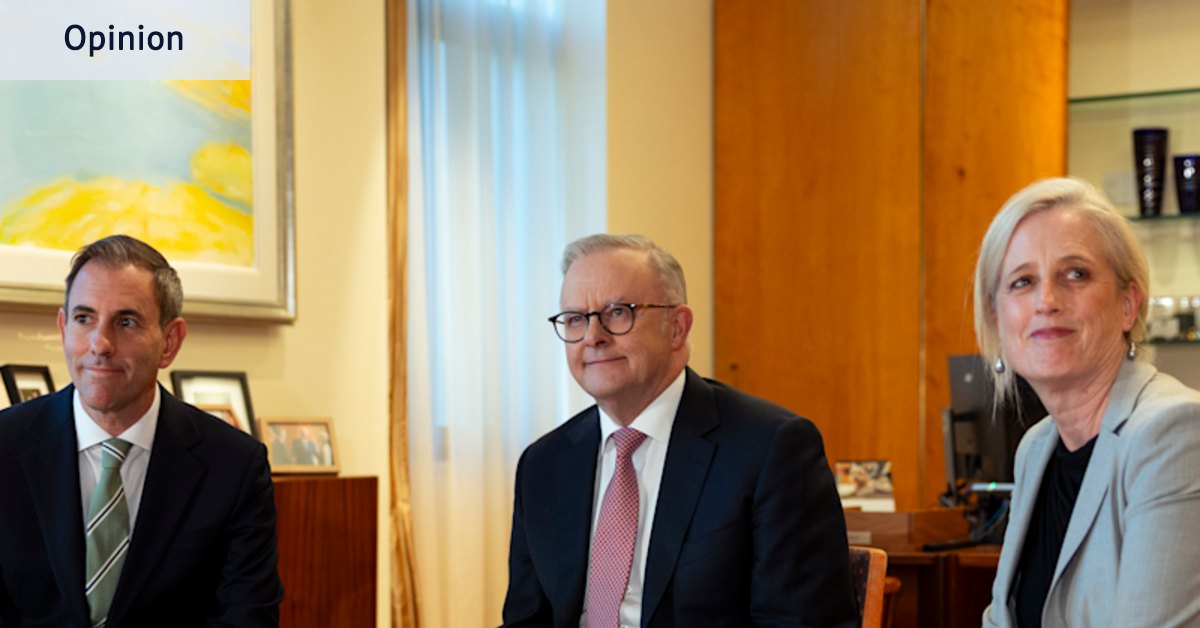
OpinionColumnist and communications adviserNovember 8, 2026 — 5:00amNovember 8, 2026 — 5:00amIt was the wrong policy, introduced in the wrong way, at the wrong time, by the wrong people. And now the trio with primary responsibility – Prime Minister Anthony Albanese, Treasurer Jim Chalmers, and Finance Minister Katy Gallagher – want our pity for how hard it is to be them. Who knew that leading a country, managing its economy and running a ruler over its expenditures could be so tricky. Certainly not the people who put their hands up to do it.Anthony Albanese, Jim Chalmers and Katy Gallagher ahead of the 2026 federal budget. Dominic LorrimerYes, we’re still talking about the 2026 federal budget. A document produced almost entirely without consultation with the people who are living and running businesses in the economy from which the Canberra bubble steals oxygen. Based on Treasury modelling so rushed and flimsy it collapsed almost as soon as it was exposed to suburban accountants. Marketed as intergenerational fairness, when the only demographic protected and helped are landlords with substantial existing property holdings. A document that introduced an unnecessary level of uncertainty into an economy already dealing with lethargic productivity, falling real wages and a volatile global environment.The poor construction of the signature policies announced in the 2026 budget has been exposed by a series of spectacular collapses over the months since they were announced. The capital gains tax increase (let’s just call it what it is) caused an immediate backlash from small businesses and tech start-ups. The government was forced to offer carve-outs for these groups, claiming it had always meant to consult after announcing the measures.This is without question the wrong way to construct the national accounts. The costings are baked into a set of papers that are supposed to be a guide to our incomings and outgoings over the coming years. If the assumptions underpinning the forecasts aren’t complete, the job isn’t done. The government should have more respect for the people than to hand in half-finished homework.That aside, they are also the wrong policies – for our time or, arguably, for any time. Most punters might not yet fully understand the capital gains tax mechanism, but since significant investors do, the effect is already seeping through the economy well before the tax change takes effect in July 2027. It’s now acknowledged that the structure of the tax will discourage investors from riskier bets on small Australian ventures. Just when the economy needs every little injection of “animal spirits” it can get.Even the decision to end negative gearing on existing properties – which might have been a winner if properly worked through and taken to an election with a dose of economic responsibility – has created havoc delivered now. Property prices have fallen much more than the 2 per cent dampener that Treasury modelled. (The refusal of either Treasury or the Treasurer’s office to release the underpinning assumptions was in itself a huge red flag, as I wrote at the time.) Surprise, surprise, it turns out that falling house prices at a time of rising interest rates, a tight rental market, and cost of living anxiety just aren’t the win the government thought they would be.So why would a government attempting to steward a nation plagued by low productivity, worsened by global strife, decide to throw sand in the gears of the domestic economy and tank the major asset held by middle-class Australians?The explanation started the day after the budget and has been painfully clear ever since. Because they had no clue about how the policies they cooked up, without consultation with the people they’ll affect, at a time when every economic misstep amplifies the existing pressures on Australians, were going to actually play out.Imagine how a first-time buyer who bought into the five per cent deposit scheme feels. They now owe 95 per cent on an asset that’s losing value thanks to a prime minister and treasurer who didn’t tell them a contentious tax change lay ahead that would pull the rug out from under the market they were buying into.If they misunderstood the economics, they knew everything about the politics. The timing of the budget changes was sensationally chosen. Sure, it was the coward’s choice. But what do you expect from politicians – a clear vision of what the country should be, alongside the hard choices it’ll take to get there, explained candidly to the electors?The government chose the timing with Machiavellian precision. While the negative gearing change took effect right away, the tax changes won’t start until the tax year beginning July 2027. That means ordinary mum-and-dad investors won’t submit their tax returns and clock the extra slug of tax until after the 2028 election. But if the changes have made it through an election – as they look likely to do, unless the opposition can turn around its fortunes – Albanese will be able to claim a mandate for them. The memory of the broken promise from before the previous election will be swept away. It’s a cunningly calibrated sweet spot to minimise political damage.No, what the irresponsible trio doesn’t understand is the policy itself. All three have stuttered, stumbled and deflected through interviews in which they were called on to explain the detail. The conclusion is that they can’t. An excruciating appearance on ABC 7.30 a week after the budget saw the finance minister disappear from the airwaves for a number of weeks. A post-budget Senate enquiry into the changes was rushed and rigged and shut out many dissenting voices. The prime minister and the treasurer have resorted to dismissing anyone who challenges them as simply politically hostile.Meanwhile, the “saves” announced in the budget are cactus. This week, Treasury’s lead actuary essentially called the government’s plan to cut the cost of the NDIS implausible. And the 5 per cent “efficiency dividend” the finance minister asked the public service to find after the last election has not materialised. Instead, the public service wage bill has surged, often without any notable increase to efficiency.But Chalmers would like acknowledgement that inflation comes from elsewhere in the world, Gallagher would like her attempts to keep costs down adequately celebrated, and Albanese would like to be anywhere in the world but here.Everything about the situation in which Australia finds itself is wrong, wrong, and wrong again. Including the fact that the people responsible haven’t a clue how to make it right.Parnell Palme McGuinness is an insights and advocacy strategist. She has done work for the Liberal Party and the German Greens and is a senior fellow at the Centre for Independent Studies. She is also an advisory board member of Australians For Prosperity, which is part-funded by the coal industry.Get a weekly wrap of views that will challenge, champion and inform your own. Sign up for our Opinion newsletter.From our partners
House prices wouldn’t be falling so fast if Albanese was a man of his word
Full Article
Original Source
Read the full article at Smh →KhanList aggregates and links to publicly available news content. We do not host full articles from third-party sources. Always verify important information with original sources.