
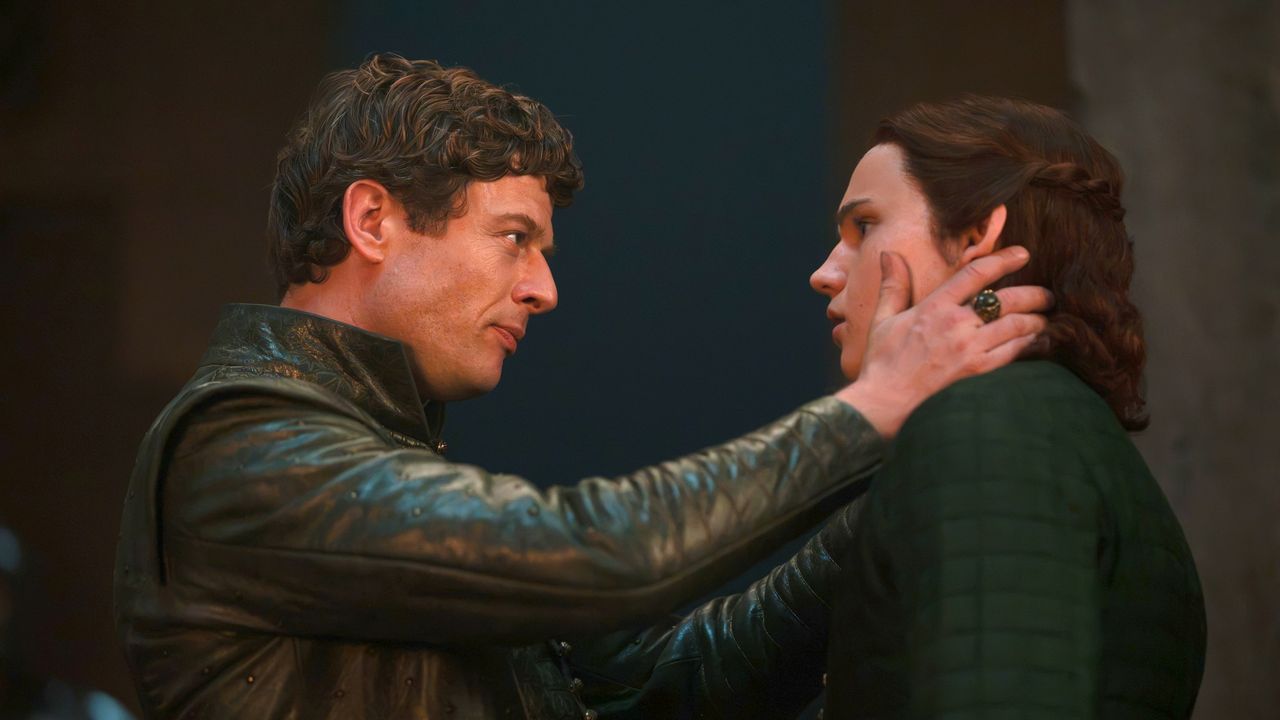
“I think Daeron is the most important person in his life,” Norton says of Ormund. “There is affection, there's love there, however warped that is.”Theo Whiteman/Courtesy of HBOThis story contains spoilers for episode four of season three of HBO’s House of the Dragon, “Tumbleton.”Don’t count out the Hightowers. While Rhaenyra Targaryen (Emma D’Arcy) may have taken King’s Landing and the Iron Throne in the early parts of this violent and gripping season of House of the Dragon, the rightful Queen is still dealing with those pesky Greens. Specifically, she's contending with Ormund Hightower (James Norton), nephew to the recently beheaded Otto (Rhys Ifans), who marched from the Hightower seat of power in Oldtown to prepare for an invasion of King’s Landing. Along with him is Alicent’s (Olivia Cooke) son Daeron (Benjamin Evan Ainsworth) and his dragon Tessarion, whom she sent away to live as a Hightower rather than a Targaryen, as she tells Rhaenyra in “Tumbleton”.While Alicent’s brother Gwayne (Freddie Fox) told her that Daeron is a “kind” man back in season two, the company he keeps is less so. “Tumbleton” shows the audience the true side of Ormund; he's a man with a temper and a fascist streak, and isn’t afraid to be one person privately and another publicly if it will help him win the war. These revelations come a head after he supposedly surrenders his army and Daeron to Rhaenyra, only to pull the chair out from under everyone by passing along someone else masquerading as Daeron. Now, Ormund and Daeron are entrenched in the nearby village of Tumbleton, where they begin making their next moves—including Ormund pressuring Daeron to kill one of the city’s denizens after he disrespected one of Ormund’s troops. The episode brings home the notion, echoed by Ser Criston Cole (Fabien Frankel), that all our characters are on the razor’s edge between being honorable and a beast. In many ways, “Tumbleton” suggests that Daeron’s arc this season centers on whether he’ll accept or reject the devil on his shoulder by giving in to pressure from Ormund.The relationship and power dynamics between Ormund and Daeron form the spine of “Tumbleton,” making it quite an interesting debut for two long-talked-about characters. We sat down for an exclusive interview with both James Norton and Benjamin Evan Ainsworth to talk about Ormund’s theatricality, how House of the Dragon prepared Ainsworth for his role as Link in 2027’s The Legend of Zelda movie, and much more.You two pulled off quite a bait-and-switch there in episode three.James Norton: It’s caused quite a stir in terms of the meme culture. I've never experienced so many memes where I'm…Ben, have you seen this? The way Ormund is now the best hair colorist in Westeros—Benjamin Evan Ainsworth: [laughs]JN: People are loving it.I’d love to know who was responsible for the dye job. They really need to open a barbershop in Flea Bottom. I do think the whole switch is an interesting insight into Ormund because he seems very theatrical to me, and that action is an extension of his theatricality. Did that come through when you first read the character, James?JN: Theatrical is a good word to describe Ormund. The first read—I remember the smell pomander, the intolerance of smells really stuck out. It was quite a big insight into this character. It was evidence that the writers, Ryan [Condal] and the creators, wanted to go kind of big and delicious with him and really be brave. There's nuance: there's a human story, a relationship with Daeron, and everything else, but there are also these characteristics which feel big and, as you say, delicious and theatrical. It’s wonderful for an actor because it gives me license to play. I was able to give quite camp versions of scenes and experiment. When you're given permission to take big swings, it's a delight. It's really fun when the parameters are slightly wider than usual.What was encouraging and admirable from my point of view is that when I watched the show, I'm like, Oh, they took the big swing. They went there. They were brave as well in the edit. Ormund, as a result, has become this slightly larger-than-life, unpredictable, many facets, many faces. His power, as well, is that he plays with that. Sometimes he loses his temper, and the faces, the different personalities that come out, are just pure rage. When he loses control, he becomes this monster, this kind of Jekyll and Hyde. But A lot of it is within his control. As you say, the hair dyeing, for some reason, fits his character brilliantly. You can imagine him at Old Town just doing an incredible dye job on Daeron. I mean, I love the moment Rhaenyra lifts up the hair and checks the roots. I was watching, going, I nailed that. There's not a root in sight. [laughs]BEA: From my perspective, I think Daeron’s relationship with Ormund—he's been his father figure for most of his life. With that comes this, I guess, longing for acceptance and appreciation. With the chaos and the unpredictable elements, it's like seeing through that theatricality and trying to know what's at the heart of these decisions he makes in order for his own survival, but also to see the bigger picture. This season, particularly, it's taking that twisted relationship in many ways and then adding more stakes and more tension to it with the circumstances that come around with Aemond not coming in episode four. It’s been so fun to watch James just give these different variations and takes and to try and react to those different versions. And like you said, to see which route the edit takes through those different versions.JN: We had a lot. I mean, Ben is terrifyingly good considering his age. He was also doing his GCSEs [General Certificate of Secondary Education] when we were shooting this. Didn't you get all A stars?BEA: Aw, too kind. But yeah, I did.JN: He's also incredibly humble, as you can tell. He basically managed to—in the UK, I don't know if you have the same—but it's like when you’re 16 or 17, you do these very important exams. This guy was taking on one of the lead roles in the new series of House of the Dragon, but also he was smashing out his exams at the same time. It was incredible.What was really important, I think, to both of us was—to offset the theatricality—make sure that this relationship was very real and authentic. As Ben says, Ormund is the closest man he has to a father. Ormund, there's not that much in the books about him. There is a family in Old Town, but certainly for him, I think Daeron is the most important person in his life. There is affection, there's love there, however warped that is. That was important for us because there is a theatricality to our scenes, and an intentional one. But what was offsetting that and grounding it was this relationship, which was very authentic, human, and something we could both relate to.I know that the cast has a chance to have not quite rehearsals, but almost like conversations with one another, before the season starts. Ben, how did the two of you go about finding the relationship between your characters?BEA: I remember we had conversations with Ryan and some of the directors early on, like you say, before filming started. Those were great in illustrating the bones of the relationship. I suppose the rest of it happens as we're filming and exploring while we're figuring that out and blocking and rehearsing on the day. It’s that mixture, I suppose: what we're doing ourselves at work, conversations, and then reacting to one another on the day.JN: And time! I sometimes get asked [to give] advice to actors. I've got to that stage in my life where I'm no longer the one taking it. I'm somewhere in between taking it and giving the advice. But my advice always is: spend time with people who you are working with. We were lucky because HBO have the resources and the commitment to the show, where for eight days we came in to do a read-through for each episode. We did an episode a day. We would come in and have time beforehand to have a coffee. Ben and I sat next to each other in those readthroughs, so we were able to meet, chat, and hear a bit about life. I met your parents and your family. When we got on set, there was already a relationship.There's nothing worse than arriving on a set and having to play this type of relationship where there is history and have it be a complete stranger. To have already met Ben and, not literally, but broken bread, chattered, had a coffee, and whatever was crucial. Then, as Ben said, the time spent on set is key because you build rapport, you build chemistry. Those later scenes, which obviously we don't shoot in linear sequence, but inevitably the last block is the later episodes. By then we had spent a hell of a lot of time together, and there was a rapport which we were able to lean on.Ben, when you’re conceptualizing Daeron, what was it on the page that you wanted to make sure you drew out in your performance?BEA: There's this internal grappling or tension between, I guess, morality, who he is as an individual, and what his identity is. He's somewhere between Hightower and Targaryen. Around Ormund, he's certainly Hightower. But as the season progresses, being Targaryen becomes more and more valuable to Ormund, to himself, and to the prospect of becoming king and within this war, which he has no control over. So who he is and who he wants to be, throughout all of this chaos around him, was the main thing that I was excited in exploring. A lot of that comes through the relationship with him and Ormund.And, as James was talking about, the history that’s there between these two characters. What does it look like when Ormund’s about to let the rage out and trying to pick on those things? His awareness is heightened because of the trauma which he's dealt with throughout these years with Ormund. So yeah, exploring those relationships, particularly his relationship with Ormund, but also those questions of identity, who he is despite all this chaos.James, what about you? Anything else outside of that theatricality?JN: There's a devotion that Ormund has to the faith and his spiritual journey, which is interesting to me because there's a very practical, strategist brain in Ormund. He's constantly conniving and thinking about how to undermine Rhaenyra and her power, infiltrate King's Landing, et cetera. But there's also this bigger picture or space that he exists on where he really subscribes to the Hightower law and faith. That was interesting to me because it also tipped into a kind of fanaticism.There's a level of superiority which he ascribes to the Hightowers, which is verging on—it's not just dubious, it's fascist. He thinks the Hightowers should rule and that the Targaryens are [pauses] I mean, he uses the word—“Your blood is tainted.” It's extreme, and it's like religious fanaticism, which is really interesting to talk about currently. The world, as we know, everyone's now subscribing to more and more polarized positions, and there are fanatics who are being given platforms that they should not.So yeah, just to root the man beyond the theatricality—because there was a version of Ormund who would've been camp, ludicrous, really fun and delicious. Then it was these other parts of him, particularly the relationship with Daeron and also this other more sinister part of him, which is almost like the eugenics side of him where he fervently believes that his kin are entitled to the throne because they are just superior. That was very important because it meant that his journey, for him, is no veering off that north star. There was no questioning his moral compass. Ormund fervently believes in his superiority to the Targaryens, which is why the relationship with Daeron was so interesting because he loves this boy. This boy is the future of the Hightower claim to the throne, and yet he's half Targaryen. There’s a lot to get our teeth into.You touched on the fascistic side of things, which I keyed into during that final scene of this week’s episode. Here’s someone who is talking about having a pure bloodline, but then has to basically be the parent to someone who is of both sides. I’m curious if you have any thoughts on how he’s squared that calculus.JN: Has he squared it away or has he just bulldozed his way through it? There's not a sophisticated compromise he has found in terms of his relationship with Daeron and his own coexisting of the Targaryen and the Hightower lineage in one person. That's very evident in the way that he just dismisses the Targaryen blood as tainted in front of Daeron.I guess what I'm trying to say is that's where Ormund’s Achilles’ heel is. He's so belligerent and so narrow-minded that there would've been a version of this where he would’ve, perhaps, kept Daeron on [his] side had he been more intelligent in his approach to this very complicated question mark around family, kin, and bloodline. But he just bulldozes his way through it. He's like, That part of you is disgusting, and it makes me violently ill.There's no nuance there. That's what I mean about it being fascistic. It's so binary. The squaring away would suggest a more sophisticated understanding. And as a result, there is a limit to the relationship. We as the audience, along with Daeron, along with Gwayne, hear him say those things, and we're just like, Wow, for all your brilliance and intelligence, you're actually thick as fuck. It's like those people who sit on those platforms and can spout all sorts of erudite language. Ultimately, when it comes down to those kinds of viewpoints—which are so binary and so unnuanced—at the end they go, “You're kind of stupid." I think the squaring away element would give him too much credit, because he doesn't really do any squaring away. He bulldozes his way through it in that very crude, rudimentary way.Ben, for as much as Daeron is still both figuring himself and his relationship with Ormund out, it’s clear he understands that Ormund has this very specific temper. I found that to be a very insightful window into understanding their relationship.BEA: James was speaking on the idea of the sensitivity to smells in the scripts, and that also stuck out to me. Seeing as I've grown up in Old Town under his mentorship, his ward, it's clear that this sort of thing and the erratic behavior we see in this episode has happened before and has possibly happened to him and has affected him as well. There’s that history of having to figure out when he's about to go, for his own safety and the safety of those around him. I think like you say, there are still things that aren't fully fleshed out with their relationship and limits to their relationship.I suppose there's a sensitivity that Daeron has as a character, which is the thing that keeps him wrapped around Ormund’s finger in many ways. He longs for a connection, acceptance, love from somebody because he's away from his family. Tessarion's locked up in the set of Tumbleton, and he only gets to see her every now and then. As much as he's aware and has a clear understanding of when he's about to go, he can't help but stay around just in case [he gets] that love or admiration. Like at the end of episode four, after he's killed a man, he gets that sense of affection from Ormund. There's something kind of twisted where he knows, morally, what he's done, but he also longs for this kind of affection. There's those twisted feelings at the end of episode four, which I think set up nicely for the latter half of the series.JN: It's that classic psychologically abusive relationship, isn't it? It's sort of Stockholm Syndrome where he's under duress. I mean, he's a prisoner for all intents and purposes, but Ormund drip-feeds him that affection and, as a result, keeps him controlled.Some of the most exciting scenes I remember with Ben were moments where I was able to genuinely hold him on his shoulders as a father would at the end of a sports day and go, "Fuck, I'm proud of you, kid. I'm fucking proud of you." And your look Ben—he’s such a wonderful actor—he would look at me with literally misty eyes, and I could see the love and the need. This boy deprived of a parent, a loving individual, a mentor. He would look into these eyes of this vicious, manipulative man and see gratitude and love. It was so fucking charged.There were a couple of moments where I would feel this immense wealth of pride for him, and you would look at me with gratitude and love. Standing outside [of it], you go, Oh God, how fucking toxic is that? [laughs]BEA: Yeah, certain takes of that scene in episode four ended up at the end feeling like this connection of love despite the fake dead body that's right next to us [laughs].JN: Yeah, it’s mad.Ben, as a younger actor—not that you're a stranger to the industry at this point—but I wonder how much in the same way that Daeron is looking for affection, if you’re maybe looking to people like Clare Kilner, Ryan, or even James to ensure you’re doing a good job, and how much of that you’re maybe bringing to the character.BEA: I try not to bring my own personal experiences to a character. I love working in imagination and connecting with James and the other actors—like Joplin [Sibtain]—and really fueling in that. But yeah, it is true. There is a similarity between Daeron's position as this up-and-comer who's kind of within a situation. He hasn't started this journey yet, like the war that's going on, and he's having to choose sides and find his way through.I suppose there's a journey coming onto such a huge set in scale, but also in how much people care about it. So there is an element of stepping up and trying to do as good a job as possible. At the end of the day, I'm just really grateful to be able to act alongside these awesome guys and to be part of the show, which I think is so cool. I've been a fan of Game of Thrones for years now. Even when the audition came through, I was like, Oh my gosh, okay, right, this is awesome. To be sat here ahead of episode four, it's awesome.Cole has the line in this episode that I really feel is the thesis statement for this season of the show: “We must cling to our honor, lest we become beasts ourselves.” I'm curious if you see your characters as honorable.JN: Very good question. I think James and Ormund have very different answers to this, obviously. Ormund, ultimately, it's an easy answer: yes. He sees himself as impeccably honorable and the most honorable. His cause, his fight is the honorable fight. I don't know how much I'm allowed to say, but there are some things later on in the series—his strategies, some of the tactics he uses are incredibly—they are seen in the modern world as war crimes. I mean, the fact that he takes over Tumbleton is a clear violation of what in modern-day terms would be using human shields—innocent bystanders, women and children as a human shield. That is him whenever he's taken Tumbleton. There is dishonor in his actions, but in his eyes they are completely justified in the meta-narrative of his cause, which is to put a Hightower on the Iron Throne. That is the most honorable cause that there is. So in his eyes, yes. Honorable for sure.Standing outside of Ormund and speaking objectively with a sober adult head on, no.BEA: [laughs]JN: It's difficult, isn't it? There is honor in that man, even objectively, the way he treats his men; there are certain scenes when he is adjudicating over the crimes committed. Whilst there is also a sort of strategy going on, there was always an ulterior motive in terms of Ormund's actions. There was always a big Venn diagram, crossover of intentions. It's not just, I'm going to be the honorable thing, and I'm going to do the honorable choice. There are bigger other narratives at play, as shown in the way he treats the residents of Tumbleton. For all his—villainy is too reductive—but for all the transgressions and dubious actions which he clearly is responsible for, I think there is honor there in terms of the way he treats his men, his loyalty to the Hightower line and his commitment to his kin.Does that mean he's an honorable man? Probably not because he's also deeply cruel, manipulative, self-serving. But there is honor there. I guess this is a testament to the show. In a way, Cole's line sets out a binary choice. The truth of this show is that actually people sit in the middle and there is honor and beast in every character, and that includes Ormund.Ben, what about you?BEA: I suppose from Daeron's perspective, he is a squire. He's training to become a knight. He's training to be an honorable person. A lot of what's been on his mind the past few years is this question of honor. Maybe he's not surrounded by the best examples. The question this season is, for him, what it means to be honorable. I think the fact he's questioning that and trying to be honorable is honorable in itself. Unless things change or certain things this season affect him in a certain direction, I think he is honorable. It's just a matter of whether he can hold onto that despite the chaos around him, which will be tested with the relationship with Ormund and the war ensuing in Westeros.I'd be remiss, Ben, to not ask you about The Legend of Zelda. I know you can't talk a lot about it, but I want to try to use House of the Dragon as a way into your experience. Did going from a production this extensive, this tactile, and this physical help prepare you for the scale of that film?BEA: It’s wild. I'm so grateful. It's like a dream come true. We filmed it in New Zealand, so to go from a show like this to a movie like that is awesome. There is that crossover, I think, just in scale. The amount of detail and work that's in the production design, set design, hair, makeup, and costume. It's wild, and the scales are certainly both similar and out of this world, really. I guess the pace of filming action as well. I got to do a bit of sword fighting for this one, and that helped with the adventures out there in New Zealand, but I can't speak too much on it. But yeah, just really grateful for the opportunity, and I'm excited for the audience to see what we did.
‘House of the Dragon’: James Norton and Benjamin Evan Ainsworth On Ormund and Daeron's “Twisted” Bond
Full Article
Original Source
Read the full article at Gq →KhanList aggregates and links to publicly available news content. We do not host full articles from third-party sources. Always verify important information with original sources.