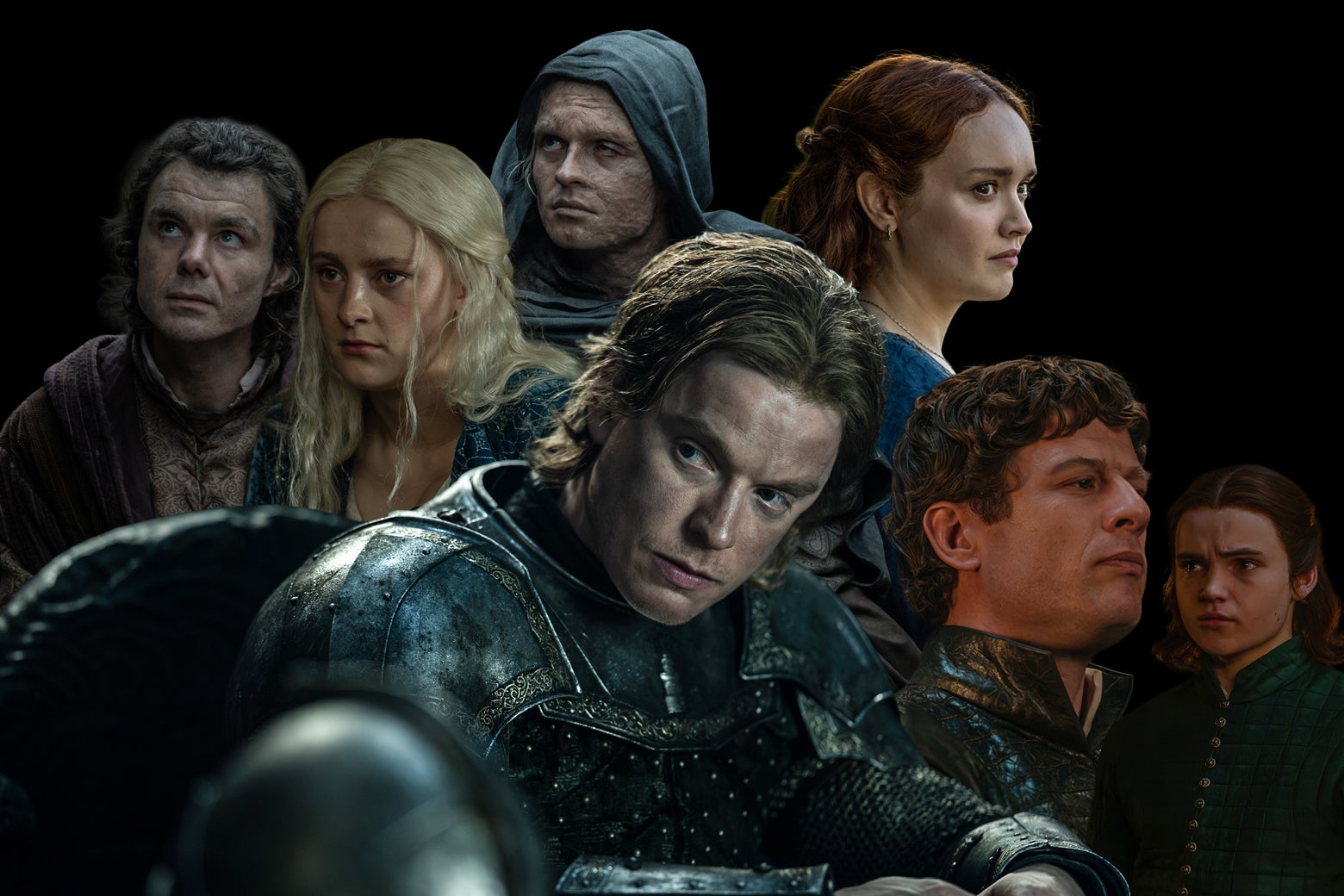
Television House of the Dragon’s New Season Has Managed to Do the Impossible The show has me rooting for characters I never thought I could. By Enter your email to receive alerts for this author. Sign in or create an account to better manage your email preferences. Unsubscribe from email alerts Are you sure you want to unsubscribe from email alerts for Jenny G. Zhang? Aug 05, 20263:36 PM Photo illustration by Slate. Photos by HBO. Sign up for the Slatest to get the most insightful analysis, criticism, and advice out there, delivered to your inbox daily. After a mess of a second season that seemed to start and end in nearly the same place, House of the Dragon’s third season has been surprisingly enjoyable, replete with interesting little characters and side plots in between bloody battle scenes and, yes, some amount of the same old sitting around a castle. It’s a positive turnaround for a series that has drawn scores of criticism, including from A Song of Ice and Fire creator George R. R. Martin, who has effectively forsworn all ties to HBO’s adaptation of his Fire & Blood novel, allegedly declaring, “This is not my story any longer” for all the changes made by showrunner Ryan Condal. Questions of fidelity to the source material aside, though, House of the Dragon has accomplished the seemingly impossible this time around: becoming watchable. (High praise, all things considered.) But this season has also accomplished something else I’d never imagined: making me root for Team Green, to the extent that you can root for any of these fools whose squabbling will lead to the destruction of all dragons. The Greens, consisting of the Hightowers and the Hightower-bred Targaryens, have always had the cards stacked against them when it comes to winning viewers’ hearts and minds. From the beginning, Rhaenyra (Emma D’Arcy) has been presented as the rightful heir to her father, King Viserys (Paddy Considine), as ordained by Viserys himself, the gods (symbolized by a white hart that she encounters in her youth), and, at least according to some, a legendary prophecy that may or may not apply to her and her future descendants (the eponymous Song of Ice and Fire of Martin’s series). The only thing standing in her way, we are shown, is the conspiracy mounted by the Hightowers to delegitimize her in favor of her half brother, Aegon (Tom Glynn-Carney), who is portrayed as wildly unfit for the throne, but is, crucially, a man, and one whom the Hightowers can control. At times, it’s been a little too blatant that we’re meant to side with Rhaenyra’s Team Black, in the face of Hightower sexism and manipulation. For much of the show’s first two seasons, Rhaenyra holds fast to a set of ideals, only reluctantly deviating when her hand is forced, or when she is pushed from peace and toward war by the Greens committing an unequivocal wrong, like Aemond (Ewan Mitchell) killing her secondborn son, Lucerys (Elliot Grihault). When Rhaenyra finally takes the Iron Throne early on in Season 3, it is presented as a form of justice, following the death of her firstborn, Jace (Harry Collett), in combat against the Greens. Even outside the series, HBO’s marketing treated Rhaenyra’s arrival on the seat of power as a momentous occasion, captioning a video, “The rightful heir sits the throne.” Once you’ve reached the top, however, the only direction to go is back down. Since that pivotal episode, the Blacks have been in a rut, both within the story itself and as part of the machinery that makes House of the Dragon run. Rhaenyra has been defanged and, even worse, defunded in King’s Landing. Mysaria (Sonoya Mizuno), her Mistress of Whispers, appears to be largely useless as a spymaster. Corlys (Steve Toussaint), the ostensible Hand of the Queen, has made himself scarce, to the extent that apparently nobody even noticed he was kidnapped until his son Alyn (Abubakar Salim) received the lovely gift of a severed finger. Alyn, his dragonrider brother Addam (Clinton Liberty), and Baela (Bethany Antonia) are now, I guess, suddenly enmeshed in a love triangle, but these characters are so underdeveloped and devoid of personality that it’s hard to care. Rhaena (Phoebe Campbell) is the most pitiable of Team Black, hiding in a cave after her new wild dragon, Sheepstealer, accidentally caused Jace’s death, but her plight is, frankly, just sad to watch, and it doesn’t quite stand up to scrutiny, when you remember that Rhaenyra is Rhaena’s stepmother, so obviously won’t kill her upon discovering the role she played in Jace’s demise. (This is, as predicted, exactly how the most recent episode plays out.) Daemon (Matt Smith) is the only one of the Blacks who is any fun to behold at this point, and that’s because he is a charismatic sociopath who constantly gets into hijinks, like pretending to be a Gold Cloak so he can catch a murderer. Team Green, on the other hand, has had a great season, at least on a meta level. We have a new villain, Ormund Hightower (James Norton), a truly inspired character who is both a scent freak and a weirdly homoerotic homophobe. We have the long-awaited Daeron (Benjamin Evan Ainsworth), given a sympathetic portrayal as a young prince whose sense of right and wrong is being crushed out of him by his caretaker Ormund. (You almost feel as sorry for him as you do for Phia Saban’s Helaena, who just wants to raise chickens in peace, but, one can reasonably assume, will never be able to.) The never-ending plight of Gwayne (Freddie Fox)—trudging through mud! stopping an assassination! dealing with Ormund!—is given extra intrigue by hints of a doomed romance with Criston Cole (Fabien Frankel), and by the suggestion that Gwayne may be the only good guy in the entire Seven Kingdoms. Even Alicent, thankless as Olivia Cooke’s role may be, is forever finding herself in ridiculous and unenviable situations, whether that’s being ordered to carry out filicide or trying to avoid getting kissed on the mouth by her son. As for Aemond, well—at least he’s been relegated to Harrenhal, where he won’t bother anyone with his mommy issues. But it’s Aegon who best illustrates just how back the Greens are this season. In earlier seasons, Rhaenyra’s rival for the throne was shown to be odious. He was a rapist who frequented child-fighting pits that, it was suggested, were populated with his own bastards. He indulged in drink and hedonism, preferring the company of his sycophant friends to anyone who would offer him honest counsel. He was no fit ruler, despite the small amounts of empathy he exhibited toward the smallfolk, and he was not particularly missed when Aemond tried to murder him and take his place. But that descent toward rock bottom set up a terrific comeback arc, one in which this once-loathsome character was stuck on his own side quest of indignity and suffering alongside the likes of Larys Strong (Matthew Needham) and Tyland Lannister (Jefferson Hall). In the season’s penultimate episode, it’s a bona fide triumph when Aegon, downtrodden and disfigured, asserts himself as a king even in the face of his demise, and we see his presumed-dead dragon, the equally scarred and mutilated Sunfyre, rise behind him and unleash lethal flames on his enemies. Part of the Blacks’ stagnancy and the Greens’ ascension, I’m sure, is by design meant to balance the scales after two seasons of writing decisions that largely flattered Rhaenyra. I will not spoil the events of the book, but canny viewers can assume that with a whole other season left to go after this one, there’s still plenty of plot remaining, and characters like Rhaenyra will not remain in the same position they currently occupy. A conflict like Blacks versus Greens, in which equally matched factions war against each other, will naturally consist of ebbs and flows, with one side rising while the other falls. The problem, however, is that the mechanics that gave Team Green a great season—seemingly minor character and storyline decisions—should, ideally, be applied everywhere, not doled out sparingly to too-obviously curry favor for one side over another. If it feels like Team Black has been hemmed in this season, it’s because they have been, suspended in stasis by writers who seemingly don’t know how to set the Blacks up for a fall without also dulling them down. Emotional stakes are built by making viewers feel for the characters we watch on our screens. That’s accomplished by giving them defined traits, by giving them things to do, by making them interact and build relationships with each other that feel real. I confess I experienced only a fleeting moment of sadness for Jace, the Blacks’ moral center, when he was killed, and that was largely because of how beautiful Collett looked in his final moments, not because there was anything particularly distinctive about his character on this show. (One common complaint from book readers is that House of the Dragon stripped many of Fire & Blood Jace’s achievements from him, leaving the show’s version without much to do.) Whenever Gwayne kicks the bucket, though, you can bet I’ll be mourning this wonderfully fruity knight who upheld a code of chivalry and thwarted an assassination attempt because he had a memory for handsome faces. Those minute details are what create a memorable character, one who will be missed by viewers when their time comes. The attachment will hurt, but in a tragedy like House of the Dragon, in which so many will die, shouldn’t that pain be the goal? Get the best of culture Get the best of movies, TV, books, music, and more. Game of Thrones HBO TV
House of the Dragon Has Done the Impossible
Full Article
Original Source
Read the full article at Slate →KhanList aggregates and links to publicly available news content. We do not host full articles from third-party sources. Always verify important information with original sources.