
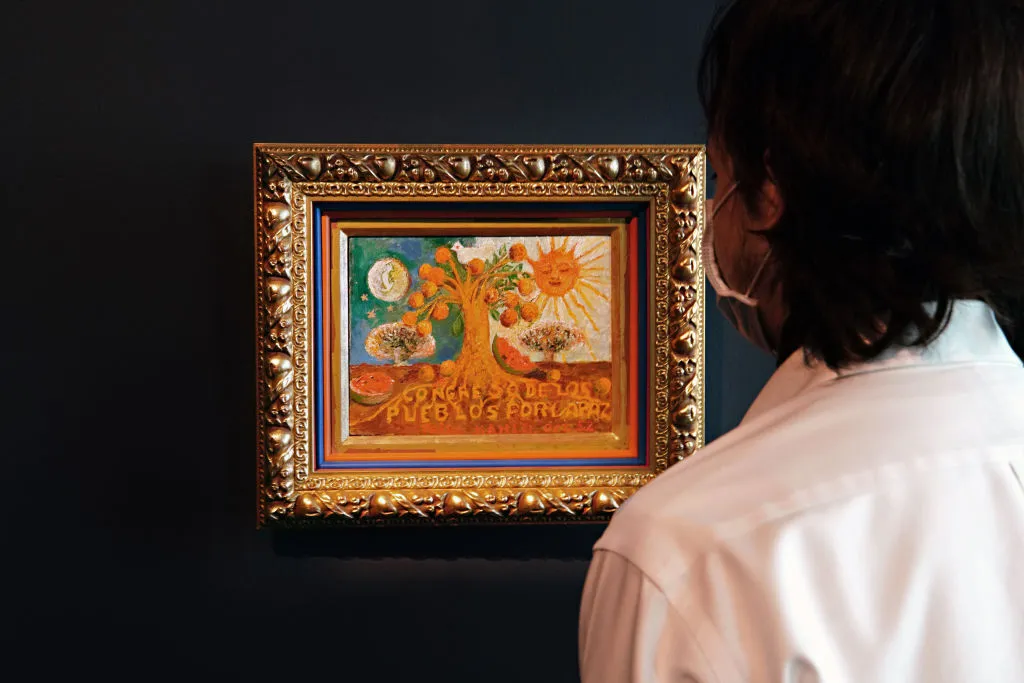
The 1952 painting, “Congreso de los pueblos por la paz,” allegedly disappeared from Kahlo’s house-museum in Mexico City under suspicious circumstances. Heritage groups argue that it rightfully belongs to the Mexican public November 18, 2026 1:30 p.m. Frida Kahlo, Congreso de los Pueblos por la Paz, 1952 Cindy Ord / Getty Images Since it was announced last month that a celebrated Frida Kahlo painting would be put up for auction at Christie’s highly anticipated 20th Century Evening Sale, excitement and intrigue had steadily built. Experts estimated that Kahlo’s 1952 Congreso de los pueblos por la paz (Congress of the Peoples for Peace), would fetch between $2.5 million and $3.5 million, a 52 percent increase from its most recent sale just six years ago. The piece shared the pre-auction spotlight with other high-profile works, including a Wassily Kandinsky masterpiece, a Gustav Klimt canvas and a long-lost Georgia O’Keeffe landscape that was recently rediscovered in a Manhattan closet. But this week, just hours before the first bids were set to be submitted, Kahlo’s painting was pulled from the sale amid questions of its provenance. The interceding effort was led by a group called Defendamos la Colección Gelman (Let’s Defend the Gelman Collection), which seeks to protect Mexico’s cherished cultural artifacts from illegally leaving the country. In a statement issued this week, the group says that the painting was included in a 1957 inventory that Kahlo’s husband, the famed painter Diego Rivera, created for the Casa Azul Trust, which left thousands of the pair’s artworks, artifacts and personal items to the Mexican people. The group goes on to allege that the work “left the Casa Azul for strange reasons and came into the hands of a New York gallery owner, and after several transfers and an auction it ended up in private hands that are now offering it, through Christie’s, for between $2 million and $3.5 million,” El País’ Beatriz Guillén reports. Did you know? Casa Azul The Casa Azul is the blue-colored house in Mexico City where Kahlo was born and spent most of her life, until her death in 1954. It was inaugurated as a museum in 1958. A representative from the Frida Kahlo Museum told ARTnews’ Tessa Solomon: “In accordance with established protocols, the auction house Christie’s has been informed that the work is part of an ongoing investigation being conducted by the competent Mexican authorities … An investigation file exists that gathers information on several works, including Congreso de los pueblos por la paz.” This investigation was launched after Hilda Trujillo, who served as the director of the Frida Kahlo Museum from 2009 to 2020, published a tell-all blog post last year alleging that her own internal investigations clearly showed that multiple Kahlo artworks had gone missing from the collection in the years before she began her role. “The documents I was able to read from this report showed that pieces originally catalogued in 1957 now belonged to private collections,” Trujillo wrote in April 2025. “How and when did these artworks leave the Casa Azul?” She added: “Pieces from the original collection are in private funds and I consider that, as a Mexican society, we are owed an explanation in this regard.” Among the specific pieces Trujillo lists as wrongfully missing is the 1952 painting Congreso de los pueblos por la paz. By 1988, she wrote, records indicated it was in private hands, where it has remained ever since. Diego Rivera and Frida Kahlo sign their marriage license in 1940 in San Francisco City Hall. Bettmann / Getty Images Gabriela Mosqueda, a Mexican curator, tells the New York Times’ Victoria Burnett that the Mexican government, which has been called upon to better protect its cultural items, “did nothing” in the aftermath of Trujillo’s accusations. “I have little hope that the government will put its house in order,” she adds. Kahlo created the painting to commemorate the 1952 Congress of the Peoples for Peace, held in Vienna, Austria. It features a white dove perching on a fruited tree, which separates night from day. “The finest representatives of art and science from every country on Earth proclaimed before Congress their determination to preserve peace intact, knowing that this defense is the best defense of themselves and their creative potential,” the magazine Tiempo wrote in a 1953 editorial, according to El País. Kahlo’s painting is not the only high-profile painting in recent weeks to have its sale disputed. Earlier this month, a French court annulled the $1.6 million sale of a Camille Pissarro landscape after allegations that it had been looted by Nazis during World War II. And this week, the contested auction of a $180 million Van Gogh painting—alleged to have been originally sold under Nazi pressure in the 1930s—was allowed to move ahead after a settlement with its rightful heirs was reached. You Might Also Like Get the latest stories in your inbox every weekday. More about: Art Art Crimes Art History Artists Auctions Frida Kahlo Mexico Painters Painting
Hours Before It Was Expected to Sell for Up to $3.5 Million, This Frida Kahlo Painting Was Whisked From the Auction Block
Full Article
Original Source
Read the full article at Smithsonianmag →KhanList aggregates and links to publicly available news content. We do not host full articles from third-party sources. Always verify important information with original sources.