
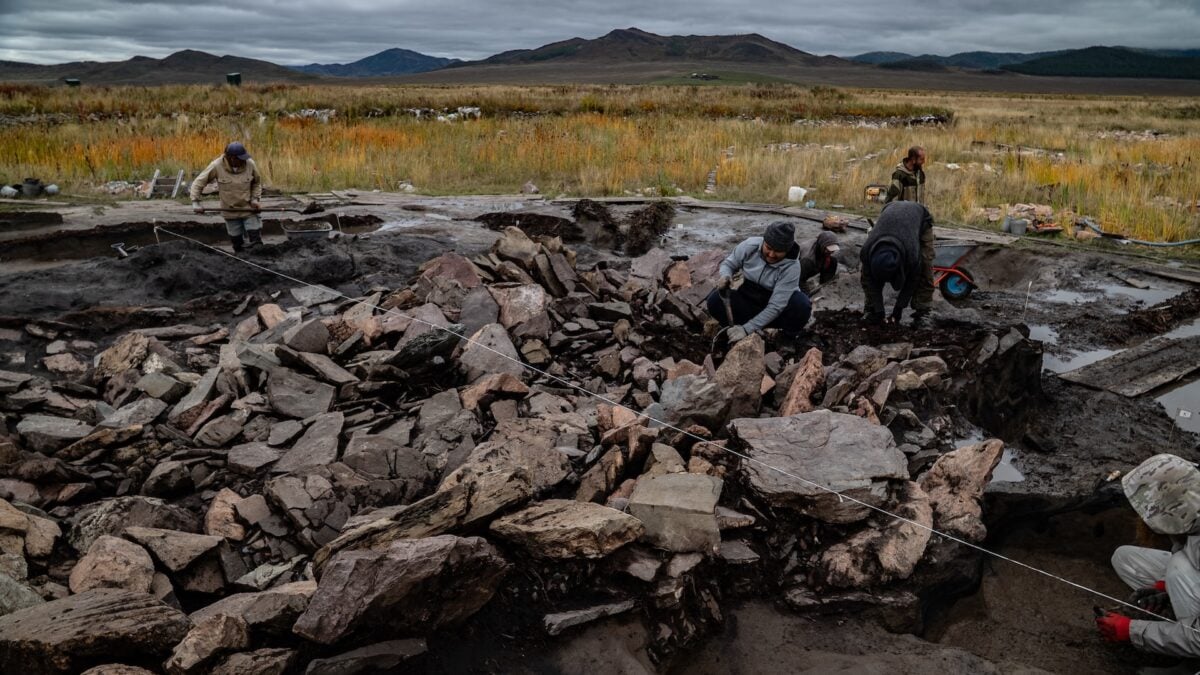
It is perhaps the ultimate bong-rip question: Who was like the first human to ever smoke weed? “Despite great interest in ancient cannabis use,” according to archaeologists at Germany’s Max Planck Institute of Geoanthropology and their colleagues, almost everything about the earliest psychoactive uses of this plant remains “poorly understood.” But some of the best and oldest evidence of ancient humans using cannabis for its mind-expanding properties is now emerging from an 8th-century BCE burial mound in Eastern Scythia, in what’s sometimes called “the Siberian Valley of the Kings.” Excavations of this 2,800-year-old burial mound, named Tunnug 1, have uncovered chemical traces in ancient human hair, as well as seeds, suggesting that cannabis was likely used in funerary rites among the region’s ancient equestrian nomads. The researchers used mass spectrometry to test samples of braided hair recovered at the site, finding an average cannabinol content of 560 parts per billion (0.56 micrograms per gram) per sample. “These data add to the growing global repertoire of archaeological evidence for ancient people using plants as mind-altering or mood-altering drugs,” according to archaeologist Timur Sadykov, a chief scientist at the site on behalf of the Russian Academy of Sciences’ Institute for the History of Material Culture, and his coauthors. “Early cannabis use thus emerges not simply as a pharmacological curiosity but as an indication of how ancient societies experimented with and ritualized the psychoactive qualities of the botanical world.” A steppe-wise approach Sadykov’s peers and their German colleagues, including archaeologist Gino Caspari from the Max Planck Institute, have been working methodically on the excavation of Tunnug 1’s secrets since at least 2024. Just to give you a sense of what that entails, their team handpicked 243 whole cannabis seeds at the burial site, alongside 722 complete and 516 fragmentary cannabis seeds recovered from flotation samples—scoops of dirt later dissolved in water to locate any trace evidence buried inside. That large number, the researchers noted, was only one reason to suggest that cannabis played a distinct role in this ceremonial burial. The proportion was suggestive too. The total assemblage of all the prehistoric plant material excavated from Tunnug 1, they wrote, “was almost completely composed of cannabis seeds” with only “a few additional wild seed types” recovered. The team subjected six of these cannabis seeds to radiocarbon dating for their new study, published Thursday in the journal Science, including two from the log coffin of an ancient Scythian labeled “skeleton 139″ and another two from the log coffin with “skeleton 135.” The samples, they reported, helped to narrow down the date range of these seeds to “sometime in the first decade of the eighth century BCE, coinciding with the dates of construction for the funerary complex.” An aerial view of Tunnug 1, taken via drone. Credit: Frozen Corpses Golden Treasures, T. Wallace & G. Caspari High plains drifter Siberia’s ancient Scythian nomads are now the first known people to have used cannabis for its psychoactive effects, according to the paper, but scholars generally believe that domesticated cannabis first emerged roughly 6,000 years ago in East Asia, where it was cultivated for its seed oil. “East Asian cannabis evolved into a distinct lineage of domesticated crops, leading to hemp and varieties still cultivated for their seeds in parts of China today,” Caspari and his coauthors noted. There’s a distinct chance, in other words, that the cannabis remnants at this burial site could help flesh out east-to-west connections between the Scythians and the early horse cultures of Mongolia, from which they likely trace their cultural origins. Surrounding skeletons 135 and 139 at the center of the burial mound, the researchers found at least five clusters of horse bones believed to be sacrificial offerings. “The horseback-riding Scythians have captured imaginations since the time of Herodotus,” Caspari said when discussing those horse sacrifices in 2024. The burial site, he said, underscores “the importance of Inner Asia in fostering early transcontinental cultural connections and the role of funerary practices in shaping the political and cultural landscape of the Eurasian steppe.”
Horseback-Riding Siberian Nomads Got High on Cannabis 2,800 Years Ago—the Oldest Evidence Yet
Full Article
Original Source
Read the full article at Gizmodo →KhanList aggregates and links to publicly available news content. We do not host full articles from third-party sources. Always verify important information with original sources.