
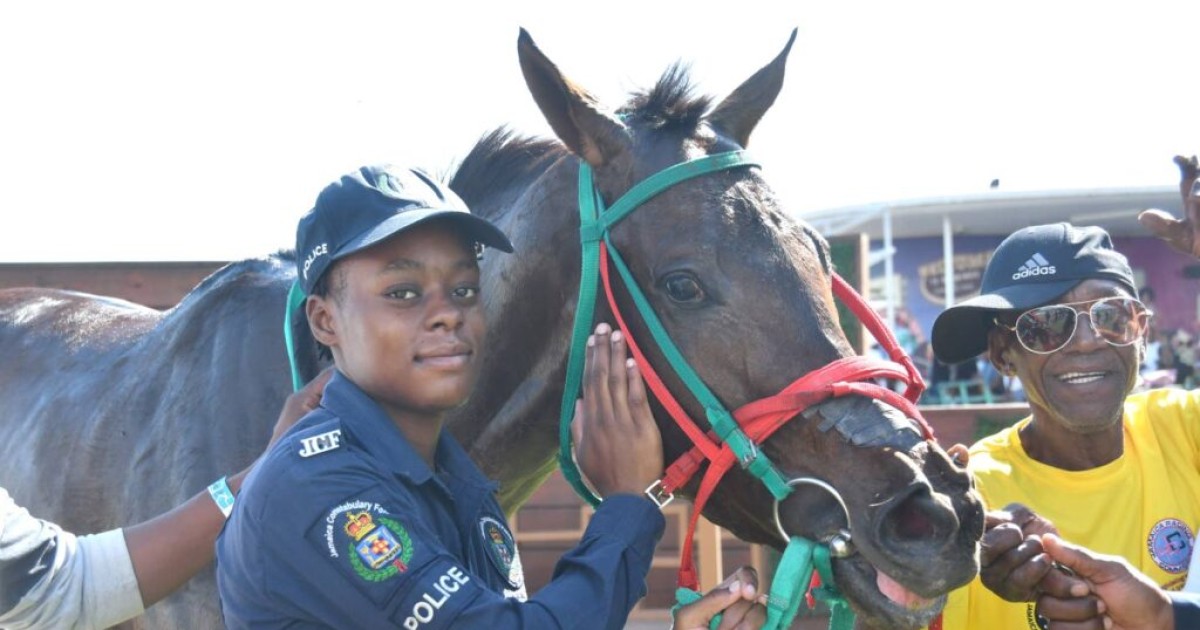
Constable Achasha Madden of the Mounted Troop Division shows her affection for Behave after visting Caymanas Park for the first time on Saturday, November 7. (Photo: Garfield Robinson) There is life after racing — and at Caymanas Park, it is a life worth living. That was the powerful message on Saturday, November 7, as the Racehorse Retirement Programme took centre stage, celebrating almost 500 horses that have been retired from racing in the past five years and given a second career, a new home, and a new purpose. This year’s showcase featured two of the programme’s key retirement partners — the College of Agriculture, Science and Education (CASE) and the Jamaica Constabulary Force’s Mounted Troop Division — along with the launch of a new QR code that takes the public directly to the Racehorse Retirement webpage. The page is a one-stop hub for the programme. It lists the names of the almost 500 horses retired from Caymanas Park in the past five years, provides access to the horse ownership transfer form, shares testimonials on race horse retirement, and carries media articles on the programme’s work. Horses make their way around the clubhouse turn at Caymanas Park, St Catherine. For Sergeant Everal Alexander of the Mounted Troop Division, retired race horses are not just animals — they are partners in service. The Mounted Troop is the oldest division in the entire Jamaica Constabulary Force (JCF), and at present it has 15 equines, ranging in age from two years old to 24 years old. “We have a veteran in TJ, from a race horse. He’s pretty much retired. So what we do there is pretty much ceremonial duties, regular mounted patrol, school visits — it’s really the lighter side of policing,” Alexander explained. DESLANDES…we teach agriculture, and its equine science course focuses on horses, and so part of our programme is to expose the students to the horses (Photo: Garfield Robinson) Alexander said that getting a race horse ready for that lighter side takes patience and skill. “We normally take them onto the street because some are not used to vehicle traffic, some are not used to noise, and so we use different apparatus like flags. What we do is to take a horse out of its competitive spirit and into a slower, calmer spirit that can be manoeuvred safely through traffic and crowds, in schools and on parade. “We are members of the retired race horse association, so when a horse is not competitive enough to win, sometimes we are fortunate when we get them, and we just automatically transition into what we do there,” Alexander told the Sunday Observer. The need, he added, is growing. “The programme is good and we are on the hunt for more horses because the ones that we have are pretty much aging, so we need to replenish the stock. Wherever we can get those horses, we do most greatly appreciate it,” he said. The Mounted Troop is also breaking new ground in its own ranks. In 2025, it trained 17 persons at the National Police College of Jamaica — including five females, the first time that has ever happened in the constabulary. At present, out of a cohort of 18 riders, six are female. Derrick Deslandes, president of CASE, said that retired race horses, have become a critical part of teaching and learning. Members of Mounted Troop Division of the Jamaica Constabulary Force Sergeant Everal Alexander (left), Constable Achasha Madden (second right), and Sergeant Jeson Dillon share a light moment with Dr Sophia Ramlal, senior Jamaica Racing Commission senior veterinarian, during their visit to Caymanas Park on Saturday, November 7. (Photo: Garfield Robinson) “We teach agriculture, and its equine science course focuses on horses and so part of our programme is to expose the students to the horses. “The programme has been around for quite a while, but we have always done equine sciences. We have just brought in the animals so the students can actually work with the animals directly,” Deslandes told the Observer. The partnership with Caymanas Park, he said, works for everyone. “So the horses are finished racing and you may not have the time to feed them and the cost to feed them, so institutions like mine will take them. And we’ll grow them out and raise them and they’ll become part of our programme, our teaching and learning programme,” Deslandes said. CASE currently has 11 or 12 horses from the programme, but like the police, it is always looking to replenish as horses age or pass on. “We’re also looking to do a programme to train young people to ride horses. We are looking to establish a programme to train people in Portland to ride horses,” Deslandes revealed. And fittingly, it was also revealed that the Richard Azan-trained Mojito — one of the most popular horses of his generation — is now preparing for his own next chapter. He will be a stable pony at his barn in 2027.
HORSE POWER
Full Article
Original Source
Read the full article at Jamaicaobserver →KhanList aggregates and links to publicly available news content. We do not host full articles from third-party sources. Always verify important information with original sources.