
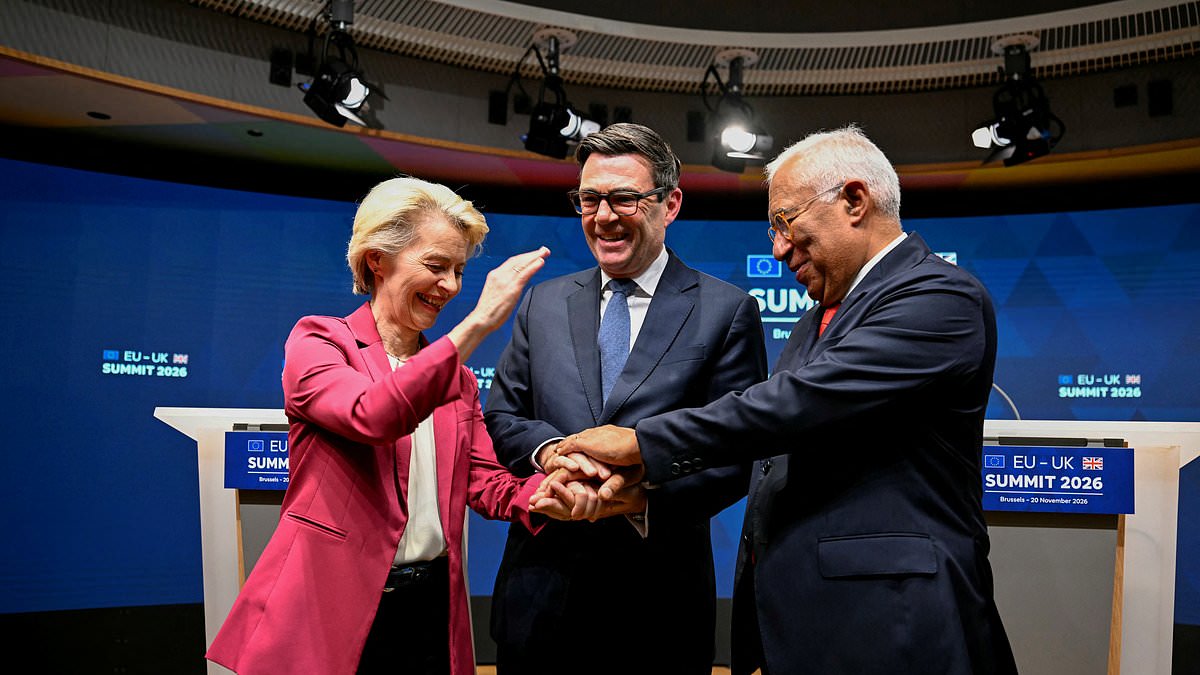
Horse owners in Britain will need to register the location of their animal under Andy Burnham's EU reset.In an added burden arising from the Prime Minister's sellout to Brussels, horse owners will be required to record where their animal lives to comply with EU law.After registering their horse, some owners will even require approval to check their animal is being kept in a suitable location, Government guidance suggests.It comes after the Prime Minister on Friday travelled to Brussels to nail down the details of his Brexit betrayal.Under the terms of the 'SPS agreement' the PM struck with officials, Britain will enter into 'dynamic alignment' with the bloc and be forced to comply with a glut of binding EU regulations.In a move criticised for heaping 'impractical bureaucracy' onto owners, horses' locations will now need to be registered on a 'Central Equine Database' to comply with EU animal health law, with information requiring updating if the horse is moved for more than 30 days.Similarly to the EU, horse owners in Britain are legally required to microchip their animal and take them out a passport.But owners could now be forced to get new microchips for their horses, while equine ID bodies could have to update microchips with country code prefixes to comply with EU rules. In an added burden arising from the Prime Minister's sellout to Brussels, horse owners will be required to record where their animal lives to comply with EU law Under the terms of the 'SPS agreement' the PM struck with officials, Britain will enter into 'dynamic alignment' with the bloc and be forced to comply with a glut of binding EU regulations British farmers will now be blocked from using a vaccine protecting their cattle against tuberculosis under the deal, critics warned on TuesdayIt is not yet clear how officials will check non-compliance with the new regulations, but further guidance is expected in Summer next year.Tim Bonner, chief executive of the Countryside Alliance on Tuesday said there was 'no obvious benefit' to the changes.He told the Daily Mail: 'The government has signed up to an agreement which commits horse owners to completely impractical bureaucracy for no obvious benefit. Horses in the UK are already microchipped and have passports.'The new rules would mean that the place every horse - from a Shetland to a shire - that is kept will have to be registered, as will any place or event in which horses gather.'This will impact tens of thousands of horse owners and thousands of events that are held day in and day out across the country.'As well as hitting horse owners, British farmers will now be blocked from using a vaccine protecting their cattle against tuberculosis under the deal, critics have warned.In a relief for farmers, the Government has backed deploying a 'game changer' vaccine from 2030 to eradicate TB entirely in England by 2038.Culls of badgers - which largely spread the disease - have effectively ended under Government's strategy, with the animals being vaccinated instead.But while trials for the vaccine would be allowed to continue in Britain under the SPS deal, EU legislation prohibits the use of vaccines against infection from TB in cattle.Ringing the alarm at a Westminster press conference, Reform leader Nigel Farage said: 'Because we're so world-leading in agri-sciences, we have now developed a world-leading bovine vaccine, which is good news. Good news for the cows. Very, very good news for farmers.'But he warned 'that vaccine will be banned' under EU rules and that Britain's Agri-tech business will more broadly 'be killed stoned dead', adding: 'I'm not sure that our TikTok Prime Minister fully understands all of that.'Mr Farage said the PM's rejoining 'large chunks of the single market' by 2028 when the SPS deal comes into force will see Britain 'rule taking without any powers of veto or any right or say as to how those laws are made'.In a warning to Parliament's Business and Trade Committee in May, the National Farmers' Union (NFU) said Britain aligning with the EU's Animal Health Law carries 'a risk that we may lose the ability to vaccinate cattle' against tuberculosis in the future.NFU deputy president Paul Tompkins told the Daily Mail on Tuesday: 'The cattle vaccine is a key part of the government's new bovine TB strategy. Nigel Farage said the PM's rejoining 'large chunks of the single market' by 2028 when the SPS deal comes into force will see Britain 'rule taking without any powers of veto or any right or say as to how those laws are made''It's vital that Defra, and those representing the UK in future EU decision-making, use their influence to advocate for acceptance of the cattle vaccine within the EU so that British farmers can use this when approval from the World Organisation for Animal Health has been granted.'Bovine tuberculosis costs taxpayers around £100million a year in England, with a further £50million cost to the farming industry.But the Government's deputy chief veterinary officer Dr Ele Brown has said cattle vaccination could be a 'real game-changer for many countries that struggle to control TB'.A spokesperson for the Department for Environment, Food and Rural Affairs said: 'The UK-EU agreement does not affect work to roll out the cattle TB vaccine. 'We are winning the war on bovine TB and talks to bring a licenced vaccine to market continue with our international partners, alongside the Agreement.'What is true, is that this deal is a huge win for farmers and British businesses. It will cut costly red tape and stop unnecessary hold-ups at the border, getting some of Britain's best-known food and produce back in front of customers across Europe.'
Horse owners to register where their animals are kept while cattle farmers to miss out on vital TB vaccine under Burnham's Brexit sellout
Full Article
Original Source
Read the full article at Dailymail →KhanList aggregates and links to publicly available news content. We do not host full articles from third-party sources. Always verify important information with original sources.