
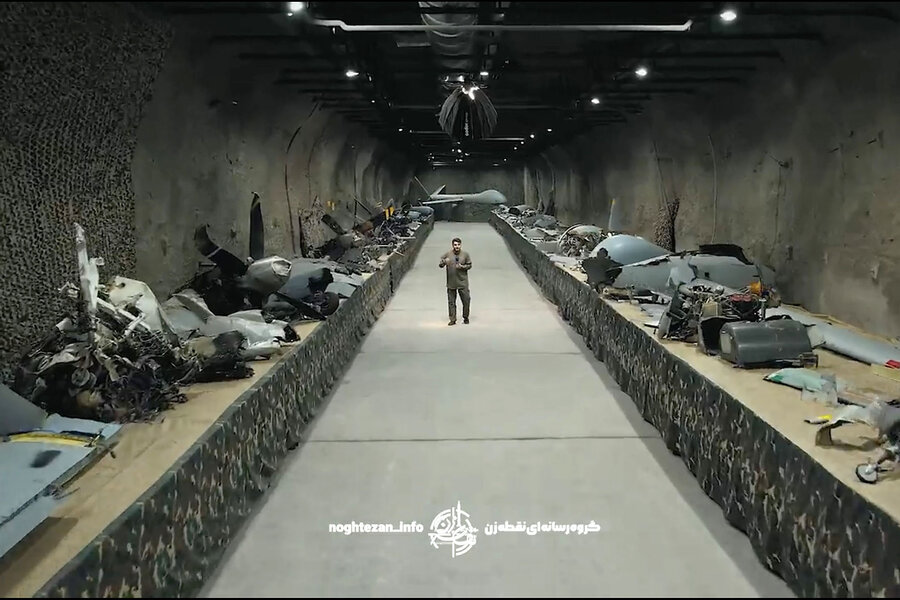
The video on Iranian state television follows the length of a long underground chamber, lined on both sides by tables heaving with wreckage of American military drones.It’s the “most important treasure trove of drones captured and hunted from the U.S. terrorist army” since the United States and Israel attacked Iran last February, says the TV presenter.The video offers a rare look inside an air-defense base of Iran’s powerful Islamic Revolutionary Guard Corps (IRGC), whose missiles and drones wrought destruction on U.S. bases and punished American allies across the Middle East. For Iran, the images are ideal propaganda: On one level, they symbolize the regime’s ability to exact a high price from more powerful enemies through asymmetric means. On another, the destroyed hardware is meant to serve as a warning to the U.S. and Israel against further escalation.The broadcast of the video comes amid an Iranian shift to a more aggressive military approach toward the U.S.Iran’s leaders and commanders, emboldened by their battlefield performance and new influence over two key Middle East energy export routes, have begun to pursue a first-strike strategy that aims to shrink the U.S. regional presence and deter future attacks. Nearly seven months after the U.S. and Israel struck Iran, analysts say Tehran’s strategy has evolved into a bid to restore deterrence and end the war on its terms. For Iran, that means forcing U.S. bases out of the region, raising the cost of their presence to Persian Gulf allies, lifting sanctions and a U.S. naval blockade, and locking in economic leverage over global energy choke points. javanonline.irIn an image taken from an online video, a TV presenter inspects wreckage reportedly from a downed U.S. aircraft, at an undisclosed Iranian military base. Tuesday, in an address to the United Nations General Assembly, U.S. President Donald Trump threatened to “annihilate the Islamic Republic and do it quickly” if Iran did not agree to his terms to end the war. Later that day, however, U.S. and Iranian officials held three hours of discussions.Iranian President Masoud Pezeshkian responded Wednesday by saying Mr. Trump “should know that threatening our people will make them more united and stronger.” On Thursday, Iranian Foreign Minister Abbas Araghchi proposed a seven-day ceasefire plan that would lift sanctions and open the Strait of Hormuz, which mirrored a deal signed by both presidents last June that quickly fell apart.Threat to widen the battlefieldBut in an indication of Tehran’s harder line, a top Iranian military adviser warned Thursday that Iran would expand the war to the Red Sea and to the Indian Ocean beyond if attacked again. Days earlier, the IRGC declared that any U.S. escalation would prompt the use of “new weapons with new capabilities” and strike new targets that would “change the geography of the war.”Throughout the conflict, Iran has retaliated against U.S. military bases and struck military and civilian targets in Israel and across the Persian Gulf.“Iran has been trying to push the United States further away, and also target those logistics that would be used for another round of aggression,” says Abas Aslani, a Tehran-based analyst at Iran’s Center for Middle East Strategic Studies.“There have been costs on the U.S. side, but they seem not to be enough,” says Mr. Aslani, noting signs of possible renewed U.S. attacks. “That’s why Iran has been talking about a new offensive strategy, departing from its traditional policy of reciprocal responses [and] proportionality. In the new phase, Iran is sometimes ... taking initiative in the first place.” That means Iran attacks U.S. bases to retaliate, he says, as well as to undermine the capacity to strike Iran in the future.The clearest example, analysts say, is Iran’s early September ballistic missile launches against a U.S. aircraft carrier and a destroyer, and against U.S. bases in Jordan.Iran used sophisticated ballistic missiles with multiple-projectile warheads against Jordan. To counter those 20 missiles, the U.S. and Jordan reportedly had to expend 70 Patriot and more than 12 costly THAAD interceptors – further depleting global stocks. Mike Segar/ReutersIranian President Masoud Pezeshkian delivers defiant remarks to the United Nations General Assembly, Sept. 23, 2026. “The aim is to establish a deterrence,” says Mr. Aslani. “If the previous model was not able to do so, Iran needs to change it. And the aim is to make any new balance, any peace, more durable.”Mr. Trump and top U.S. officials have repeatedly claimed to have destroyed Iran’s military capability, but part of its missile and drone arsenal remains. An IRGC officer told Iranian state television during their mid-August visit to an underground air base that Iran had preserved 85% of its air-defense production capacity and increased production of its most “effective” missiles by one-third.“New military age”Images of the collected American drone wreckage also featured this month in an IRGC documentary about how an Iranian Shahed drone in March destroyed one of the most expensive planes in the U.S. military, an AWACS radar platform.“When a $20,000 Shahed drone blows up a half-billion-dollar AWACS, know it’s a new military age,” said the IRGC presenter, of the strike that marked a “turning point in regional air defense calculations.” Indeed, the IRGC has reveled in the scale of destruction of U.S. military assets, which partly achieved a long-standing Iranian demand – little more than fantasy before this conflict – that the U.S. “withdraw” from the region.The Pentagon inspector-general last week issued its first public assessment of the $33.4 billion cost of the war through June 30. It counted $3.7 billion in “equipment losses” alone, including nearly 60 aircraft. No figure was put on the value of “hundreds of buildings” at U.S. bases wrecked by Iranian strikes in eight countries.The cost of rebuilding and Iran’s targeting range are fueling hopes in Tehran that the U.S. military footprint will shrink.Early in the war, the Islamic Republic was responding more reflexively to “existential” threats, says Hamidreza Azizi, a Berlin-based senior analyst with the International Crisis Group. “This latest stage is more pinpoint, in the sense of them knowing exactly what they want, which is making U.S. forces around the region dysfunctional, in order to push the U.S. presence as far away from Iranian borders as possible.”Yet locking in such gains remains uncertain. Deepen your worldviewwith Monitor Highlights.Politics with respectGet political stories with respectful analysis.There‘s a world of new ideas in everyBooks newsletter.There‘s more to life, enrich yours withCulture & Learning weekly.Follow humanity‘s discoveries withScience & Nature stories in your inbox.Gain a spiritual perspectivefrom the stories in your inbox.Want to understand the deeper impact of critical events? Learn the Monitor‘s insight.Already a subscriber? Log in to hide ads. “They’ve been prepared for this for decades,” says Dr. Azizi. “They are confident in what they have achieved so far, but less confident in the extent to which they can preserve those achievements in the longer term.”An Iranian researcher contributed to this report. ALREADY A SUBSCRIBER? LoginReal news can be honest, hopeful, credible, constructive.The Christian Science Monitor was founded in 1908 to lift the standard of journalism and uplift humanity. We aim to “speak the truth in love.” Our goal is not to tell you what to think, but to give you the essential knowledge and understanding to come to your own intelligent conclusions. Join us in this mission by subscribing.
Hoping to push the US away, Iran’s strategy is to go on the offensive
Full Article
Original Source
Read the full article at Csmonitor →KhanList aggregates and links to publicly available news content. We do not host full articles from third-party sources. Always verify important information with original sources.