
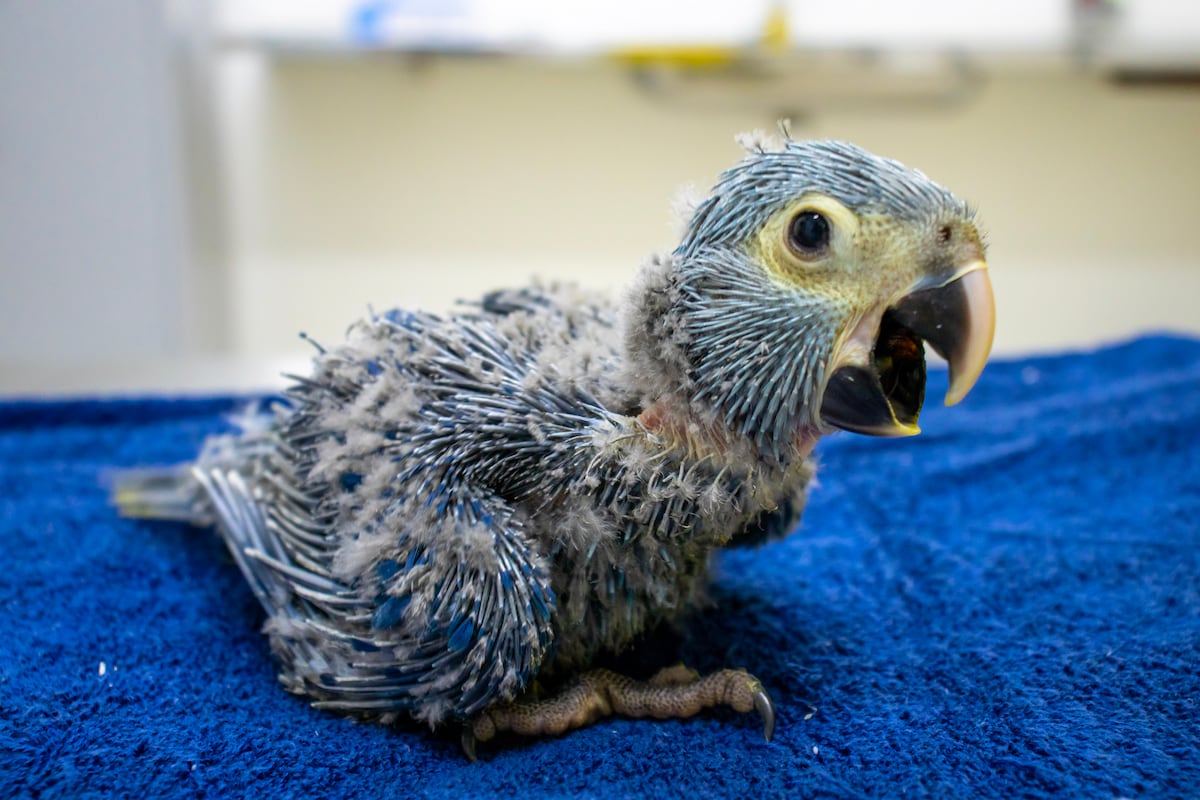
She weighs just 350 grams, but in her tiny little body, covered in sharp feathers ready to burst forth, she embodies the hope of an entire species — which is why she’s named Hope. She is a Spix’s macaw chick, or ararinha azul as it’s known in Brazil, a species that has been extinct in the wild for more than two decades. This female was born a little over a month ago at the São Paulo Zoo, marking a major milestone in conservation efforts.“We had to wait two years for the first pairs to form and then a little longer to see if they exhibited reproductive behavior,” explains Fernanda Guida, the chief biologist of the zoo’s bird department, over the phone. “Last year we had two pairs and 38 eggs, but no hatchlings,” she adds, giving a sense of just how eagerly awaited Hope was. The joy was even greater upon discovering that she was a female, since most of the zoo’s specimens are male.Hope has been introduced to the public in grand style, but raising her has been anything but easy. Because this is a critically endangered species, protocols mandate that, for safety’s sake, the extremely valuable eggs be removed from the animals’ nests and protected in incubators. After spending 26 days at 37.5 degrees Celsius and a humidity level between 40 and 45 percent, the chick’s beak was supposed to start poking through, but nothing happened. “We waited two days and finally had to intervene and break the shell. She was trying to hatch but couldn’t. She was positioned incorrectly.” You could say that Hope was born by Cesarean, they joke. During the first few days, the team of biologists practically slept right next to the newborn. She refused the usual syringe used to feed her the porridge that keeps newborns alive during those first few days, hour by hour. In the end, they had to feed her through a feeding tube. It was one headache after another, but 15 days later, once the critical phase had passed, everyone began to breathe a sigh of relief. Now blue plumage is beginning to cover the chick, which moves around well and has almost reached the weight of an adult. Of course, routine stool and bacterial tests are conducted every week.The fragile health and fertility problems of this species, which is endemic to Brazil, stem precisely from the fact that there are so few living individuals. There is a very high degree of inbreeding, and the reproductive rate is very low compared to other species. The conservation program maintains a family tree for each bird that shows which birds are related and helps in selecting breeding pairs.The blue macaw (Cyanopsitta spixxi) inspired the 2011 animated film Rio, and the story told in the film is very similar to what is happening at the São Paulo Zoo. The species disappeared from the tropical savannas of northeastern Brazil — its natural habitat — in the 2000s and has since only survived in captivity: there are barely 330 individuals left worldwide. A few survived at this zoo, some of them quite old. They were more of a sad reminder of the dangers posed by Homo sapiens than a promise of a comeback.That changed radically in August 2023, when 27 birds arrived from a private breeding facility that had stopped participating in the national conservation plan for the species. The Ministry of the Environment asked the São Paulo Zoo for help; the zoo built a special enclosure for them and threw itself wholeheartedly into the breeding program. Although the zoo is private, the animals are owned by the state and cannot be sold or exchanged with other facilities outside Brazil. The government coordinates the plans to save the species at the national level.Biologist Fernanda Guida feeding Hope.Isaac Fontana (EFE)Hope was born on October 18.Leandro Ferreira AmaralIt is the first specimen of this species to be born at a zoo in Brazil.Leandro Ferreira AmaralAlthough the species went extinct more than two decades ago, it is estimated that there are about 330 individuals worldwide, all in captivity.Leandro Ferreira AmaralSpix's macaws at the São Paulo Zoo.Leandro Ferreira AmaralThe conservation team introduces Hope.Leandro Ferreira AmaralThe new enclosures for the Spix’s macaws were built 200 meters away from any other area of the park, and the vast majority are not on display to visitors. Only one caretaker is allowed to feed them. No amount of preventive healthcare is too much for such an extremely sensitive species. Furthermore, the trauma from the failed project to reintroduce the animals into the wild is still fresh in the experts’ minds. The project was led by a private breeding facility that, due to unsanitary conditions and other instances of negligence, ended up infecting several birds with a virus that caused the entire effort to fall apart.The species is now in intensive care, but it is hoped that, once there is some leeway, releases into their native habitat can be reconsidered. All eyes are on Curaçá, in the state of Bahia, where the last remaining individuals were sighted. Although no macaws currently fly there, conservation efforts continue unabated. The goal is for the biome to be ready to welcome them as soon as possible, in the medium to long term. “Obviously, the ultimate goal is to have the ararinha safely back in the wild, but to do that, we first have to increase the number of individuals. Ideally, we’d have all the pairs breeding. We’d like to have about 10, but even if there are just two, that would already be a victory,” says Guida.Sign up for our weekly newsletter to get more English-language news coverage from EL PAÍS USA Edition
‘Hope,’ the macaw chick that could bring back a species that has been extinct in Brazil for over two decades
Full Article
Original Source
Read the full article at English →KhanList aggregates and links to publicly available news content. We do not host full articles from third-party sources. Always verify important information with original sources.