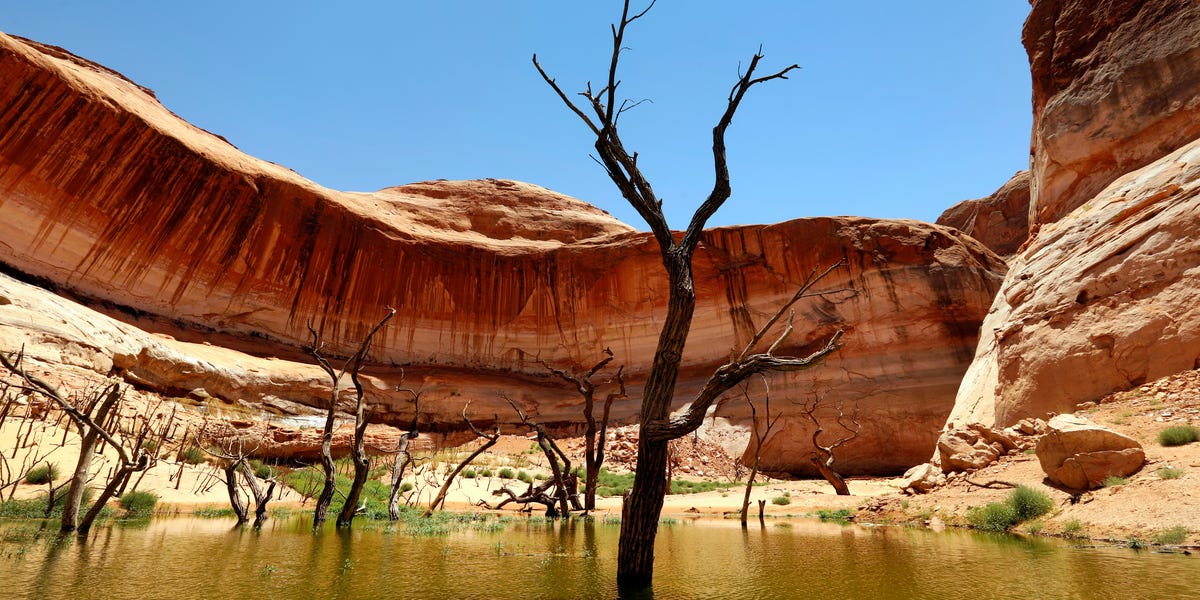
9 min readFROM THE RIM of Lake Powell, you can’t see the danger line. There isn’t a flashing gauge or a chart on the canyon wall that warns visitors when one of the most important machines in America begins to fail. There’s only an invisible number: 3,490 feet above sea level.Engineers call it “minimum power pool.” Above that elevation, Lake Powell can still push water through Glen Canyon Dam’s massive penstocks, spin its turbines, and send electricity across the Southwest with no trouble. Below it, the dam loses the function that helped justify its existence. The river still wants to move, but the machine starts running out of ways to move it.Glen Canyon Dam and Lake Powell sit near the center of the Colorado River system, upstream from Hoover Dam and Lake Mead. Together those reservoirs store the water that cities, farms, and power plants across the Southwest depend on. Now the entire system is being pushed past its limits, and Lake Powell is where the cracks are really starting to show.Since 2000, the Southwest has been caught in a megadrought that has steadily pulled down water levels in both Lake Powell and Lake Mead. Climate change has made that trend hotter, drier, and harder to reverse. In 2026, a punishingly weak snowpack and an extreme heat wave pushed the basin deeper into emergency. The Bureau of Reclamation began taking steps to keep Lake Powell’s water levels high enough for electricity generation; Hoover Dam’s hydropower output is expected to drop by 40 percent of its maximum capacity this year.“It’s a crisis moment for the Colorado River,” says John Berggren, regional policy manager for Western Resource Advocates. “We’ve known about this problem for years.“It’s been the slowest-moving train wreck in history, yet we’re letting it play out in front of us.”LONG BEFORE IT became an engineered system, the Colorado River was a dynamic desert waterway. Prone to both floods and droughts, it began in the Rocky Mountains, wound through the heart of the Colorado Plateau, carved the Grand Canyon, and emptied into the Gulf of California. On October 9, 1936, several 4-million-pound generators inside the brand-new Hoover Dam began turning the wild river’s force into electricity—and holding back the water that would become Lake Mead.Hoover’s curved ax-head shape and its 726-foot-high walls eventually made it an icon of American engineering: a single structure that could control floods, generate power, store water, and supply the cities and farms spreading across the deserts of the Southwest.This dam was only the beginning. In the decades that followed, the once-wild Colorado River turned into a complex web of dams and reservoirs designed to deliver electricity—and, even more crucially, water—to roughly 40 million people. The system now includes 14 other dams, including Glen Canyon Dam.But none of them can work without enough water in the right places.On paper, Hoover Dam and Glen Canyon Dam basically work the same way. Water stored behind each dam drops through giant tubes called penstocks, spins turbines, activates generators, and then flows downstream for agricultural and municipal purposes. But it’s the small differences in the two dams—particularly in the design of how water can leave their reservoirs—that could spell the end of electricity generation along the Colorado River.At Glen Canyon Dam, Lake Powell has three main exits. The first is the penstocks, which are the only way to generate power through the dam. The second is the spillways, built for floods and used only once, in 1983. But the spillways sit high on the dam, so they aren’t all that useful in today’s drought-induced crisis.The third exit: four small tunnels farther down from the penstocks that can bypass the generators and release water downstream without producing power. These are called river outlets. But with a flow rate of 15,000 cubic feet per second, the river outlets can also release excess water during flooding or for other conservation programs. In 2023, the Bureau of Reclamation used them to flush sediment that had built up in Lake Powell downstream.Each exit comes with its own important elevation numbers and terms. When the surface of Lake Powell sits at 3,700 feet above sea level, the reservoir is officially at “full pool,” meaning it’s reached its max capacity of 26 million acre-feet of water, and the penstocks can work as designed. Then, at 3,490 feet above sea level, Lake Powell officially enters that “minimum power pool” phase. Here, electricity generation is no longer possible, as water levels have fallen below the penstocks, but water can still exit through the river outlets.Getty ImagesWhat looks like a vast reservoir is actually a shrinking margin of safety. As Lake Powell declines, one of America’s most ambitious water projects is entering unfamiliar territory.That creates two problems at once. The first is downstream disruption: The smaller river outlets were never designed to operate continuously or move the same volume as the penstocks. The second is mechanical danger. As water levels continue to drop, turbines and outlets can begin pulling in air, raising the risk of cavitation that could pit metal, attack concrete, and destroy machinery from the inside.“It’s the incorporation of water bubbles in the water column. When those water bubbles collapse, they send off shock waves, and those shock waves can destroy concrete and metal,” says Jack Schmidt, director of the Center for Colorado River Studies at Utah State University and former chief of the Grand Canyon Monitoring and Research Center. “This is a situation that has been calculated, but it’s never been tested because we’ve never been this low.”Below minimum power pool is the final, even more ominous threshold: “dead pool.” Under 3,370 feet, Lake Powell would fall below the level of the river outlets. At that point, water could remain in the reservoir but would no longer be able to rely on gravity to pass through the dam’s existing outlets. The result would be a reservoir trapped behind a dam that is no longer able to release it the way it was designed to.That possibility is no longer theoretical enough to ignore. As of June 2026, Lake Powell rests at an elevation of 3,528 feet—only a few dozen feet above minimum power pool. Schmidt says the Bureau of Reclamation isn’t treating 3,490 feet as the magic switch that flips all at once; the agency wants to keep Powell closer to 3,500 feet to preserve a margin of safety.“People really ought to think about this as a natural disaster,” says Sharon B. Megdal, director of the Water Resources Research Center at the University of Arizona. “For years I’ve said that people need to be vigilant, they need to be aware, but they don’t have to be alarmed.“Well,” she continues, “I’ve been alarmed this last year.”In April 2026, the Bureau of Reclamation began triage. The agency announced plans to release 660,000 to 1 million acre-feet of water from Flaming Gorge Reservoir, upstream on the Green River in northeastern Utah, while holding back roughly 1.48 million acre-feet that would otherwise flow from Lake Powell to Lake Mead. The government is basically borrowing water from one part of the system and withholding it from another to keep Glen Canyon Dam above its danger zone. Hoover can retrieve water from elevations lower than that of Glen Canyon, but if Powell falls below minimum power pool—and especially toward dead pool—it could spell the end of hydropower all along the Colorado River.“People really ought to think about this as a natural disaster.”WHILE HYDROPOWER IS built into the foundation of the Colorado River system, the story starts with water. On May 24, 1869, John Wesley Powell, a Civil War veteran and explorer, began a survey expedition down the Green and Colorado rivers to assess the area for possible settlement. In his 1879 report, Powell described the Colorado River Basin as part of the “Arid Region” and warned that redeeming it would involve “engineering problems requiring for their solution the greatest skill.” He advocated for a system of reservoirs as a means to store water during the nongrowing seasons, and eventually his vision came true: The Colorado became one of the most engineered rivers on earth.The dams were built to manage water, but hydropower helped make them politically and financially possible. Hoover Dam and Glen Canyon Dam promised decades of dependable electricity, which sold the projects.“Hydropower revenues are what paid for all of these dams,” says Douglas Kenney, director of the Western Water Policy Program at the University of Colorado. “Even if the language of the authorization doesn’t list hydropower as the primary purpose, it kind of is the primary political purpose for getting the project authorized in the first place.”Hoover Dam’s construction costs were repaid with power revenues by May 31, 1987, according to the Bureau of Reclamation. When Glen Canyon Dam finished construction in 1963, it also stored, controlled, and converted the river into revenue-generating electricity.But now, as water levels in Lake Powell and Lake Mead fall, experts are beginning to focus less on how much power the dams can produce and more on whether they can keep storing and moving water. Some utilities are already adapting: The Lincoln County Power District in Nevada, for example, which once relied on Hoover Dam for 100 percent of its electricity needs, is now heavily investing in solar, an ideal technology for one of the sunniest regions in the country.Getting more power is one thing. Getting more water is another thing entirely.“There was always another basin—there was always another river where we should get water,” Kenney says. “That’s no longer the case.”Getty ImagesThese massive penstocks are the arteries of Hoover Dam’s power system, carrying water to the turbines below. If reservoir levels fall too far, they can no longer do the job they were built for.IN 1922, SEVEN Colorado River Basin states—Wyoming, Colorado, Utah, New Mexico, Arizona, Nevada, and California—signed the Colorado River Compact, one of a group of documents that collectively became known as “the Law of the River.” The compact essentially divided the river’s water among states and users in an era that assumed more water than the basin can now reliably provide.In 2007, years into the current megadrought, all seven states agreed to temporary guidelines for managing shortages and coordinating Lake Mead and Lake Powell. Those rules are now expiring, and the states have already missed key deadlines for agreeing on how to replace them. Now, the river’s physical and political operating systems are both under stress at the same time.“The imbalance of supply and demand in the Colorado River Basin is a wicked water problem,” Megdal says. “These are big problems, and it takes a lot of effort and collaboration and innovation to address.”Engineering a solution can buy time, but it can’t end the megadrought. The Bureau of Reclamation has floated major modifications to the Glen Canyon Dam, including new tunnels through the structure, rerouted river outlets that could produce power, or even a tunnel around the dam entirely. Any fix would likely cost between $500 million and $3 billion, take years, and raise questions about whether preserving hydropower is worth the price. But if Lake Powell keeps falling, the federal government may have no other choice but to build a bypass around one of its most important dams.Other ideas are larger, if arguably less realistic. Massive water transfer projects could, in theory, move water from wetter regions into the basin, as China has attempted with its South-to-North Water Diversion Project. But in the U.S., the legal and financial issues with funding such a project would likely be immense. The easier answer on paper is also the harder one to execute: Use less water.“The imbalance of supply and demand in the Colorado River Basin is a wicked water problem.”Across the basin, that means stretching the same supply further. Phoenix is expanding water reclamation with a serious upgrade to its Cave Creek Plant, which is expected to produce 7 million gallons of purified drinking water every day by 2027. Meanwhile, farmers who rely on the Colorado River are experimenting with using low-flow nozzles, installing small-scale hydropower generators, and investing in crops that are less water intensive. While none of these fixes are as dramatic as a new dam, that’s the point. The future of the Colorado River may depend less on one huge engineering fix and more on lots of smaller decisions to use less, waste less, and stop treating the river as if it will never run out.For decades, the dams of the Colorado River helped the Southwest live beyond the river’s natural limits. They stored water, generated power, and supplied farms and cities. But the past few years have begun to show the limits of that system. It was built for more water than the river can now reliably provide, and keeping it working will require the Southwest to face the hardest part of the crisis: learning to take less from the river that made so much of its growth possible.“It’s not that the system is going to collapse this year,” says Schmidt. “But it’s very low and it’s in a perilous state. If next winter is also dry, then we’re in a five-alarm fire drill.”Darren lives in Portland, has a cat, and writes/edits about sci-fi and how our world works. You can find his previous stuff at Gizmodo and Paste if you look hard enough.
Hoover Dam Is Losing Power. Inside the ‘Slowest-Moving Train Wreck in History’
Full Article
Original Source
Read the full article at Popularmechanics →KhanList aggregates and links to publicly available news content. We do not host full articles from third-party sources. Always verify important information with original sources.