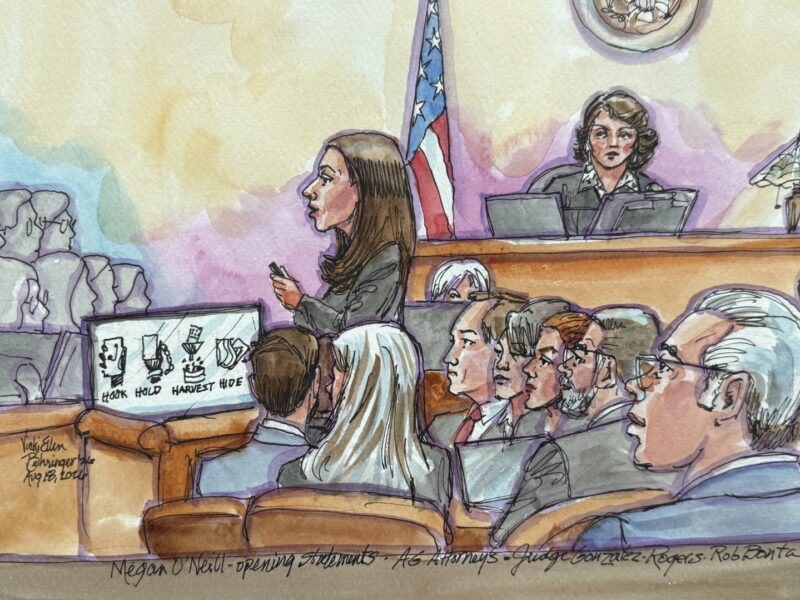
OAKLAND, Calif. (CN) — A Northern California jury heard opening statements Tuesday by state attorneys general and Meta in a seismic federal trial over whether the tech giant deceived the public about addictive features of its social media platforms and their risks to teen mental health.The blockbuster trial in U.S. District Judge Yvonne Gonzalez Rogers’ courtroom — the first in the multidistrict litigation of more than 3,000 active cases — pits the parent company of Facebook and Instagram against California, Colorado, Kentucky and New Jersey. Another 25 states that sued Meta in 2023 will head to trial later.The states claim Meta violated the Children’s Online Privacy Protection Act, a federal law that requires online companies to obtain verifiable parental consent for users under 13 years old. Additionally, California, Kentucky, Colorado and New Jersey claim Meta made deceptive statements about its platforms that likely misled the public, violating consumer protection laws.Similar to the bellwether trial in Los Angeles that also litigated social media addiction claims, high-profile witnesses such as Meta CEO Mark Zuckerberg, Instagram head Adam Mosseri and Meta vice president Antigone Davis are scheduled to testify in the coming days.The initial multidistrict litigation consolidated hundreds of personal injury lawsuits on behalf of children and adolescents by school districts, local governments and state attorneys general. The plaintiffs claim Meta’s Facebook and Instagram, Google’s YouTube, ByteDance’s TikTok and Snap’s Snapchat are designed to foster compulsive use by minors.If Meta is found liable by the jury, penalties could reach up to $200 billion and change the way Meta handles teen accounts.In her hourlong opening for the states, California Deputy Attorney General Megan O’Neill said Meta told the media, legislators, users and parents that it prioritizes kids’ safety and kept children under 13 years old from its platforms. But she argued the company’s internal research and employee communications contradicted their public statements.“Hook the users. Hold them for as long as they can. Harvest their data. Hide the truth from the public when making public statements,” she said. “If you aren’t paying for the product, you are the product — kids are the product.”O’Neill said that based on Meta’s own research and surveys, it knew its impacts on the mental health of adolescents was significant, despite Zuckerberg and Mosseri testifying before Congress saying the opposite.“Meta knew when it was time to make a decision to choose what was safe for kids or to make profits, and time and time again, profits won,” she said.Meta’s attorney Paul Schmidt, a partner at San Francisco-based Covington & Burling, said it was important for the jury to remember the states need to show specifically how the laws were violated. He also argued the states don’t have any witnesses that will testify about their own harms from their Instagram or Facebook use.Schmidt said some things won’t be disputed during the trial, including teens’ struggles with time management, kids under 13 accessing social media because they put in the wrong birthday and users posting negative content. What is disputed, he argued, is how Meta acts on those understandings, and how seriously Meta takes those issues.Schmidt noted Meta created time management tools starting in 2018 with features like “time spent” surveys and reminders. The company continued to develop other resources with “take a break” reminders and topic nudges in 2021 as well as teen accounts in 2024.O’Neill countered that Meta didn’t start the teen accounts feature until after the AGs filed their lawsuit. She said Meta failed to take the “most simple, obvious steps” to keep kids off the apps.“The health and well-being of kids is a shared responsibility," she said. “Meta didn’t do its share, and it prevented parents from doing theirs.”She said that 1 in 5 teens felt negatively about themselves after app use, and an internal survey based on user responses during one week in 2021 showed large percentages of 13- to 15-year-olds witnessing bullying (27%), negative comparisons (21%), violence (12.8%), unwanted sexual advances (13%) and self-harm (8.4%), with similar percentages for 16- and 17-year-olds.Schmidt said the AGs wanted to contort the data, pointing to the fact that the survey mentioning 1 in 5 teens with negative feelings also referenced 41% of teens with positive feelings.In a joint lawsuit filed in late 2023, a bipartisan coalition of 29 states claim Meta built a business model that maximizes young users’ time on its platforms and employs psychologically manipulative platform features. They accuse the tech behemoth of publishing misleading reports on user harm and continuing to downplay the negative consequences of its products.After opening statements, the states’ first witness, former Meta employee Arturo Bejar was called to testify. Bejar was a director of engineering at Facebook between 2009 and 2015 and an independent contractor working on safety for Instagram for two years.He said he wanted to return to Meta after his own daughter experienced harms on Instagram as a young teen, including unwanted sexual messages. He said, at the time, there was no way for his daughter to report to the company about the content. Bejar said it was “inconceivable” to him that Meta wasn’t “doing anything about it.”“Instagram changed from a product that you can use into a product that uses you,” he said.Bejar said Meta continually made goals to develop and test tools to understand teen usage and harms and documenting the findings, but those tools ultimately didn’t change the way teens were actually experiencing the apps.“This is a company that is incredible at taking a metric and reducing it,” he said.Rogers, a Barack Obama appointee, instructed the jury of five women and three men about trial logistics, including how they would get photos of all witnesses during deliberations to jog their memories.She tried to bring some levity during a break from proceedings due to technical difficulties in the courtroom. She pointed to a very large whiteboard in the back of the room, saying that was how they used to show demonstratives, but it was too large now to remove it from the courtroom.“Maybe I should put it on Facebook Marketplace,” said Rogers, to a few laughs from the courtroom gallery.The trial continues Wednesday at the Ronald V. Dellums Federal Courthouse in Oakland with cross-examination of Bejar.Subscribe to our free newslettersOur weekly newsletter Closing Arguments offers the latest about ongoing trials, major litigation and rulings in courthouses around the U.S. and the world, while the monthly Under the Lights dishes the legal dirt from Hollywood, sports, Big Tech and the arts.Additional Reads
‘Hook, harvest, hide’: States slam Meta’s secret strategy on first day of jury trial
Full Article
Original Source
Read the full article at Courthousenews →KhanList aggregates and links to publicly available news content. We do not host full articles from third-party sources. Always verify important information with original sources.