
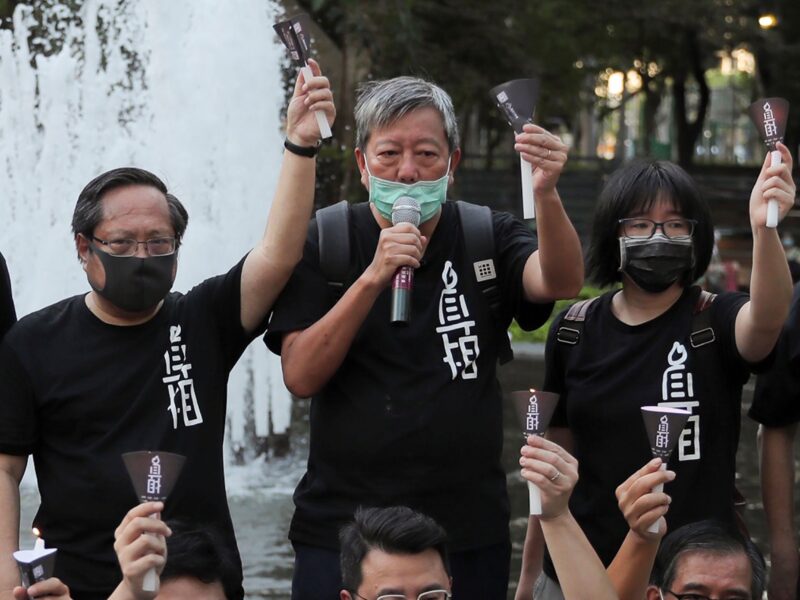
Hong Kong and Macao were the only places on Chinese soil that permitted public mourning for those killed during Tiananmen Square protests. But public commemorations have effectively been banned in both cities in recent years.(AFP) — A Hong Kong court on Friday sentenced three Tiananmen vigil activists to prison terms ranging from five years and two months to seven years and three months for national security crimes, drawing international condemnation.Lee Cheuk-yan, 69, Albert Ho, 74, and Chow Hang-tung, 41, have been behind bars since they were charged in 2021. Their sentences are expected to include credit for time served.The United Nations, rights groups and foreign governments condemned the sentences, which were imposed under a national security law Beijing enacted in Hong Kong in 2020 following mass pro-democracy protests.A court ruled in August that the activists had violated the Chinese constitution by calling for an “end to one-party dictatorship.”Lee and Chow, who pleaded not guilty, were sentenced to seven years and seven years and three months, respectively, AFP journalists in court reported.Ho, a former lawmaker who pleaded guilty in January, was sentenced to five years and two months.The verdict said that although the case did not involve violence and the defendants had not proposed a specific timetable for bringing about an “end to one-party dictatorship,” their offense was still “of a serious nature.”Chow, a lawyer who represented herself, told a hearing last month that she had “nothing to repent for.”She raised both arms and waved at supporters as officers escorted her away.Supporters outside the court hugged her mother, Medina Chow Lau Wah-chun, who said her daughter had remained in high spirits during the trial.“She is not a competent barrister. She is simply an outstanding defendant,” her mother said.Lee crossed himself, smiled and bowed to his wife, Elizabeth Tang Yin-ngor, and supporters, including Roman Catholic Cardinal Joseph Zen, a prominent democracy advocate. Tang and Zen clasped hands after leaving the courtroom.“I’m really sad, and very angry,” Tang told reporters, adding that Lee would “definitely appeal.”Dozens of police officers surrounded the court and erected cordons to hold back crowds.Stern warningHong Kong and Macao were the only places on Chinese soil that permitted public mourning for those killed on June 4, 1989, when Beijing sent troops and tanks to crush protests calling for political reform in and around Tiananmen Square.But public commemorations have effectively been banned in both cities in recent years.The three were leaders of the now-disbanded Hong Kong Alliance, which organized annual vigils in the city’s Victoria Park.Hong Kong leader John Lee said in a statement that “the law will never allow anyone to use the pretext of human rights, democracy and freedom to blatantly harm their own country and compatriots.”National security police chief Steve Li told reporters that the sentences were “a stern warning to those who may be contemplating similar acts.”Taiwan, which China claims as its territory, condemned the sentences. A European Union spokesperson said the ruling “undermines confidence in the rule of law and harms Hong Kong’s reputation.”U.N. human rights chief Volker Türk “calls for these sentences to be quashed,” his office said in a statement.Elaine Pearson, Asia director at Human Rights Watch, said the “harsh sentences” expose “the cruelty and insecurity of a government afraid of memory and the people.”Urania Chiu, a legal expert, told AFP that the heavy sentences apply not only to overt acts of activism or advocacy but also to acts of remembrance.The national security law “is actively shaping what is and is not allowed to remain part of the official history,” she said.Pillar of ShameThe Hong Kong Alliance also operated a museum dedicated to the crackdown and held events, including an annual washing of the “Pillar of Shame,” a statue memorializing the victims.The statue was removed from its longtime plinth at the University of Hong Kong in 2021. Other local universities subsequently removed similar memorials.Prosecutors argued that evidence in the case, including the statue and archives from the Hong Kong Alliance’s museum, should be confiscated.Judge Alex Lee said Friday that the statue’s fate would be decided after its ownership was determined.Jens Galschiøt, the Danish artist who created the “Pillar of Shame,” called the trial’s outcome and the statue’s potential confiscation “outrageous.”The statue tells the story of Tiananmen, said Galschiøt, who has sought for years to reclaim his work.Destroying it would also “destroy the story that everybody should know,” he told AFP.Subscribe to our free newslettersOur weekly newsletter Closing Arguments offers the latest about ongoing trials, major litigation and rulings in courthouses around the U.S. and the world, while the monthly Under the Lights dishes the legal dirt from Hollywood, sports, Big Tech and the arts.Additional Reads
Hong Kong sentences Tiananmen activists to between 5 and 7 years in prison
Full Article
Original Source
Read the full article at Courthousenews →KhanList aggregates and links to publicly available news content. We do not host full articles from third-party sources. Always verify important information with original sources.