
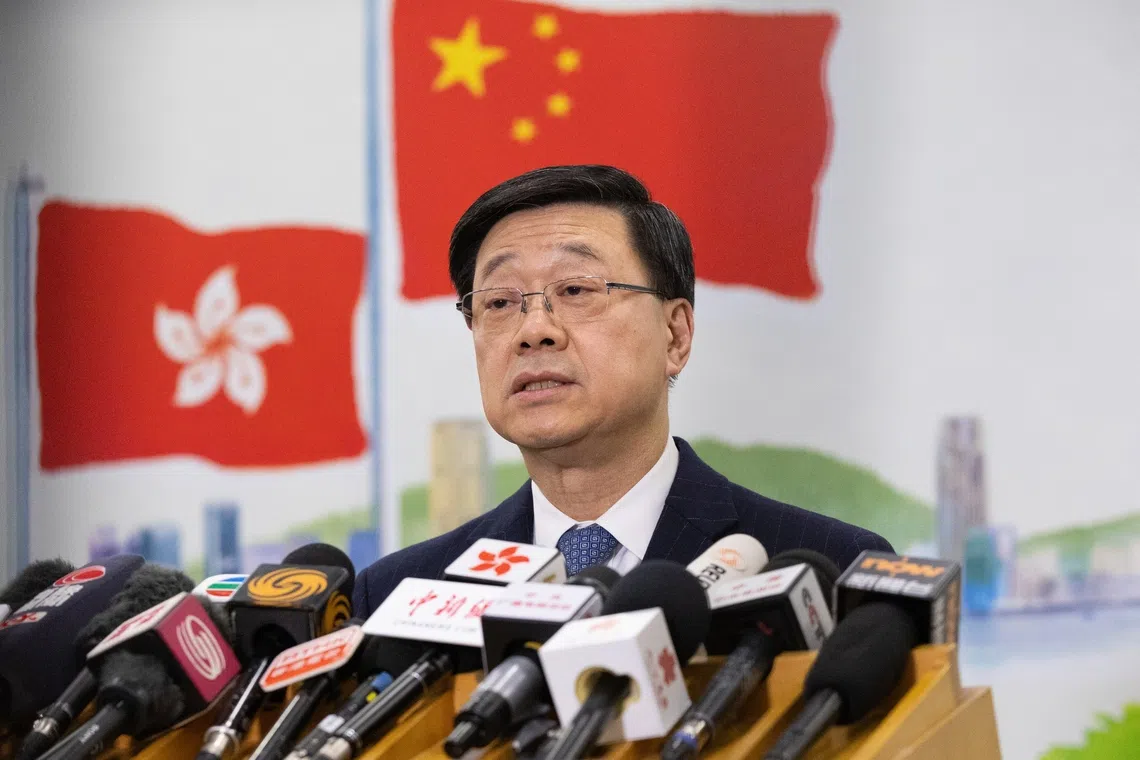
HONG KONG – Hong Kong leader John Lee is taking the unprecedented step of outlining a five-year vision for the Asian financial hub. The question is whether he will be the chief executive to see it through.On Sept 16, Lee will unveil Hong Kong’s first five-year plan, a blueprint his administration has spent much of the year crafting as it seeks to align the city’s priorities with China’s national strategy.It will be followed by Lee’s fifth and final policy address of his current term, which ends in June 2027.Hong Kong’s move to adopt five-year plans, which China’s ruling Communist Party has deployed since 1953, raises questions about whether the city is abandoning its traditionally light-touch governance that has seen it ranked as the world’s freest economy by the Fraser Institute almost every year since it returned to Chinese rule.Lee has argued the new approach will not alter Hong Kong’s capitalist system and that he will uphold its status as an international city with free flow of funds, people and trade, according to an opinion piece published in the South China Morning Post on Sept 14.The new framework will offer Lee’s clearest statement of the legacy he hopes to leave – and, potentially, his case to Beijing for another five years at the helm.The former security chief, who oversaw Hong Kong’s national security crackdown, has demonstrated to Beijing that he can restore order.Lee will now need to convince China’s leaders he can deliver economic growth, foster innovation and strengthen competitiveness, all while hewing the city more closely towards the nation’s strategic needs.“John Lee served a purpose returning Hong Kong to law and order,” said Bernard Chan, who was a Hong Kong deputy to China’s national legislature for 15 years. “Now, the question is, what sort of chief executive is in the best interest of Hong Kong going forward?” Since Hong Kong returned to Chinese rule in 1997, no chief executive has served two full terms.Neither of Lee’s two immediate predecessors, Carrie Lam and CY Leung, sought a second term.Political veterans say it is too early to predict whether Lee might break that pattern, given Beijing’s influence.Possible insights could emerge after the Communist Party’s Central Committee holds its plenary session in the fall, according to Chan, who served as the convener of Lam’s Executive Council.Lee has put his personal stamp on the 2026-2030 master plan, declaring early on that he would personally oversee the drafting.In June, the government launched a two-month public consultation, which drew about 16,000 submissions.About 80 per cent were from individuals, and the remainder from professional groups, political parties and chambers of commerce, according to Secretary for Constitutional and Mainland Affairs Janice Tse.Details such as whether it will include quantifiable economic and social targets are not yet known.But the government has outlined six areas of interest, including the city’s role as a global hub for finance and trade, policies to boost innovation and the tech sector, as well as urbanisation projects such as the Northern Metropolis.The plan will include what he called binding indicators for the government as well as metrics that are “anticipatory,” Lee told reporters on Sept 15.Hong Kong has had plenty of long-term plans before, from building new towns to massive transport projects.Yet these have typically focused on providing stronger infrastructure and social networks, rather than top-down economic framing.The adoption of five-year plans is a “signalling effect to tell everybody that Hong Kong will have more industrial policy aligned with the mainland”, said Alicia Garcia Herrero, chief economist for Asia Pacific at Natixis.Yet institutionalising that longer-term vision introduces a new political dynamic: future administrations might inherit policy objectives set by their predecessors, while chief executives may leave office before plans they crafted run their course. This timing of the plan’s release has brought Lee’s political future into focus. With less than a year left in his first term, he has not given clues over whether he will seek another five years in office. The last time Lee was asked, he told the local media “a year is a long time in politics”.“He’s been very careful, but honestly, I don’t detect any unwillingness on his part to continue,” said Ronny Tong, a member of the Executive Council, which advises the chief executive. “On the other hand, if there’s somebody better on the sideline, then of course somebody can step in and become the next chief executive.”Lee’s case for a second term will likely come down to Hong Kong’s value to Beijing.The city has long served as a financial gateway to mainland China, the world’s leading offshore renminbi centre and a platform for Chinese companies to raise capital.Lee has vowed to strengthen those roles.He recently told a banking event that the city’s five-year plan will include expanding offshore renminbi usage and cross-border investment.His administration has also courted the Middle East and Central Asia as the city seeks to diversify trade and financial ties.Complicating that economic mission, Lee is among officials sanctioned by the US in 2020 for their roles in implementing Beijing’s national security law.That has constrained his ability to engage with US officials and some of its close allies.In July, Washington lifted sanctions on nine Hong Kong and mainland Chinese officials after US President Donald Trump allowed a 2020 executive order to expire, but Lee remained on the list.Lee’s tenure has also been marked by Hong Kong’s deadliest blaze in more than seven decades. The Tai Po fire in November 2025 killed 168 people and triggered a level of public outrage unseen since the 2019 protests. A judge-led panel is due to release the findings of its investigation by the end of October.The following month, a small-circle election will be held to determine the composition of the 1,500-member Election Committee, the Beijing-loyalist body which chooses the city’s leader.That body is set to vote for the city leader in March.Lee was the sole candidate in 2022, campaigning on the promise of a “new chapter” for Hong Kong.Whether he gets to write Hong Kong’s next chapter is ultimately Beijing’s call.The new five-year framework is designed to ensure policy continuity regardless of who is in office.Even if Beijing had made a decision to seek a new candidate, it would make sense to keep that quiet for now.“If they want to change, they don’t want people to think this is a lame-duck government,” Tong said. “Then Hong Kong will become more difficult to govern.” BLOOMBERG
Hong Kong leader John Lee to unveil five-year plan that outlasts his term
Full Article
Original Source
Read the full article at Straitstimes →KhanList aggregates and links to publicly available news content. We do not host full articles from third-party sources. Always verify important information with original sources.