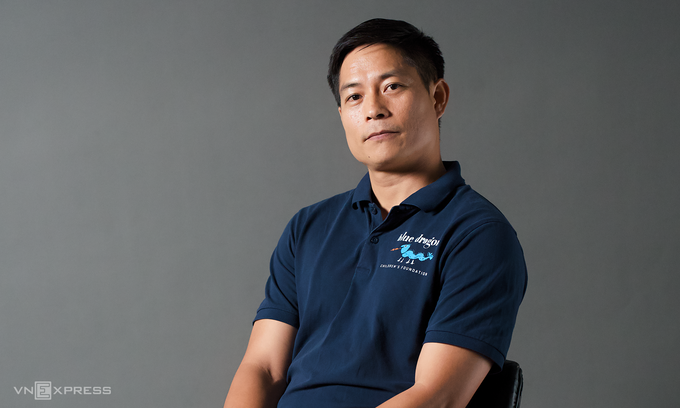
Nearly two decades later, that question still stays with Vi, co-CEO of Blue Dragon Children's Foundation, which rescues vulnerable children in Vietnam.Once a homeless shoe shiner himself, Vi joined the organization planning to stay for only six months. But he never left because of one unwavering belief: "If it is not me either, who will believe these children?"In an interview with VnExpress, Vi speaks about rescuing children, the lives he could not save, the psychological scars that come with his work, and why he still cannot walk away from a job he hopes one day will no longer exist.Q: What changed your life and led you to help street children?I used to live on the streets of Hanoi, earning money by shining shoes. My family was poor, so I ran away to the city with a few friends.I was 15 but looked like an 8-year-old because I was so undernourished. I was often robbed and beaten after wandering into areas controlled by other groups. The only way to survive was to memorize every alley so that I could escape. I stayed close to older shoe shiners because they could protect me, but in return I had to run errands for them and lend them money.Then one day I met Michael Brosowski, who later founded Blue Dragon. He gave me a ChocoPie and invited me to attend free English classes.I did not trust people easily. Over time, though, Michael showed me that he did not see street children as trash or a burden on society. He saw them as children who needed help.At the time I could go a whole week without changing clothes. I avoided getting close to people because I was ashamed. Michael never judged me.One day he told me: "You are very smart. If you had a proper education, your life would be very different."No one had ever said that to me. Living at the bottom of society, I believed I was worthless. Because Michael believed in me, I started believing in myself.My life changed quickly after that. I learned computer skills and web design, then found work in restaurants and five-star hotels. After about five years, I returned to Blue Dragon to repay what I had been given. I planned to stay for only six months.Q: Why have those six months turned into 17 years?At first, I stayed because Michael could not find enough staff.Then I met a little boy. He belonged to an ethnic minority community and was about 8 or 9 years old. He had come to Hanoi looking for work. By the time I met him, he had been sexually abused several times and was in poor health.Doctors suspected he had HIV. When I told him the positive results, he asked me: "Why didn’t you find me sooner?"I could not answer. That was the moment I decided to stay with Blue Dragon for good.I kept thinking about the other children asking for help. They reminded me of myself when I was desperate and wished someone like Michael would appear.If I walked away, how much longer would those children have before their lives became even harder? Who would become their miracle?That was when I accepted that this work had chosen me.Q: What have you given up to do this work?When I worked in hotels, I earned a comfortable income and had saved a fair amount of money.My starting salary at Blue Dragon was lower than the tips I received in a single month at the hotel.It is difficult to explain, but at some point money stopped being the most important thing. Still, returning was not easy.I went from wearing suits and serving successful businesspeople in a five-star hotel to working under bridges and at bus stations, dealing with gangs, extortionists, and traffickers.Even though I had once lived on the streets, I was shocked.In the beginning, I received threats all the time.Once, I tried to help a 10-year-old girl selling candy near Hoan Kiem Lake. A man claiming to be her father confronted me with a weapon and demanded to know who I was.Another time, more than a dozen men waited in an alley near my home carrying weapons. I had to learn how to judge dangerous situations and leave immediately if something felt wrong.The most frightening experience happened one day when I met a homeless teenager. As usual, I bought him food and asked where he lived. He offered to show me.He led me to a huge abandoned construction site near one of Hanoi's main bus stations. Tall metal fencing surrounded the area.Normally I would be with two or three colleagues, but that day I was alone. Since it was daytime, I thought it would be safe.A few meters inside, I stopped. Several men were standing behind some bushes. From my experience, I recognized them as men who paid to sexually exploit boys.They looked me up and down. Every hair on the back of my neck stood up. Fortunately, they did not approach us.I wanted to turn around, but the boy acted as though nothing was unusual. He seemed used to it.He led me through a guava grove and then into grass taller than us. By then we were hundreds of meters from the main road.At the center of the site, he pointed to a small shack and said several friends were inside.I lifted the tarp covering the entrance. About 10 teenagers and young adults jumped to their feet.Only then did I realize I had walked into their hideout. Some of them probably survived by stealing.Knives leaned against the wall near the entrance. There were water pipes used for smoking tobacco, pots and pans on the ground.They were frightened of me because they did not know if I had come to arrest or hurt them. I was just as frightened.Luckily, one of them recognized me from an earlier meeting and called out my name.The tension eased. I asked, "Have you eaten? Let me buy everyone some food."After that, everything settled down. We ate together and talked for a long time.When I finally returned to the office, I collapsed onto a sofa. I had no energy left. Only later did I realize my body had exhausted itself after staying in survival mode.The danger was not only directed at me. I regularly saw children being abused, beaten, and exploited.Most of the time I felt angry because life treated them so unfairly. I also felt helpless because I could not do enough.There were periods when I slept only three or four hours a night and suffered constant nightmares.Q: Does this work reopen your own childhood trauma? Have you pushed yourself too far?People deal with trauma in different ways. Helping others is how I heal myself.Instead of seeing myself as a victim trapped by the past, I use those experiences to help other people. That approach works for me.By the time I returned to Blue Dragon, I had already proved to myself that I could earn a good living. I had even been named employee of the year. I had overcome my fears of poverty and my lack of education.That does not mean the same approach works for everyone.Some colleagues who also grew up on the streets returned to help the organization.But every time they met a child whose story mirrored their own, they froze. Their past trauma would overwhelm them.If someone has not healed, this work may not be right for them.Q: After becoming a person who helps instead of receiving help, what belief turned out to be untrue?I returned believing that kindness, shelter, money, and education would change a child's life. I learned that those things alone are not enough.The hardest case involved an 11-year-old boy. Eight or 10 families had adopted him, but each eventually gave him up. He ended up back on the streets.I brought him to Blue Dragon and cared for him like family. I found him clothes, meals, relatives, legal documents, and a school. During weekends I took him out. He was affectionate. It took me two years to help him leave street life behind.Then one day I saw him skip school and pick up a basket of chewing gum to sell for someone exploiting children.He told me he preferred staying with that person because he felt loved there. I begged him to return to school. He shook his head.With no other option, I bought him a train ticket and sent him to live with his biological mother, whom he had never lived with as a child.At the station, I could not watch the train leave. Later, while meeting friends at a café, I broke down in tears in front of strangers for the first time.That was the moment I reached my limit.Q: What did you learn from that experience?At first, I thought I had failed. It made me realize how difficult it is to change someone's life.I left home because of poverty. But homeless children often face many other problems, including domestic violence and abandonment.At first I tried to solve every problem in their lives. The more I tried, the more complicated everything became.The more we talked about their problems, the less confident they became. Nothing improved.I also expected children to change quickly because I had invested so much in helping them. People do not work that way.Behavior is only what you see on the surface. The real causes lie much deeper, in years of emotional wounds and unmet needs. Healing can take years.I suffered because my expectations were wrong. I believed I was responsible for someone else's life.In the end, I realized the person who needed to change first was me.Q: How did that realization change you?Instead of saying ‘I will help you become this kind of person,’ I now ask, ‘What do you want from your life? How can I help you?’I do not change anyone's life. I am here to help them. If there is a barrier they want to overcome, I will stand beside them while they do it.The second lesson is compassion. When you help someone and do not see results, your instinct is to blame or judge them.I have learned that social work is not about changing someone as quickly as possible.It is about having enough patience never to give up on them. That is a challenge every social worker faces.Q: Even though you once lived through similar hardships, you have said you reached your own breaking point when you did not see results. What has been the hardest part of helping your colleagues stay compassionate toward these children?In the early years, many children came to Blue Dragon only to leave again. I managed the street outreach team, whose job was to find children and bring them to our center. After a few weeks, another team would take over and support them.But I noticed that many children disappeared.Back then, success was measured by simple indicators: Were they going to school? Had they stopped spending time in internet cafés? Were they still lying to staff? If the answer was no, many employees concluded the child did not want to change. Support could then be withdrawn.The conflict reached its peak while I was on a work trip overseas. A boy I had once brought to the center sent me a message: "Brother, I’m hungry."He told me he had dropped out of school and refused to return to his family. Because of that, Blue Dragon had stopped supporting him, and he was back on the streets. I called a colleague and asked them to bring him a meal and check on his mental state.When I returned to Vietnam, I was taken straight into a meeting. My colleagues told me the organization had decided to end all assistance. No staff member was allowed to help him because he had broken the rules too many times.I was stunned.He had grown up in a deeply troubled family. His stepmother rejected him, his father was seriously ill and he was in emotional crisis. Yet instead of receiving more support, he was cut off completely and treated as someone beyond help.After that meeting, I submitted my resignation.Q: Others believed support should end. Why did you think otherwise?Blue Dragon exists for children like him. If the organization would not help them, I saw no reason to stay.A child may not be ready to change today. That does not mean the child no longer deserves help. Children deserve unconditional support.You can lead a horse to water, but you cannot make it drink. I wanted the organization to offer not just one or two chances, but as many chances as necessary until the timing was right.Blue Dragon once gave me English lessons, but I quit halfway through the course. They found me jobs, and I quit the first three within weeks. Even when I started working at a five-star restaurant, I almost gave up because I felt I did not belong.Children like me rarely admit those feelings. Yet Michael never decided I was beyond help.Eventually, the organization's founder learned what had happened. They stepped in and required Blue Dragon to rethink its approach.Q: Many children learn to lie or steal to survive on the streets. What happens when a child keeps making the same mistakes? Is there a limit to compassion?Most of the children I have met are kind and work very hard. Some, however, commit crimes because they are trying to survive or because adults exploit them.Compassion does not mean ignoring harmful behavior.I once worked with a boy whose father had taught him to steal when he was only eight or nine. His father later went to prison, but the habit stayed with him.Whenever he was arrested or got into trouble, he called me for help.Eventually I realized I was rescuing him from the consequences instead of helping him change.So I told him plainly: "You are responsible for what you do. If you keep stealing, you will face the consequences. You could be beaten, arrested or prosecuted. I won't rescue you anymore."But I never cut him off completely. I still answered his calls. I still checked on him. Three years later, he stopped stealing on his own and found steady work.Not every story ends that way. I cannot help every child. Sometimes time has to do its work.What I can do is make sure a child never feels abandoned, never feels that the whole world has turned its back on them. I think everyone needs that feeling, especially children who have no parents.Q: After that disagreement, how did Blue Dragon change the way it works with children?Some children test social workers. They want to know whether adults really care about them and whether they will still be treated with kindness when they misbehave.Blue Dragon grew very quickly, but our systems and philosophy did not keep pace. We rebuilt our entire approach.Now, when a social worker can no longer work effectively with a child, we change the worker or the support strategy. We do not give up on the child.I also changed how we train staff. In addition to psychology and social work, everyone has to spend time on the streets, meeting children and witnessing conflicts firsthand. They need to understand what lies behind the behavior they see.Our conversations with children changed as well. I used to begin by asking about their problems. Every time children talked about what they lacked, they became more insecure and withdrawn.Now I ask different questions such as ‘What are you good at? What are you most proud of?’ When people feel proud of themselves, they want to achieve more.One girl first came to Blue Dragon simply because she wanted to learn hip-hop dance. She was shy at first, but gradually became more confident. She returned to school, learned English, studied overseas, and eventually joined an international company.A dance class became the starting point for much bigger changes.Q: After 17 years of witnessing so much suffering, have you ever thought about quitting?Many times.Someone once asked me what the worst thing I had ever seen was. I replied, ‘Do you really want to know?’Some memories involve death.For people who have experienced trauma, the mind can be like a cassette tape tangled beyond repair. Every time you revisit those memories, the wound opens again.Even today, some of those memories keep me awake at night.There was a period when I struggled with depression. I asked myself, ‘If I disappeared, would this pain disappear too?’ Fortunately, I realized what was happening early enough to tell someone I trusted ‘I need help.’I reminded myself that my work should contribute something positive to society, not become another burden.Whenever I lose hope, I visit the children at our center.Many of them have no parents. Simply having someone spend time with them means a great deal.When I first arrived in Hanoi, loneliness was the hardest part. I was surrounded by millions of people, yet completely alone.Being with these children reminds me why I started.Q: Looking back on your own journey, what lesson do you most want to pass on to your children?The biggest lesson is that life is never easy. If you want something, you have to give it everything you have. Challenges are not something to avoid. They are how people grow.The greatest thing I can leave my children is not money but the ability to navigate life.I often bring them to activities with young people at Blue Dragon. They meet children who have shown remarkable resilience and have a great deal to teach.I am not worried about my children being exposed to difficult behavior. In fact, I think growing up without facing real-life challenges leaves people unprepared for adulthood.I would rather let them experience the world and then talk through what they have seen.Q: You became co-CEO in 2022. What concerns you most today?Blue Dragon has worked in Hanoi for 21 years, and the number of street children there has fallen significantly.But every time I visit Ho Chi Minh City, I see children selling lottery tickets, shining shoes or breathing fire for money as soon as I step outside.Over the past two years, Blue Dragon has worked with government agencies to support several hundred children there.The more we do, the more I realize how small that number is.I hope one day I will be out of a job because there are no more children in need of rescuing.20 or 30 years from now, I hope Blue Dragon will no longer be a rescue organization; I hope it will focus on education or child development instead.Do Duy Vi, CEO of Blue Dragon, talks to VnExpress about his childhood and his journey with the organization. Video by Kim Long, Trung Kien, Pham LinhStory by Thuy Ngan, Phuong Nghi
Homeless man hopes his charity that takes kids off streets will soon become jobless
Full Article
Original Source
Read the full article at E →KhanList aggregates and links to publicly available news content. We do not host full articles from third-party sources. Always verify important information with original sources.