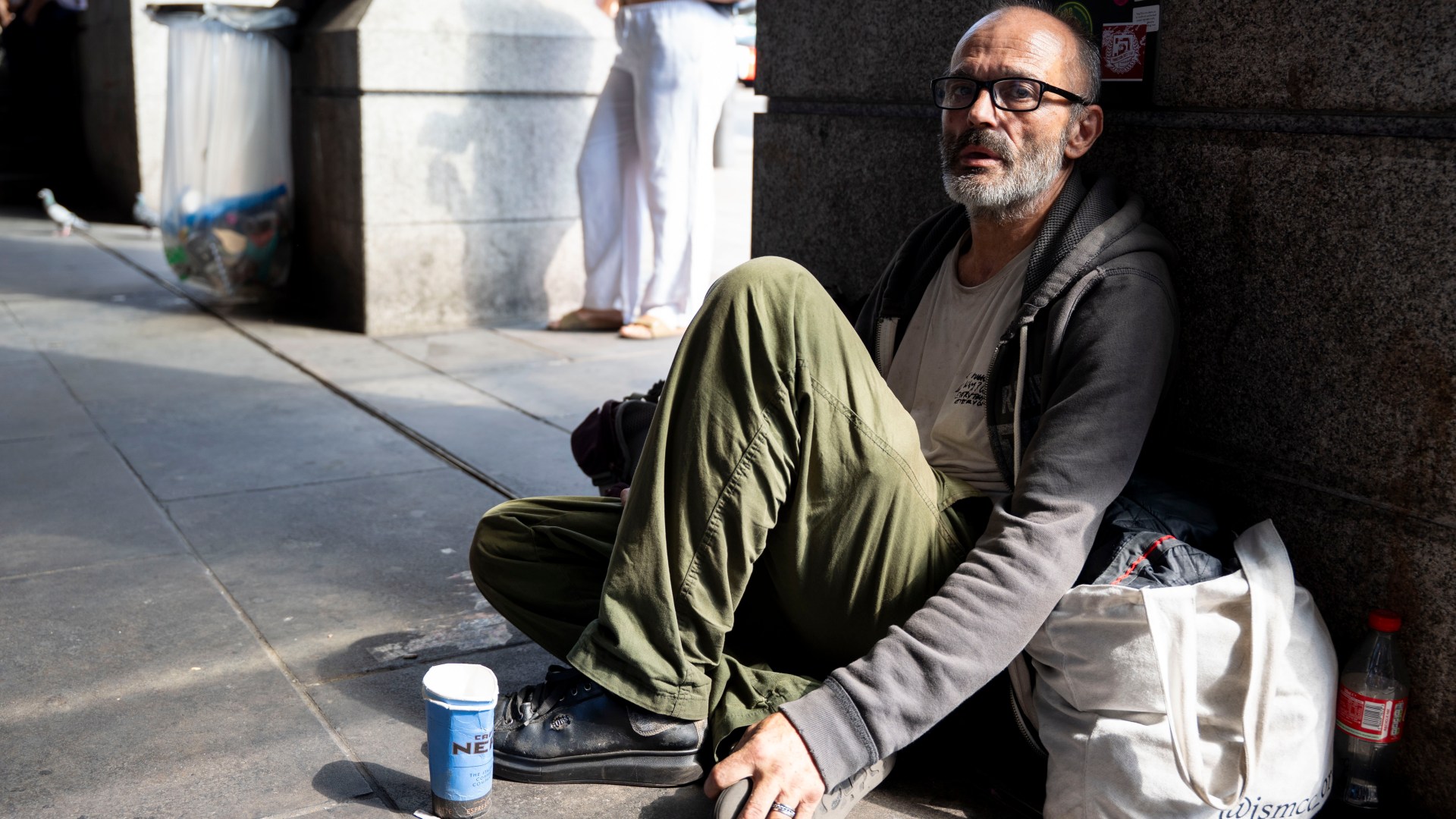
HOMELESS Brits have told Andy Burnham “you need to look after your own first” as another wave of Channel migrants arrived in the UK. The Sun spent three days speaking to dozens of rough sleepers across London’s streets, with many saying the Government has failed THEM while continuing to house asylum seekers in around 160 hotels across the UK. Paul once cooked for the Queen Mother, but now begs for a sandwich outside a Tube station Credit: Louis Wood News Group Newspapers Ltd Sleeping outside a London theatre, Paul said the Government shouldn’t be giving houses and money to asylum seekers when they cannot look after homeless Brits Credit: Jon Bond After being brought ashore a group of illegal migrants are processed before boarding a coach to Manston Credit: Gary Stone A record 230 migrants crammed on to a single dinghy heading for Britain this week Credit: AFP While the Government provides accommodation to asylum seekers, homeless Brits have no automatic right to a roof over their heads. It comes as Andy Burnham pledged to end rough sleeping in the UK during his first speech as Prime Minister. Sign up for The Sun newsletter Thank you! Bradley, 62, from London, became homeless after his marriage broke down and he moved into his mother’s council house. But after she died just a few months later, he found out he was not entitled to live in the property so was evicted and left to sleep on the streets. John has been sleeping rough for the last eight months and claims that asylum seekers are ‘getting everything… we’re getting nothing’ Credit: Jon Bond A former construction worker, also called Paul, suffers from epilepsy and claims he has to beg for money to buy medication Credit: Jon Bond “Because I don’t have any addictions I’m not a priority. How does that make any sense? If I came over on a boat I’d be fine,” he said. His comments come after a record 230 illegal immigrants crammed on to a single dinghy heading for Britain last week – landing taxpayers with an estimated £25million bill. Once ashore, migrants are typically taken to the Home Office’s Manston processing centre before being moved into hotels, houses of multiple occupancy or former military sites while their asylum claims are considered. Nearly 94,000 asylum seekers were living in government-funded accommodation at the end of March 2026, compared with the 4,793 people recorded by the Government as sleeping rough in England on a typical autumn night. Most read in The Sun Former chef Paul, 59, who says he once cooked for the Queen Mother at Ardoe House in Aberdeen, lost his home after a relationship breakdown and a subsequent drug addiction. After nearly 40 years of working in restaurants around the world, he is now begging for a sandwich outside Westminster Tube station. Paul has been on and off the streets for the past four years. He claims to be now sober but claims there isn’t enough support for rough sleepers who aren’t substance users. Big Issue seller Kevin tells The Sun the Government ‘should be helping their own first before helping anyone else’ Credit: Jon Bond Paul tells The Sun it’s become normal to see 60-year old people begging on the streets even though they have worked and live in the UK their entire lives Credit: Louis Wood News Group Newspapers Ltd He said: “I’ve approached a few organisations here who say to me, because I’m not a drug addict or an alcoholic, that there’s nothing they can do for me because the system is set up just for those kinds of things.” And without ID or a postal address, he says he can’t open a bank account to receive Universal Credit. He claims a job centre worker told him to “rely on the kindness of strangers”. Paul added that even if he had official documents and possessions, they would likely be stolen from him at night from other rough sleepers. “Nobody has any honour anymore,” he said. “So what’s the point?” When asked about the government-funded accommodation for asylum seekers, he responded: “Part of me thinks live and let live, and part of me thinks that 40 years ago this wouldn’t be happening. “I think we’ve just diluted our whole identity down to something that now it’s normal for 60-year-old people to be sitting on the street, begging for food, having worked and lived here their whole lives. “While people that have just arrived, [the Government is] quite happy to look after them and give them what they want. It’s hard not to be resentful. And apparently if you are resentful, that makes you a racist. So you can’t be resentful, apparently.” He added: “And when it gets to the point that you’re probably better off in prison, because at least you’re getting three meals and a bed, that can’t be good either, can it?” A group of migrants are brought into the Border Security Command compound in Dover, Kent Credit: PA Tam tells The Sun the Government proved it could reduce rough sleeping during the pandemic, but claims many are back on the streets Credit: The Sun A parliamentary report found the Government spent £4.9billion on the asylum system in 2024-25, including £2.7billion on accommodation alone. The Labour Government says they now have less than 160 hotels in use – down for 400 in 2023 – saving £1billion in accomodation costs since they took power and closing anohter 11 this week. In comparison, the Government allocated £500million over a three-year period to help fund councils to reduce rough sleeping through outreach programmes and emergency accommodation in 2022. On his first day as Prime Minister, Andy Burnham pledged to end rough sleeping at the “earliest opportunity” and announced an additional £340million over the next five years. But Tam, 62, from Glasgow, who has been sleeping rough for 40 years, said successive governments have failed to tackle the crisis. Sitting outside a Leicester Square supermarket he claims: “Every government comes into Parliament trying to get rid of rough sleepers. It’s not going to happen.” “If I was the Prime Minister, I would make sure to sort your own people first rather than treating all these people who are coming into the country.” Tam said the Government had proved rough sleeping could be reduced during the pandemic, when emergency accommodation brought many people off the streets, but claimed many Brits had since ended up sleeping rough again. Government figures suggest British nationals account for nearly two-thirds of all people sleeping rough. While 13 per cent are from EU countries, 11 per cent are from non-EU countries and 11 per cent are unknown. Migrants who arrive in the UK by small boat are usually detained at Manston before being moved on to asylum accomodation Credit: Getty Once processed, asylum seekers are taken to government-funded hotels, HMOs or former military bases Credit: PA Kevin, 59, a Big Issue seller from London, became homeless after spending time in prison but is vague about his “petty” conviction. He says his own family doesn’t know he’s living on the streets, but like many others who were interviewed, says his pride comes first. Kevin believes more support should be targeted at Brits over asylum seekers who he says are given “special treatment”. “I don’t mind anybody coming over for a different life if they’ve come from a war-torn area, but not just to come and think it’s about the NHS, come and sponge up the Government funding or come and just milk the system and get housing before our own people. They should be helping their own first before helping anyone else.” Kevin believes homelessness services often fail people without addictions because they are housed alongside those with serious drink and drug problems, followed by little support to help them move into permanent accommodation. He claimed: “It was a waste of my life. There was no proper move-on plan.” Outside Charing Cross station, John from Galway, stands with a sleeping bag draped over his shoulders, wearing a pink cowboy hat he was given by a hen party. He apparently served 16 years for armed burglary and says he has been on the streets for eight months. John said he occasionally stays in a hostel but fights regularly break out in the night over drugs in the sweltering hostel room he shares with 20 other people. “We should be looked after. People coming across in the boats, they’re getting hotels. They’re getting everything. We’re getting nothing. And we’re just being left, and that’s it.” Former construction worker Paul, 44, from Oxford, says he has been sleeping rough for the past two years – also after leaving prison, where he spent four years serving a sentence for assault. He says: “I shouldn’t be on the streets, there should be other people on the streets. “They shouldn’t be letting people come over on boats and giving them houses and money every f***ing month when they can’t even help their own. I think that’s disgusting.” Paul suffers from epilepsy and claims he has to beg for money to buy medication after he says authorities refused to prescribe the controlled drug he says he needs. Migrants who are receiving Home Office asylum support are entitled to free NHS prescriptions, certain travel costs as well as housing. According to the government website, asylum support is available to migrants if they are homeless or do not have money to buy food. The Holiday Inn Express in Greenock, a migrant hotel, where violent protests took place in June Credit: Kenny Ramsay Asylum seekers can claim for housing and cash by filling out a 37-page government application if they are destitute or likely to become destitute within 14 days. Migrants who have appealed their asylum decision or even had their application rejected can still apply for support while they arrange transport to return back to their country of origin. Meanwhile, for homeless Brits, local authorities assess each applicant to determine what legal duty they are owed, with emergency accommodation generally reserved for those who are in a “priority need” category. “Priority need” for accommodation includes pregnant women, households with children, victims of domestic abuse, vulnerable people or those made homeless by a disaster such as a flood or fire. None of the rough sleepers who spoke to The Sun over a three-day period said they were categorised as a priority need. Instead, they had all made their way to central London where they begged outside some of the biggest and busiest tourist attractions in the country. London and the South East accounted for 43 per cent of all rough sleepers in autumn 2025, according to government data. Westminster remains the local authority with the highest number of people sleeping rough with 360, followed by Camden (134), Somerset (103), the City of London (83), Bristol (70), Birmingham (68) and Leeds (65). A Westminster City Council insider told The Sun it does more than any other local authority in the country to support people sleeping rough and invests £8million a year to help people come off the streets. A spokesperson for the homeless charity St Mungo’s said: “Our Outreach teams are out on the streets day and night meeting thousands of people rough sleeping, all of whom have different life experiences and needs. “These teams help people realise their needs, rights, and entitlements as the first step in moving away from the streets for good. “We know however that we cannot tackle the moral tragedy of homelessness alone. Prime Minister Andy Burnham’s announcement of ending rough sleeping on day one of his tenure is a galvanising moment for the sector, and for the people we support. “We hope that this will bring greater coordination within government and improve access to statutory services. Only then can we close the cracks in support and ensure homelessness ends for good.” A government spokesperson said: “Ending rough sleeping is a personal commitment of the Prime Minister’s. “He made the pledge on his first day in office and backed it immediately with an extra £340 million to tackle rough sleeping and homelessness across the country.” Homelessness help HERE is some useful information if you are homeless or know someone who is experiencing homelessness. FIRST CONTACT If you or someone you know is sleeping rough you can use the alert Streelink service to help connect them with outreach services: www.thestreetlink.org.uk/start FOOD You can find free food stations via: The Pavement – for food and soup runs: www.thepavement.org.uk/services Homeless Link – for day centres: www.homeless.org.uk The Trussell Trust – for food banks: www.trusselltrust.org/get-help/find-a-foodbank/ Food Cycle – for food services – www.foodcycle.org.uk/free-food-locations/ HOUSING Councils have a duty to help people who are homeless or facing homelessness. Contact the Housing Options team from the council you have a local connection to and see if they can offer: Emergency accommodation – a place in a shelter or a hostel Longer-term accommodation including independent or social housing Visit: www.gov.uk/find-local-council During times of severe cold or heat, local councils have special accommodation known as Severe Weather Emergency Protocol (SWEP). Find out more here: www.gov.uk/find-local-council. For advice, support or legal services related to housing visit www.shelter.co.uk or call 0808 800 4444. You can also contact Crisis: www.crisis.org.uk/get-help/ For housing advice, call Shelter on 0808 800 4444 or visit: www.shelter.org.uk. DAY CENTRES Day centres can help by providing internet access, free or cheap food, shower and laundry facilities, safe storage for belongings, phone charging and clothes, toiletries or sleeping bags. They can also help with services for benefits or immigration advice; health support; finding work; educational or social activities; hostel, night shelter or outreach referrals. Centres can be found through Homeless Link: www.homeless.org.uk/ BENEFITS Normally you can claim Universal Credit if you are sleeping on the streets or staying in a hostel. If you are in a hostel, you can claim Housing Benefit to help with rent. You do not need a fixed address or a bank account. USEFUL CONTACTS Crisis – visit: www.crisis.org.uk or call 0300 636 1967. Shelter – visit: www.shelter.org.uk or call 0808 800 4444. Centrepoint (for people aged 16-25) – visit: www.centrepoint.org.uk or call 0808 800 0661. St Mungo’s (Bath, Bournemouth, Brighton, Bristol, Christchurch, Leicester, Oxford, Poole and Reading) – visit: www.mungos.org or call 020 3856 6000. Depaul UK (for young people) – visit: https://www.depaul.org.uk/ or call 0207 939 1220. Citizen’s Advice (legal advice) – visit: www.citizensadvice.org.uk or call 0345 404 0506. The Samaritans (health and wellbeing) – www.samaritans.org/how-we-can-help/contact-samaritan or call 116 123. Comment now
Homeless Brits starving on streets plead ‘look after us first!’ as small boat migrants ‘given priority treatment’
Full Article
Original Source
Read the full article at Thesun →KhanList aggregates and links to publicly available news content. We do not host full articles from third-party sources. Always verify important information with original sources.