
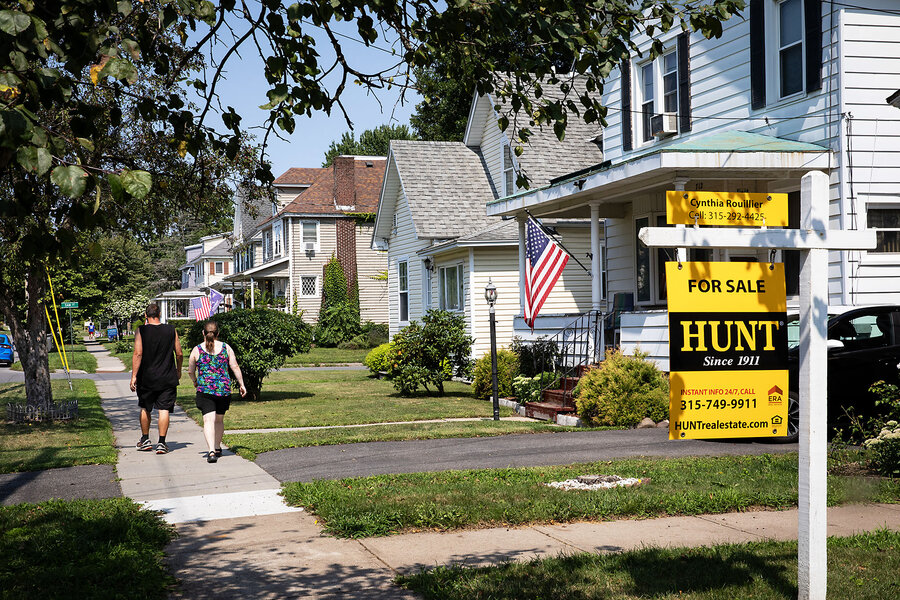
In the 21st century, housing costs for new homebuyers have doubled, and mortgage rates rose from 3% to a current national average of about 6.7%. The result is that many first-time homebuyers are priced out of the market, a phenomenon that Susan Wachter calls the “Great Postponement.”Ms. Wachter, a professor of real estate and co-director of the Penn Institute for Urban Research at the Wharton School of Business, says an ambitious federal housing law passed this summer will help make housing more affordable eventually.But it will take a combination of time and broader shifts in the economy to persuade young families to end this postponement of life decisions, such as having children, getting married, and leaving the parents’ home. Why We Wrote This A bipartisan housing bill that became law in June could be part of the answer to America’s housing affordability crisis, but it’s not expected to have much of an effect over the next few years. In the meantime, others are trying ways to help hopeful homebuyers find a way into the market. “Getting on the ladder of homeownership is so much harder,” Ms. Wachter says, noting that one-third of young adults under the age of 35 are living with their parents.The housing law is likely to encourage developers to start new housing projects, including homes in the low-to-medium price range. It offers first-time buyers options such as federal loans for houses costing less than $100,000, higher limits for some manufactured home loans, caps on institutional investors, and streamlined permitting to speed up the construction of new homes.But, Ms. Wachter notes, most of those provisions won’t come into effect until January 2027.In the meantime, there are other solutions being offered, though perhaps none as potentially far-reaching as the housing law. Cities like Rome, New York, are offering down payment assistance programs. Fannie Mae and Freddie Mac, the government entities responsible for stabilizing mortgage markets, offer the same kind of help for low-to-moderate income households. In addition, the Federal Housing Administration offers mortgages with very low down payments.“It’s not easy,” Ms.Wachter says. “But it’s easier now than it’s been in the last four or five years since 2020. There is now a shift in the market a bit.” Melanie Stetson Freeman/Staff Longtime real estate agent Fred Macchia, who runs 1st Rome Realty, and Jacqueline Izzo, a real estate agent and former city mayor, chat in their office, in Rome, New York, Aug. 12, 2026. Attempts at solutionsRome is a city in central New York of about 32,000 that was home to Griffiss Air Force Base, which created thousands of high-skilled jobs and drove the local economy, from business to retail to entertainment, for the town’s burgeoning middle class.Mothballed in 1995, the former base was revitalized as a business park, but Rome has seen its population drop from 50,000, and the median household income is well below the national average.The city’s initiatives, funded mainly by property taxes and state grants, include a down payment assistance program for first-time homebuyers. The program provides up to 4% of the purchase price of a home.Interest in the program has been strong, says Sam Mirarchi, who runs training sessions for Home Ownership Center, a nonprofit that partners with communities on housing and growth efforts. Most of the applicants he has seen lately are in their late 20s to early 40s. The eight-hour, first-time homebuyer course teaches the basics of all the hidden and unanticipated costs that come with purchasing a home, while a separate one-on-one session prepares buyers to understand basic bookkeeping and finance.He says a starter house in Rome can be around $150,000, with a typical down payment of around $5,000.“But for low-income people, finding out you have to put a $30,000 roof on that house can be a deal-breaker,” he says. Worse, it can force the homeowner into default on their mortgage payments.“That’s why we have conversations about what they can afford,” Mr. Mirarchi says.Rome’s down payment assistance makes sense, says Jacqueline Izzo, a real estate agent and former city mayor. Rome has a large population of young families of low and moderate income, and improving their chances of buying a home can help both homebuyers and the housing market, she says. Melanie Stetson Freeman/Staff A home is for sale for $139,900, in Rome, New York, Aug. 12, 2026. To help prospective first-time homebuyers, a city program is offering help with down payments. During her eight-year tenure, which ended in 2023, Ms. Izzo says the city reinvested in downtown areas and revitalized Griffiss Air Force Base to attract businesses that would create new jobs for the next generation.“There’s a lot of good people who are qualified for these programs,” she says. “You’ve got hardworking people in retail and customer service earning $20 an hour. These are the types of people we are trying to help. They will stay in Rome if they can.”Ms. Izzo says that Rome may eventually see new housing construction as a result of the federal housing law, but she’s not holding her breath.“We’re typical of the size of cities that are not going to benefit from the housing law,” she says, noting the majority of provisions in the law are aimed at larger urban areas. For the near term, small and medium-sized cities will need to look after their own people, she says. “We have to be more resilient here, we have to help our people.”Help on the horizonIt’s been almost three months since Congress passed the 21st Century ROAD to Housing Act, and mortgage rates remain high, housing supply is tight, and inflation for daily necessities such as food and fuel continues to rise. For millennials and Generation Z, day-to-day expenses could trump lifetime goals a little longer.“Anything that gets started right now, let’s say you have all the financing and you have the permits and everything, it will take six months to a year before that stuff comes online,” Ms. Wachter says. “Anything that’s going to be responding to the new opportunities of the Road Act are going to be things that will take even longer.”Even so, there are glimmers of hope, she says.For one, housing prices are flattening, and in some markets there is an excess supply of houses on the market. And a growing number of communities are bucking market trends, and encouraging the construction of affordable homes and rental apartments.This means changing zoning regulations to create new-build developments of starter homes for young families and first responders such as police and firefighters, Ms. Wachter says.“Communities want to have housing for first responders to keep their communities safe,” she says. “People want their children to be able to live nearby. So there are reasons why communities will go against the grain because the grain is actually to make it more difficult to zone for inexpensive homes.”
Homebuyer help programs, new law aim to untie housing affordability knot
Full Article
Original Source
Read the full article at Csmonitor →KhanList aggregates and links to publicly available news content. We do not host full articles from third-party sources. Always verify important information with original sources.