
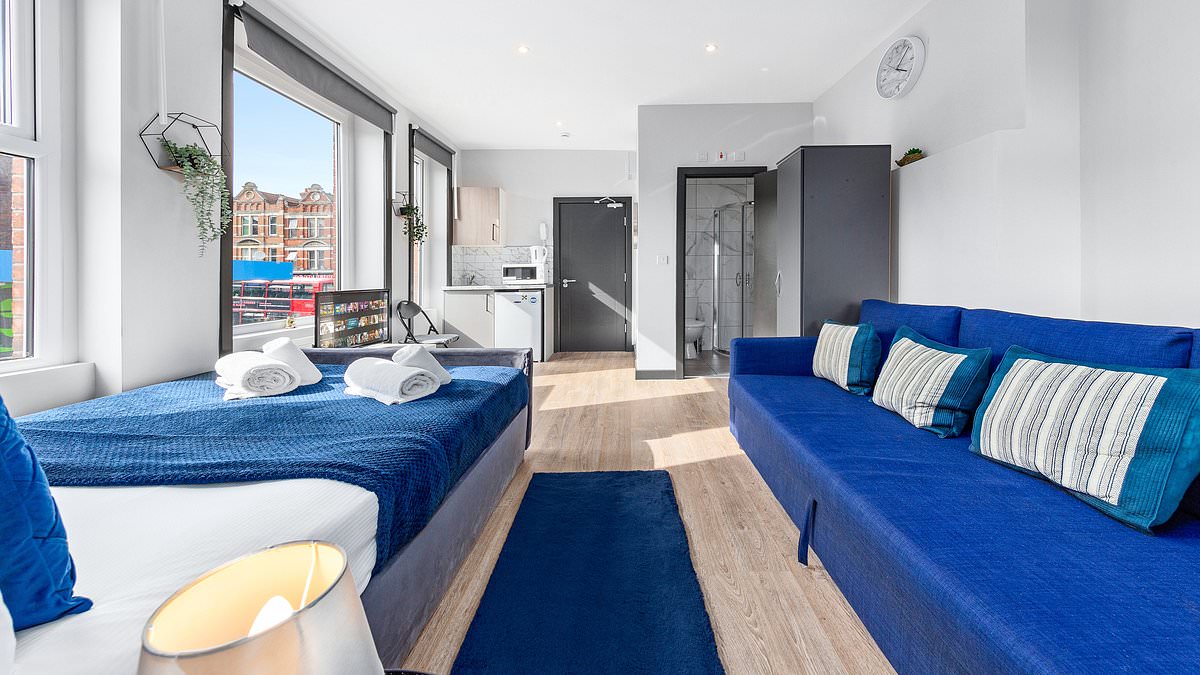
Buyers in Britain now receive 41 per cent less space in a home for their money compared to a decade ago, data suggests. Since 2016, buyers have lost 70 square metres per £300,000 spent compared to 2016, an analysis of Land Registry, Rightmove and energy performance certificates by Post Office Life Insurance said. With buyers' money not stretching as far, the amount of property space lost per £300,000 spent is the equivalent in size of a two-bed bungalow, according to the analysis. How much space has been lost per £300,000 spent in the period varies depending on where you live. Manchester residents have suffered the biggest loss, with buyers getting 58 per cent less space at home for their money than a decade ago. With average house prices almost at £300,000 in England, buyers in Manchester could buy nearly 200 square metres in 2016 on this budget. Feel the squeeze: Buyers in Britain get 41% less space in a home for their money this year than a decade agoToday, that same budget would only buy an average of 84 square metres worth of property in the city. So, buyers in Manchester are now getting 114 square metres less space for a £300,000 budget than a decade ago, the research said. Buyers in Birmingham have also been adversely affected. In Birmingham, where Post Office said average annual salaries were £30,180, buyers are getting 93 square metres less space for a £300,000 budget than they would have a decade ago. In 2016 a £300,000 budget would have got a buyer 189 square metres, dropping to 96 square metres this year. Leeds was the third worst location in England for property space loss per £300,000 spent, with buyers losing 84 square metres for the same budget. In 2016 £300,000 in Birmingham got you 174 square metres of space, against 90 square metres today. In Liverpool, where Post Office said the average annual salary was £30,947, the level of floor space available per £300,000 spent has also fallen sharply. Across the city £300,000 would get you 240 square metres of space, compared to 126 square metres this year. Space loss: Spending £300,000 gets you far less property space now than in 2016With average annual earnings of £31,119, buyers in Doncaster have also been affected, Post Office said. In Doncaster buyers could get 255 square metres in space at a property for a budget of £300,000. Fast forward to 2026 and this has dropped to 138 square metres. Despite its reputation, London has seen some of the smallest changes in floorspace per £1,000 over the same period. Inner London has seen a fall of just 0.01 square metres since 2016, while the outer areas of London are down 0.04 square metres, Post Office said.A spokesman for Post Office said: 'What’s striking is how much physical space people have lost without realising it. 'In cities that were once seen as affordable, buyers are now paying far more for far less, which puts added pressure on household finances.'Post Office said buyers across Britain now typically get 0.33m square metres of property per £1,000 spent. How small can a new-build flat be?The current national space standards were set by the Government in 2015. Studio flats must be set on a single storey and have a minimum gross internal area of either 39 sq metres with a bathroom, or 37 square metres with a shower room. This must include provision for at least one square metre of built-in storage.One-bedroom two-person flats over a single storey must be at least 50 square metres, or 58 square metres over two storeys. The flats must be able to accommodate at least 1.5 square metres of built-in storage. For two-bedroom flats over a single storey, they either need to have a footprint of at least 61 square metres to accommodate three bedspaces, or of 70 square metres to accommodate four bedspaces. Despite the space requirements, British households live in some of the most cramped conditions in Europe. Best mortgage rates and how to find them Mortgage rates have shot up again due to inflation triggered by the conflict with Iran reversing hopes that the Bank of England would cut rates. This means those remortgaging or buying a home face higher costs.That makes it even more important to search out the best possible rate for you and get good mortgage advice, whether you are a first-time buyer, home owner or buy-to-let landlord.This is Money's partner L&C can help you with its fee-free mortgage service.> Compare mortgage rates> Find the right mortgage for you To help our readers find the best mortgage, This is Money has partnered with the UK's leading fee-free broker L&C.This is Money and L&C's mortgage calculator can let you compare deals to see which ones suit your home's value and level of deposit.You can compare fixed rate lengths, from two-year fixes, to five-year fixes and ten-year fixes.If you’re ready to find your next mortgage, why not use This is Money and L&C’s online Mortgage Finder. It will search 1,000’s of deals from more than 90 different lenders to discover the best deal for you.> Find your best mortgage deal with This is Money and L&C Mortgage service provided by London & Country Mortgages (L&C), which is authorised and regulated by the Financial Conduct Authority (registered number: 143002). The FCA does not regulate most Buy to Let mortgages. Your home or property may be repossessed if you do not keep up repayments on your mortgage.
Home buyers get 41% less space for their money compared to a decade ago with Manchester buyers seeing the biggest squeeze
Full Article
Original Source
Read the full article at Dailymail →KhanList aggregates and links to publicly available news content. We do not host full articles from third-party sources. Always verify important information with original sources.