
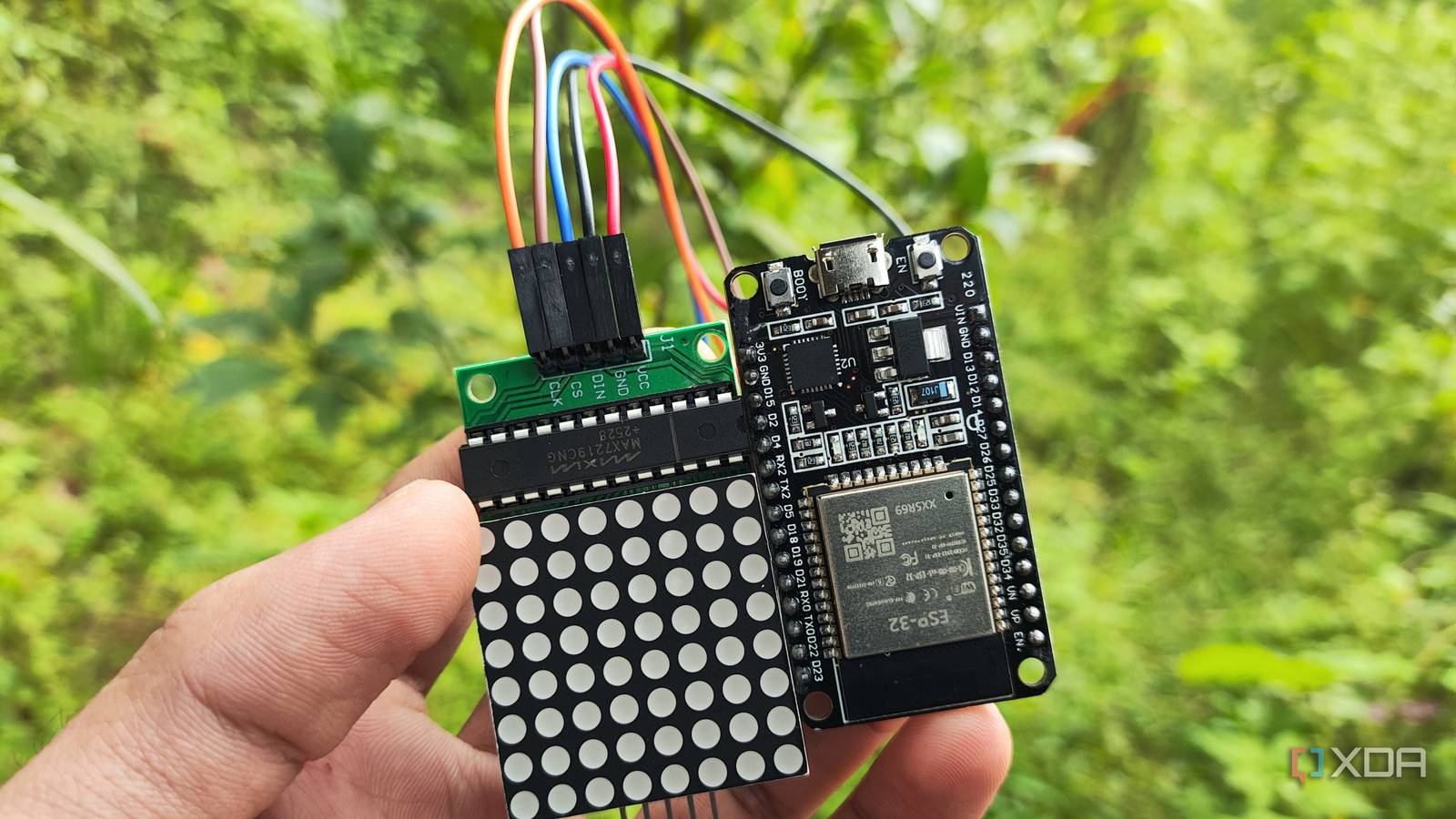
Published Sep 2, 2026, 2:30 PM EDT Jasmine is Software and PC Hardware Author at XDA with years of tech reporting experience ranging from AI chatbots right down to gaming hardware, she's covered just about everything. Whether it's breaking news about the latest AMD NPUs or creating video tutorials on social media platforms, Jasmine has contributed to the world of AI and tech in a variety of ways including interviewing the CEO of Razer, AMD's Director of Product Marketing and the VP of Lenovo. Passionate about gaming and PC technology, she has built countless computers, keyboards and other peripherals - knowing them inside and out. After spending a week purging Tuya, Ring, and cloud-connected IoT gear and replacing them all with custom ESP32 microcontrollers, you might assume that your smart home has become an impenetrable air-gapped fortress. However, just because you have local control, meaning that your devices are communicating locally with Home Assistant over the native API, doesn't mean that you have network isolation. Home Assistant does not act as a firewall, a proxy, or a barrier between your devices and the wider web. If an ESP32 is on a standard flat home subnet, it has an open, unmonitored, default gateway directly to the public Internet. Out of the box, it can make unrestricted outbound DNS and NTP requests. Download OTA payloads expose unauthenticated web servers and become an ideal pivot target if it becomes compromised. Home Assistant is an automation coordinator, not a security gateway. Flashing an ESP32 with open-source firmware only solves the vendor cloud problem without explicit layer 3 firewall policies, encrypted API hand checks, and hardened firmware configs. Your DIY microcontrollers remain fully exposed endpoints on your local network. What's going on under the hood for ESP32? Your microcontrollers are at risk So what's actually going on when it comes to ESP32? By default, common ESP32 frameworks like ESPHome or WLED configure external NTP time servers and public DNS resolvers. Since external NTP pools (pool.ntp.org) are hardcoded by default in ESPHome and WLED, the device will initiate outbound WAN UDP traffic on port 123 out of the box. Microcontrollers continuously beacon out to external WAN addresses across your WAN interface without your knowledge. This can lead to outbound leaks and hard-coded upstreams. You also risk unauthenticated access on over-the-air update ports by leaving them without any passwords or using default credentials. This can allow anyone with local network access or malware on an infected PC to push malicious firmware to the flash memory. Simple diagnostic HTTP servers bundled with microcontrollers rarely support robust rate limiting, CSRF protection, or TLS encryption, making them susceptible to buffer overflows and local cross-site scripting. While the ESPHome native API is fast and lightweight, if you leave the encryption and key settings unconfigured, this means that you can fall victim to state changes, sensor values, and control commands traveling across your Wi-Fi as plain text TCP packets, leaving them vulnerable to hackers. Nothing is too small for a hacker to target They may use it as a bridge to your primary devices While initially you might think that microcontrollers wouldn't be the target for hackers, this is actually far from the truth, as many of them target microcontrollers specifically. This is because they are low-power hardware with high network privilege. Attackers rarely target an ESP32 to get a hold of your temperature readings. They're actually targeting it because it lives on the same Layer 2 broadcast domain as your primary desktop, NAS, and mobile devices. An ESP32 compromised via an unauthenticated OTA port or vulnerable C++ library dependency provides an always-on low-power foothold inside your perimeter. Unlike sandboxed operating systems, microcontrollers run bare-metal C++ without any memory management units or address space layout randomization. A single stack buffer overflow in a network stack gives an attacker direct execution access over the chip's memory space. Since consumer routers allow unrestricted outbound UDP/TCP traffic on high ports, an infected microcontroller can easily establish outbound reverse shells or command and control tunnels to external servers without tripping basic router logs. All of these factors combined together make your microcontrollers the prime target for external attackers and leave a pathway for them to access your main PC or devices. Luckily, you can fix the issue Take note of what will change In order to rectify these problems, there are a few steps you should take. The first thing you need to do is enforce native API encryption in ESPHome. By enforcing dedicated high-entropy OTA passwords, you can prevent unauthenticated flash overwrites. You should then strip production firmware of unnecessary sockets. You can remove the web_server: and captive portal components from finalized deployed sensors once initial pairing is complete. You might also benefit from carving out an air-gapped IoT VLAN. By placing all of your ESP32 devices onto an isolated VLAN, you can restrict them altogether from accessing the internet. All you have to do is create a rule that explicitly blocks this VLAN from your WAN In your firewall. It's worth noting that some elements of your smart home will change when you take these devices offline. There should be zero disruption to your automations, and you might actually notice your smart home running slightly faster because there are no external DNS timeouts occurring. You should be able to still handle updates offline too, as OTA updates still function cleanly across the local subnet or via Home Assistant's internal dashboard compiler without requiring external access. However, a feature that might lose functionality is fetching external webhooks directly from the microcontroller, a pattern that should be handled inside Home Assistant's automation engine anyway. Home Assistant is great But it doesn't come with the layer of protection you need Home Assistant is the ultimate brain for a private smart home, but it cannot enforce network boundaries. True digital sovereignty requires defending both the application layer and the network perimeter. Don't assume your DIY sensors are safe just because you wrote the code yourself. Tweak your router's firewall rules tonight and sever your microcontroller's access to the open web. This way, you can lock down your network like an enterprise sysadmin and be sure that it's not vulnerable.
Home Assistant doesn't protect your ESP32 devices from the internet, and most users don't realize it
Full Article
Original Source
Read the full article at Xda-developers →KhanList aggregates and links to publicly available news content. We do not host full articles from third-party sources. Always verify important information with original sources.