
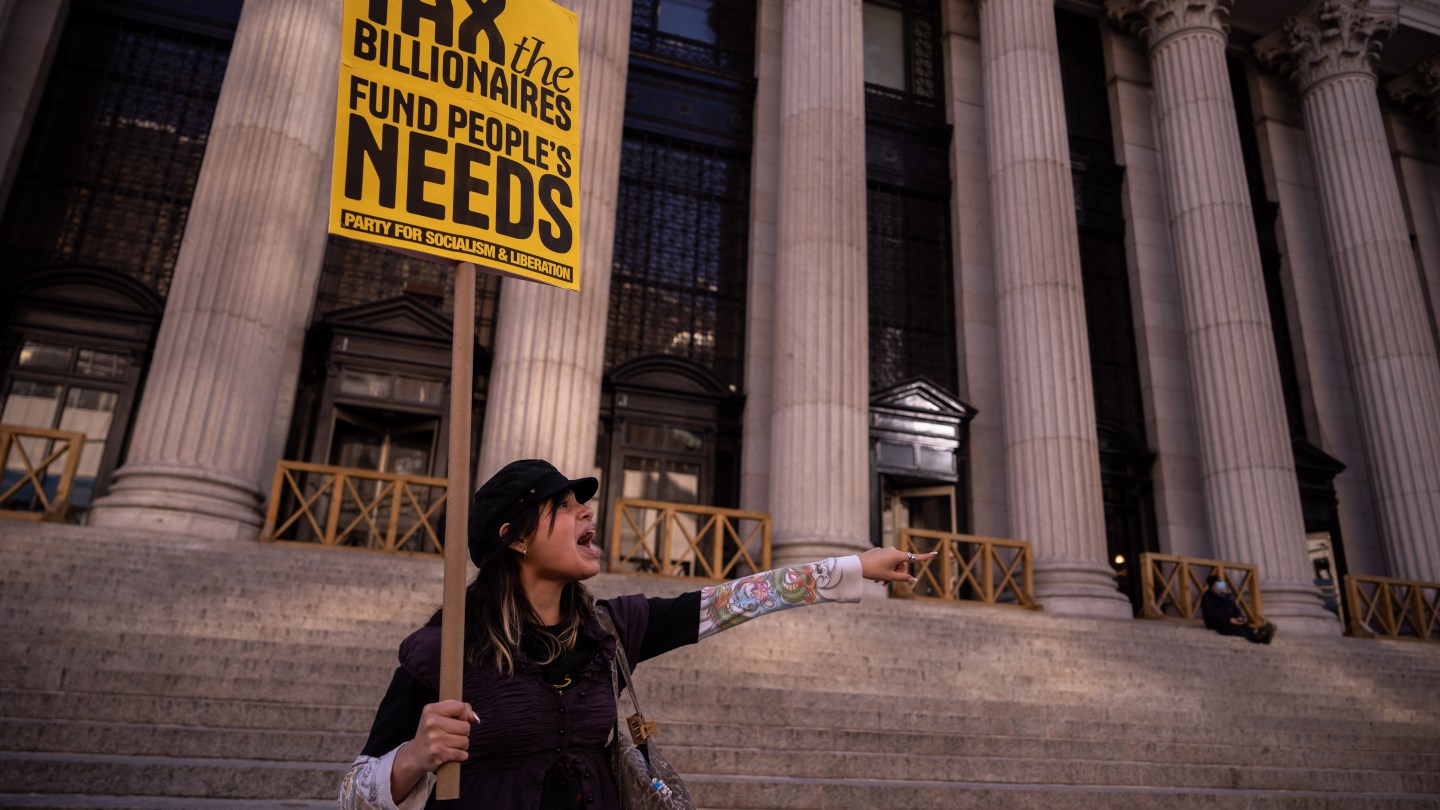
California’s proposed billionaire tax is heading toward defeat, striking a blow to the struggling Hollywood workers who stood to gain healthcare coverage from the measure and delivering a victory to its super-rich opponents. With about half the votes counted early Wednesday morning, the “no” vote held a commanding lead of nearly 13 points, or one million votes, making passage very unlikely. The ballot-measure fight was one of the costliest in state history. More than $350 million was poured into the billionaire tax battle, with opponents and allied campaigns accounting for over 96 percent of that figure. The national conversation on the initiative has transformed it into a referendum on the power controlled by a handful of the nation’s richest people, like Sergey Brin and Peter Thiel, who spent big bucks opposing the proposal. Hollywood largely stayed out of the fight despite what appears to be an increasingly urgent situation emerging in which workers across the industry are failing to qualify for union health insurance plans. “It’s hard out there right now,” says Cheyenne Jackson, known for his onscreen roles in several seasons of American Horror Story, 30 Rock and Glee. Last month, he launched One Job Away, a project meant to highlight actors in need of a few more gigs to meet the SAG-AFTRA annual minimum to get health insurance. He says he’s already received hundreds of inquiries from union members at risk of losing coverage. Under the initiative, a one-time five percent tax would’ve been imposed on the state’s 200-ish billionaires with net worths above $1 billion. It’s aimed at shoring up the state’s healthcare fund to offset federal cuts. That includes Medi-Cal and other coverage programs for low-income Californians, potentially providing a backstop for entertainment workers who lose employer- or union-sponsored insurance. Other possible beneficiaries of the tax: freelancers and other low-income workers, like grips, set decorators, costume designers, editors and production assistants, among others in the entertainment workforce who mostly get seasonal work. The measure could’ve helped preserve or expand the safety net for a large swath of Hollywood behind the camera. In recent years, actors have struggled to qualify for health insurance because of the sharp drop-off of scripted television series orders and productions opting to shoot in other countries amid industry cost-cutting. Actors on the SAG-AFTRA plan are increasingly having a tough time meeting quarterly deadlines to qualify by reaching $28,000 in earnings. In total, roughly 22% of workers in the arts, entertainment, recreation and accommodation industry were enrolled in Medi-Cal in 2023, according to a survey from the UC Berkeley Labor Center. The Motion Picture Television Fund has increasingly been providing financial assistance and services to industry members. In 2024, it helped more than 1,100 low-income or uninsured workers obtain health care coverage, including Medi-Cal and Covered California plans. “Everybody was silent on this,” says Ashley Craig, a volunteer for Patriotic Millionaires, a group that includes Disney scion Tim Disney among the ranks that supports the tax. “That’s the billion-dollar question,” Jackson says of Hollywood’s collective silence. “Some conversations need to happen.” For a workforce grappling with a growing health insurance gap, the prospect of new funding should’ve been appealing. California Gov. Gavin Newsom, however, emerged as one of the biggest opponents of the measure, arguing that the tax would drive California’s wealthiest residents and their businesses out of the state. Meta founder Mark Zuckerberg threatened to leave if the measure passed. Earlier this year, Steven Spielberg moved from California to New York, stirring speculation that he was trying to dodge the tax. He’s one of the few in Hollywood who could’ve been assessed the 5% levy since the measure takes into account intellectual property rights among the assets subject to valuation, and Spielberg has a cache of them. Other potential Hollywood payees include George Lucas, David Geffen and Oprah Winfrey. The political dynamics surrounding the tax laid bare Newsom’s recent intervention in California’s lawsuit to block Paramount’s $110 billion bid to acquire Warner Bros. Discovery. He played the role of unofficial mediator, inserting himself into negotiations to encourage a settlement. “I’m very mindful of what this means to the state — our reputation,” he said at a press appearance in August, adding that he took CEO David Ellison’s threat to move out of California “seriously.” The episode offered a window into the political leverage Ellison exercised for government approval of the takeover. Newsom’s opposition to Prop. 40 — and his endorsement of Prop. 42, a billionaire-backed measure headed for victory that would effectively prohibit many future wealth taxes — underscored his alignment with powerful figures who’ve been increasingly emboldened to exercise political clout. “Newsom really set the tone,” Craig says. This is part of The Hollywood Reporter’s ongoing midterm coverage. You can check out all of our pieces here.
Hollywood Sat Out the Billionaire-Tax Fight. Its Workers Could Pay the Price.
Full Article
Original Source
Read the full article at Hollywoodreporter →KhanList aggregates and links to publicly available news content. We do not host full articles from third-party sources. Always verify important information with original sources.