
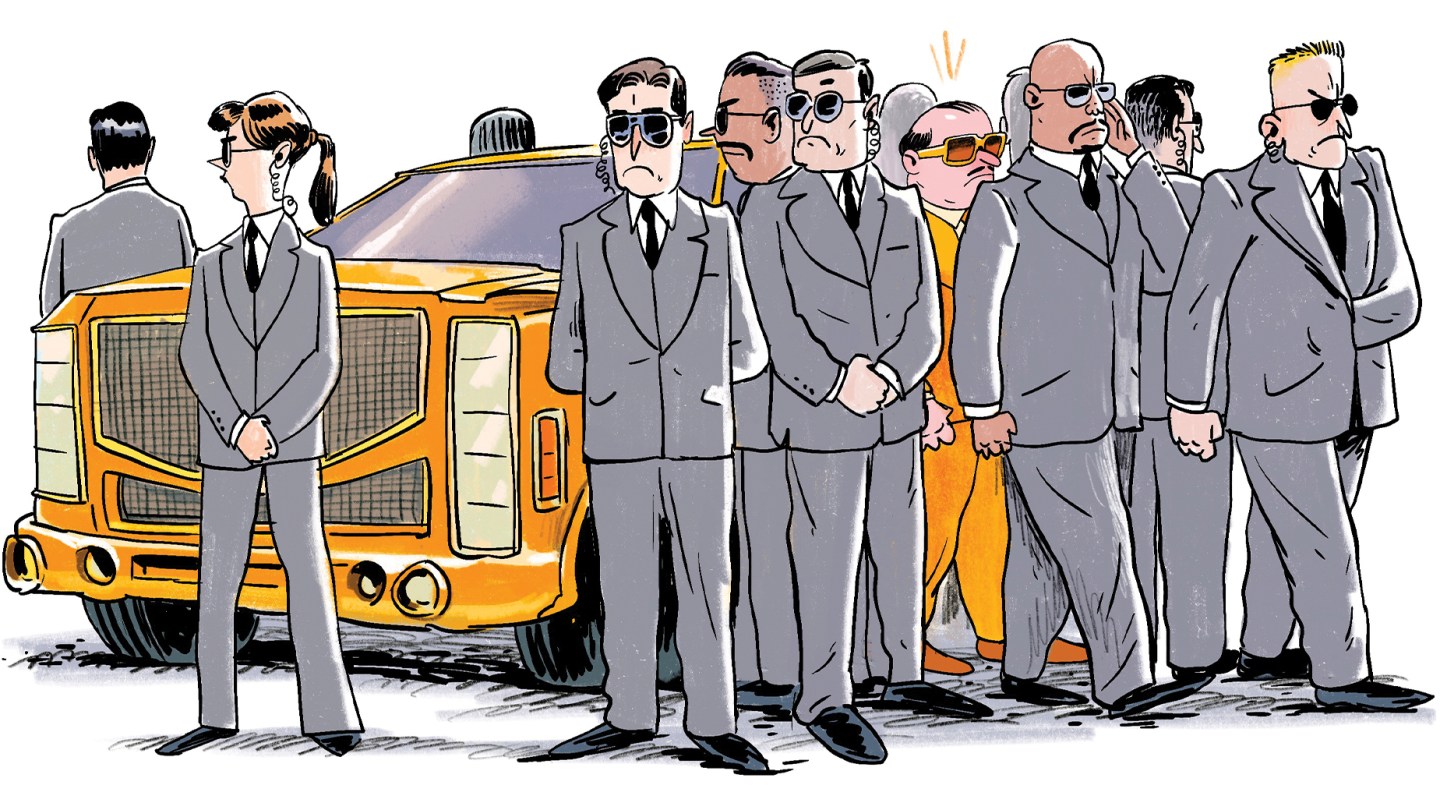
At 3:45 a.m. on April 10, a man approached the fence outside of OpenAI CEO Sam Altman’s home and threw an incendiary device over it. The homemade Molotov cocktail bounced off the house, and no one was hurt, but Altman, one of the highest-profile CEOs in America, was alarmed enough to write about the incident in a post later that morning, led by a photo featuring his husband and baby son. “Normally we try to be pretty private, but in this case I am sharing a photo in the hopes that it might dissuade the next person from throwing a Molotov cocktail at our house, no matter what they think about me,” he wrote, expounding on the role tech should play in society. The Altman incident was a highly public moment involving a mogul, but it’s not an isolated one. Multiple CEOs in the entertainment business have faced specific threats. By Oct. 31, 2025, documented physical and cyberattacks targeting senior corporate executives had already doubled the previous year’s total, per the Security Executive Council, a research firm. In fact, according to the security pros who spoke with The Hollywood Reporter, the threats facing corporate execs are at an all-time high. And companies in the entertainment, media and tech sectors are responding by spending substantially more on CEO security, by double — and in some cases triple — digits. At Disney and Netflix, which each spent $1.8 million on security last year, costs rose more than 30 percent. At Amazon ($1.7 million), it was more than 50 percent; at Warner Bros. Discovery ($3.2 million), it was more than 200 percent, all in service of keeping leadership safe during a challenging, disruptive time for big business, and in a moment when resentment against wealthy elites keeps mounting. “There’s a lot of anger directed at people leading these companies, and the threat vectors are coming from different places that we didn’t have, say, a decade ago,” says James Hamilton, the founder of consultancy Hamilton Security Group. Basic economics like inflation are a factor in the rise, however: “It’s not just one [thing]. There are a bunch of reasons why security costs are rising,” says Jeff Zisner, the president and CEO of AEGIS Security & Investigations, citing a more active travel schedule for CEOs post-COVID, among other factors. “In addition, I think there’s been more targeting of executives by disgruntled former employees, angry customers or people who are negatively affected by those companies. It has escalated after the New York shooting [of UnitedHealthcare executive Brian Thompson].” (On Aug. 14, Luigi Mangione pleaded guilty to killing the CEO in December 2024.) Indeed, the murder of Thompson was a turning point, “an event that significantly influenced public and corporate perceptions of executive-directed violence,” according to a report from The Security Executive Council. “For many executives, the event prompted reflection on their overall risk landscape and the potential vulnerabilities of their families and assets.” The most high-profile execs face more scrutiny. That is true for Meta’s Mark Zuckerberg ($22.5 million) and Elon Musk, who have security details that rival some world leaders, but it’s also true for media execs who oversee news organizations in a highly polarized world, where the cancellation of a TV show or the shelving of a movie can activate an online army of haters. Companies in the space acknowledged as much in corporate filings, with Fox noting in its explanation of security costs ($1.9 million) that “a core aspect of our business involves broadcasting extensive news coverage of elections, sociopolitical events and public controversies and related opinion programming, which sometimes produces strong reactions from viewers and critics.” Disney pointed out the “unique security risks” facing Bob Iger (who passed the CEO torch to Josh D’Amaro in March), while Fox and Meta noted how Lachlan Murdoch and Zuckerberg are “synonymous” with their respective companies. “We believe that Mr. Zuckerberg’s role puts him in a unique position: He is synonymous with Meta and, as a result, negative sentiment regarding our company is directly associated with, and often transferred to, Mr. Zuckerberg,” the company said in a proxy filing in April. “Fame is often a risk multiplier, requiring a different approach compared to protecting an executive with a limited public profile but operating in an industry with its own security risk factors,” says Sid Kosaraju, president at the risk management and security firm Crisis24. That is true even for execs that aren’t tech titans: WBD’s board wrote in a filing earlier this year that “the Committee authorized a security program for Mr. Zaslav to address safety concerns due to specific threats to his safety arising directly as a result of Mr. Zaslav’s high profile position as our CEO. We believe these security measures are for the benefit of the Company and our stockholders because of the importance of Mr. Zaslav and his leadership to WBD and we believe that the scope and costs of these security programs are appropriate and necessary.” Hamilton, the security expert, adds, “You can attribute anger at Mark [Zuckerberg] based on things Mark has done, okay, but then you have these individuals who are being threatened because of the position they occupy, which is the age-old ‘let’s blame the president for all the ills of America,’ Joe Biden or Trump can be blamed for a pothole that I just ran over because it’s convenient to blame the leader.” To be certain, the rise in security costs is not limited to media and tech companies. According to a Sept. 1 report from Institutional Shareholder Services, “the number of companies disclosing CEO security benefits … has more than doubled since 2021, though the practice remains relatively uncommon among smaller firms.” However, companies in the media, entertainment and tech space spend far more: ISS calculates the median value of CEO security costs at about $94,000 for companies in the S&P 500, but companies in media and tech spend millions on security, underscoring the risks they face. In fact, the disclosed numbers probably undersell the cost of security to these companies. They often don’t include a car and driver or corporate jet use, for example, each of which is considered part of the security program, with many corporate boards requiring CEOs to use them. Numerous companies also do not reveal how much they spend on security while an executive is on company property, like at a studio lot or office, or on a business trip for a conference or film shoot, for example. Instead, the disclosed costs typically reflect what it takes to secure executives outside of the office. The biggest driver, experts say, is people, like guards stationed outside homes or bodyguards who travel with the executive. “Protection, by its very nature, is an imposition into your private life,” says Hamilton, noting that the pool of highly qualified security personnel (think former Secret Service, FBI or military security) remains relatively small. But a security program will also include such physical elements as alarm systems, cameras and fences, maybe even drones or armored windows in a home. “The systems that you have for the offices and for the executives’ residences are generally more robust and more enterprise grade than you would otherwise see in a typical suburban home,” says Zisner. The programs may also feature software that scans the internet, social platforms and public databases for potential threats. For major companies and corporate boards, however, they are costs worth incurring. “I think companies are approaching these situations now largely like an insurance policy, where it’s not guaranteed nothing’s going to happen,” Zisner says. “Executive protection is an important part of business resilience, not a personal luxury,” adds Kosaraju. “If a CEO is incapacitated or otherwise compromised, that can have far-reaching, significant consequences. Boards are becoming increasingly attuned to this in their role of overseeing business continuity and enterprise value. Every dollar spent on a well-designed executive protection program is a dollar that reduces the probability of a materially larger impact.” But as sharp as the increase in cost for CEO security was in 2025, experts predict that it will only go up from here, as the threats get more complex and as the political landscape remains driven by outrage. For CEOs, being frequent topics of conversation on social platforms and cable news won’t help, and growing wealth inequality across the world may only exacerbate the problem. “This is going to be the reality for a long time, because the disparity in wealth is not getting more finite, it’s actually getting larger,” Hamilton adds. “Meaning the rich are getting a hell of a lot richer, and the poor are getting a hell of a lot poorer.” This story appeared in the Sept. 9 issue of The Hollywood Reporter magazine. Click here to subscribe.
Hollywood CEOs Are Spending Millions On Bodyguards As Threats Soar
Full Article
Original Source
Read the full article at Hollywoodreporter →KhanList aggregates and links to publicly available news content. We do not host full articles from third-party sources. Always verify important information with original sources.