
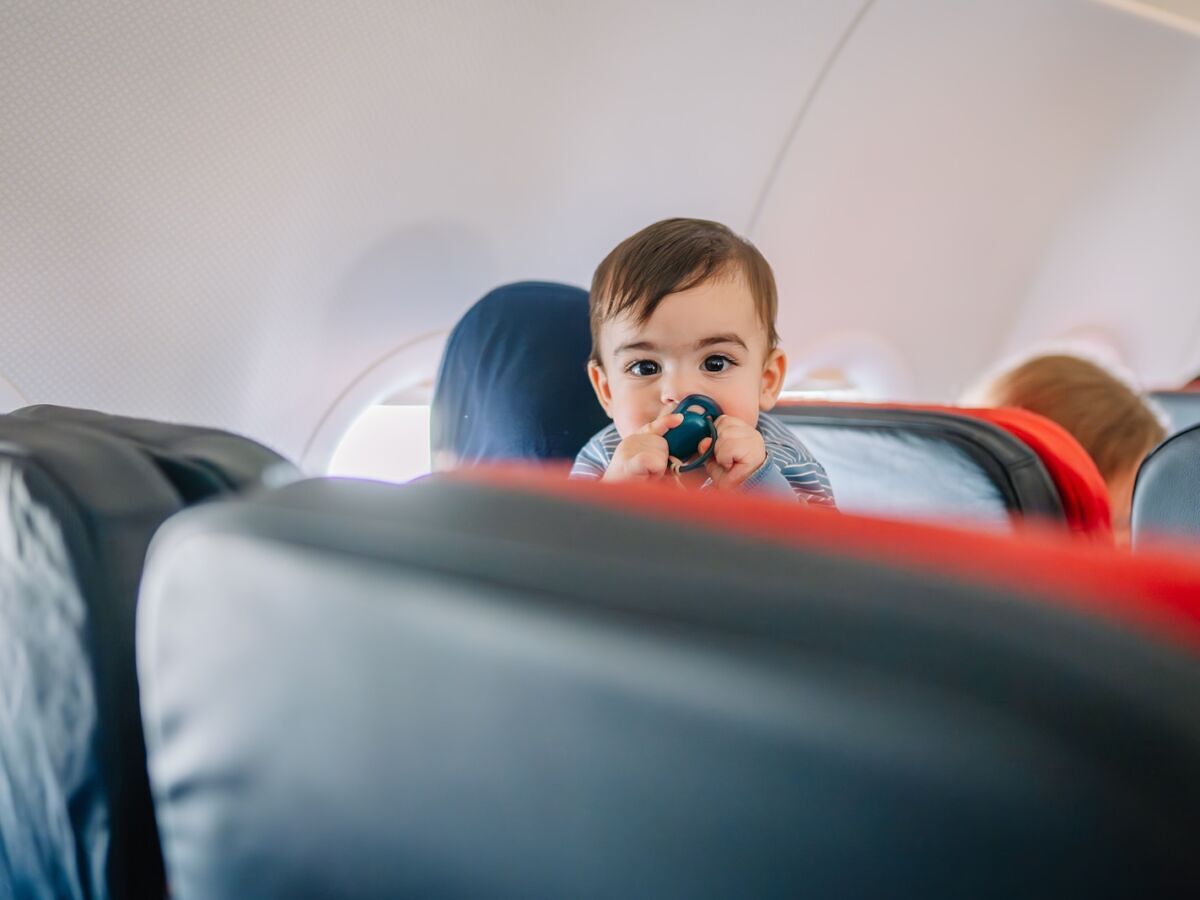
A new survey from point.me, a platform for finding flights using loyalty points, looked at how frequent flyers handle the friction that comes with a packed flight. The company’s 2026 airplane etiquette survey talked to 2,018 travelers, more than half of whom reported flying at least five times a year. Other similar surveys have found that seat-kicking is the single most annoying in-flight behavior, but the point.me survey asked a slightly different question: not what bothers frequent flyers, but what they’ll actually speak up about. Crying babies get a pass Parents dreading how their fellow passengers will respond to their crying infant can relax a little: only 2.3 percent of respondents said they would speak up about a crying baby — perhaps because everyone understands there’s very little to be done about it. Older kids are another matter, however. More than 80 percent of people said they would speak up about an older child kicking their seat, making it the most likely behavior on the list to get a reaction. More than half (55.5 percent) would speak up about someone playing audio without headphones, and 45.8 percent would say something to a neighbor taking over their already limited legroom. Men said they were more willing to confront fellow passengers across the board. More than 85 percent of men would address a seat-kicker, compared to just 73.9 percent of women. About 60 percent of men said they would call out audio played without headphones, compared with 50.7 percent of women. Men were also more likely to step in if someone was rude to a flight attendant, at 34.7 percent versus 26.4 percent of women. The worst seat isn’t the middle The window-versus-aisle debate has a gender split, too. Women were split almost evenly between the window (35.1 percent) and the aisle (34.8 percent), while men clearly favored the aisle (41.8 percent). Gen Z was the only age group that preferred the window on the whole, with 45 percent opting for it. But the dreaded middle seat actually wasn’t chosen as the least-favorite option. That honor went to the seat next to the bathrooms, with 41.9 percent saying it was their least favorite. The next worst seat was the middle, but not just any middle: 38.1 percent said their least favorite is the middle seat of a wide-body plane’s middle row of five. Seat swaps come with conditions Thanksgiving flights are full of families trying to sit together, but the survey showed getting someone to swap seats isn’t a guarantee. The most popular reason people gave for agreeing to change seats was that the new one was in a better location (57.5 percent of respondents). A generous 57.2 percent said they’d agree to swap simply to help a parent sit with a young child. After that, goodwill dropped off. Only 33.4 percent said they would swap so a family could sit together, and fewer (28.5 percent) would do it to allow a couple to sit together. Another 12.1 percent said it’s never acceptable to ask a stranger to swap seats. The takeaway for families traveling together, especially during busy travel days, is to spend the extra money to book seats together rather than counting on the kindness of a stranger at the gate. Younger flyers avoid the call button Sixty-two percent of respondents said they use the call button to get a flight attendant’s attention. But younger travelers were far more likely to avoid asking for help at all. Among survey participants under age 40, 18.9 percent said they’d rather not ask for anything, though that applied to just 8.5 percent of people over age 46. Women were also more likely to avoid asking flight attendants for help at all, at 13.4 percent versus 8.6 percent. The carry-on problem When asked about the most frustrating in-flight scenarios they may encounter while traveling, 43.5 percent said it would be having to carry their carry-on bag 20 rows behind their seat to find storage space. A messy airplane bathroom came in second at 23.3 percent, followed by a broken seatback entertainment screen (18 percent) and a flight without Wi-Fi (7.1 percent). More like this
Holiday Flyers Will Forgive a Crying Baby — But Not Kids Who Do This
Full Article
Original Source
Read the full article at Matadornetwork →KhanList aggregates and links to publicly available news content. We do not host full articles from third-party sources. Always verify important information with original sources.