
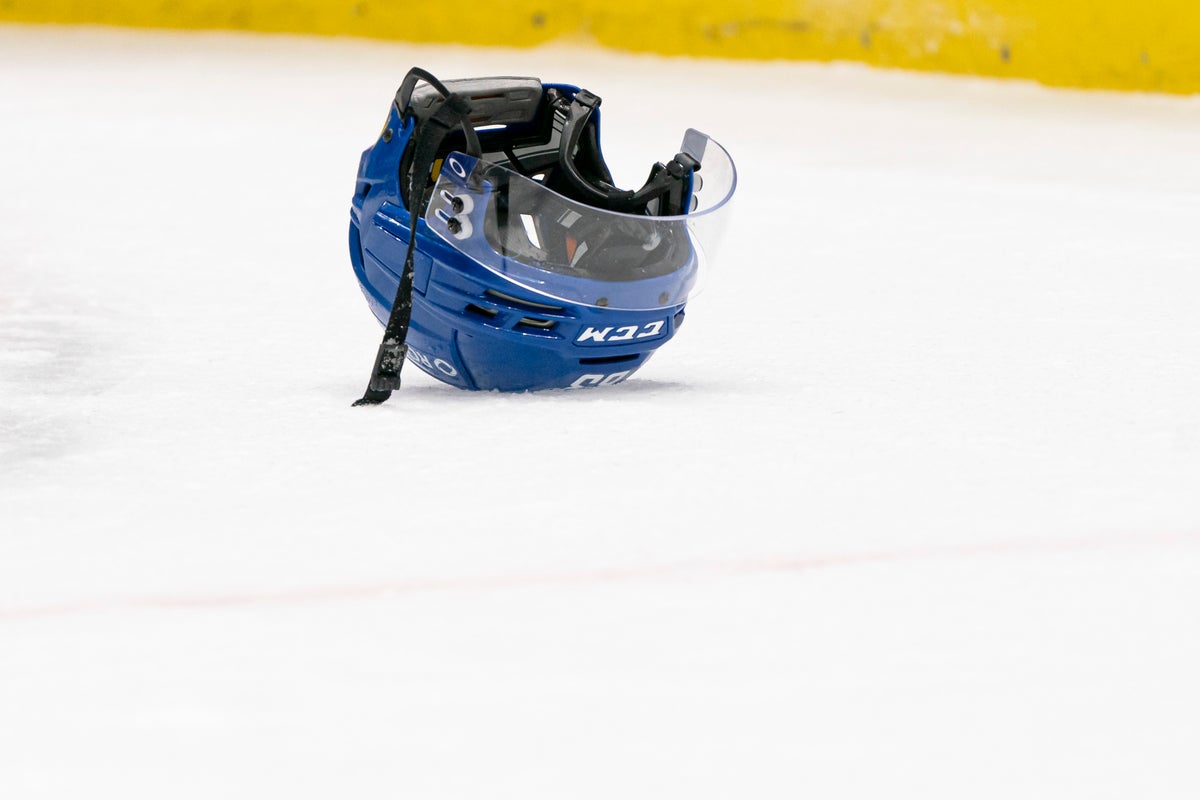
In St. Paul, Minnesota, Kelly Rand’s twin teenage sons are going through constant growth spurts, forcing their family to buy replacement hockey equipment almost constantly.The financial strain is obvious: a goaltender's helmet that ran $400 in 2022 now sells for $1,000, while a chest protector purchased a year ago for $465 currently costs $900.For a sport where families already face mounting costs for ice time, gear, travel, and coaching, the recent 50% tariffs imposed by President Donald Trump's administration on Canadian goods present an unwelcome added burden, threatening to push prices even higher.A Vancouver Canucks helmet lays on the ice during NHL hockey action against the Calgary Flames at Rogers Arena (Getty)"If a kid on the ice breaks a stick, every other parent is looking at that mom or dad going, ‘Ahhh oh, no!’" Rand said. "You feel for them. How many $400 sticks can you afford in one season?"Hockey sticks and skates feature among more than 550 items hit by the White House tariffs. According to John Merola, e-commerce director at B&R Sports, custom goalie gear and specialized skates made in Canada by companies such as True Hockey fall directly under these trade rules.Merola noted that standard sticks now average $200, with top-tier models reaching up to $400. He added that major brands including Bauer, CCM, and True continue to manufacture a significant portion of their custom lines in Canada.A truck crosses into the United States on the Gordie Howe International Bridge, connecting Windsor, Ontario, and Detroit, Michigan (AFP/Getty)"This not a minor blip by by any means," Sports & Fitness Industry Association CEO Todd Smith said. "Even if manufacturers have moved over the last several years from Canada to other countries, there’s still healthy amount being manufactured in Canada and, yeah, this 50% tariff is a big deal."When Rand’s family bought a complete custom goalie package a few years ago, the setup cost $3,300. Historical data from HockeySkates DB shows that skate prices, which ranged between $80 and $900 in 2016, now span from $200 up to $1,230.Widespread inflation and tariffs applied to other trading partners have driven up gear costs in recent years. A sales report from the Sports & Fitness Industry Association indicates that US spending on hockey equipment surged 45.4% from 2020 to 2025, rising from $228.9 million to $332.9 million alongside rising participation.Data from the U.S. International Trade Commission, which combines ice and field hockey products, shows Canadian imports made up approximately 8.5% of total equipment imports last year. That puts Canada fourth behind China (52.7%), Vietnam (13.2%), and Thailand (9.5%). Mark Carney and Donald Trump at the G7. The Canadian PM has imposed ‘dollar for dollar’ retaliatory tariffs after the U.S. president launched new levies against his northern neighbor (Reuters)Of the 2.1 million sticks imported last year, over 1.5 million (74.1%) came from China and 268,000 (12.8%) from Mexico, compared with 18,909 (0.9%) from Canada.Chris Douglas, an economics professor at the University of Michigan-Flint, considers an immediate 50% jump in stick prices across the board unlikely given Canada's small market share, but he cautions that price pressure could build if demand shifts."Maybe that causes the price of hockey sticks to rise somewhat — maybe by $50 or something like that," Douglas said. "Hockey is expensive with the equipment, ice time and so forth, so maybe there’s a family right on the margin where $50 or $100 in additional cost causes them not to enroll their kids at hockey any longer."Daryl Watts #95 of Team Canada skates with the puck through a stick check by Sanni Rantala #7 of Team Finland in the third period during the Women's Preliminary Group A match between Finland and Canada on day six of the Milano Cortina 2026 Winter Olympic games at Milano Rho Ice Hockey Arena (Getty)Reflecting on previous trade actions against China, Merola noted those tariffs had a broader commercial effect, though the impact was not immediate."Bauer, CCM — the big, heavy hitters in the market — came in and said: ‘We’ll absorb these costs. Don’t worry about it,’" Merola said. "And then as nothing happened, they kind of came back and said, ‘We can’t cover this, so we’re gonna have to increase pricing.’"A similar wait-and-see strategy could take place now, delaying how soon manufacturers and retailers pass costs along to consumers. Canadian Prime Minister Mark Carney said trade negotiations could resume if Washington shows a serious interest in discussions.The Ottawa Senators celebrate after a 5-2 win as the Toronto Maple Leafs skate off the ice at Scotiabank Arena (Getty)Douglas noted that much depends on how long businesses expect the duties to remain in force."It’s hard to form expectations of the current tariff regime where tariffs are changing basically every day, it seems like," Douglas said. "But if there’s an expectation that tariffs are going to be permanent or at least in place for the long term, then I think prices rise pretty instantaneously because the cost of production has risen and that gets passed on to consumers via a higher price."Merola believes persistent tariffs will prompt brands to shift further production to the US, Asia, or other regions. However, Roustan Hockey—the last major stick producer operating in Canada—reaffirmed last week that it intends to maintain domestic manufacturing."We remain committed to our employees, our customers and our manufacturing operations here in Canada," founder W. Graeme Roustan said in a statement after hosting federal minister Evan Solomon for a tour of the facility in Brantford, Ontario.The Sports & Fitness Industry Association is calling for an end to the tariffs, highlighting a 7% rise in US hockey participation over the past three years driven by events like the 4 Nations Face-Off and the Winter Olympics.While acknowledging that the National Hockey League, USA Hockey, and local teams provide free equipment and ice time through learn-to-play initiatives, Smith remains concerned about the long-term impact of trade duties."This has, obviously, the potential to really stunt that growth," he said. "It couldn’t be a worse time for tariffs to hit in terms of really having the having the possibility to increase costs."
Hockey parents already pay $400 for sticks. Trump’s tariffs could make it worse
Full Article
Original Source
Read the full article at Independent →KhanList aggregates and links to publicly available news content. We do not host full articles from third-party sources. Always verify important information with original sources.