
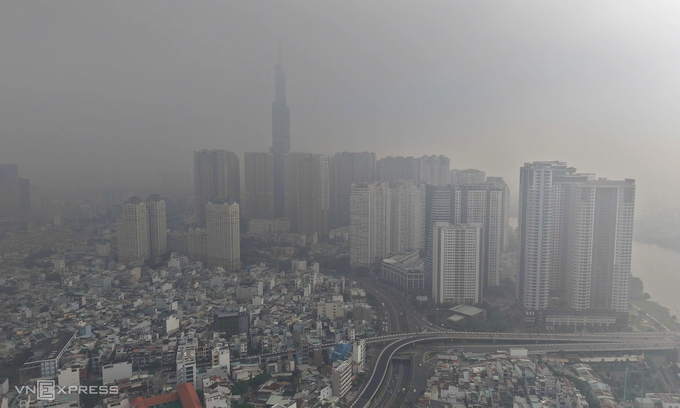
Ho Chi Minh City aims to achieve "good" or "moderate" air quality on 80% of days annually by 2030, alongside a steady reduction in fine particulate matter. An ambitious air quality management plan approved by the municipal People’s Committee last week sets an even higher benchmark for 2045, targeting "good" air quality every day of the year. Municipal data links the city's air pollution primarily to dust along major traffic corridors, seaports, industrial zones, and mining areas. Road traffic remains the leading culprit, closely followed by industrial emissions. Recent measurements highlight the severity of the issue. In 2025, PM2.5 concentrations spiked between 1.1 and 4.6 times above regulatory limits at specific times and locations. The Cat Lai port area proved particularly hazardous. Between 2021 and 2025, 84% of total suspended particulate measurements recorded in the port zone exceeded legal standards. To combat this, city officials will enforce stricter car and motorcycle emission standards based on a new national roadmap. HCMC plans to establish low-emission zones and systematically restrict vehicles that fail to meet these tighter requirements. The shift toward clean energy vehicles will begin with commercial fleets, prioritizing buses, taxis, and trucks before expanding to private transport. By 2030, the city intends for its entire public transportation network to operate on environmentally friendly energy. To support this transition, the Department of Construction is drafting policies to encourage the replacement of aging motorcycles. The department will also outline fee exemptions and reductions to incentivize students to use public transit. Construction sites will face rigorous new dust-control mandates. Contractors must install protective barriers, securely cover all building materials and waste, and wash the wheels of vehicles entering and exiting sites. The city itself will increase vacuum sweeping and road washing operations. Officials also plan to pilot mist-spraying systems to suppress airborne dust and will expand urban tree-planting initiatives. Heavy polluters, including cement plants, thermal power stations, steel mills, and industrial boilers, will be subjected to strict oversight designed to systematically lower their emissions. Alongside these physical interventions, HCMC is upgrading its monitoring, forecasting, and alert networks. The ultimate goal is to ensure 95% of residents can easily access real-time air quality updates through the city's digital platforms.
Ho Chi Minh City targets 80% of days with 'good' or 'moderate' air quality by 2030
Full Article
Original Source
Read the full article at E →KhanList aggregates and links to publicly available news content. We do not host full articles from third-party sources. Always verify important information with original sources.