
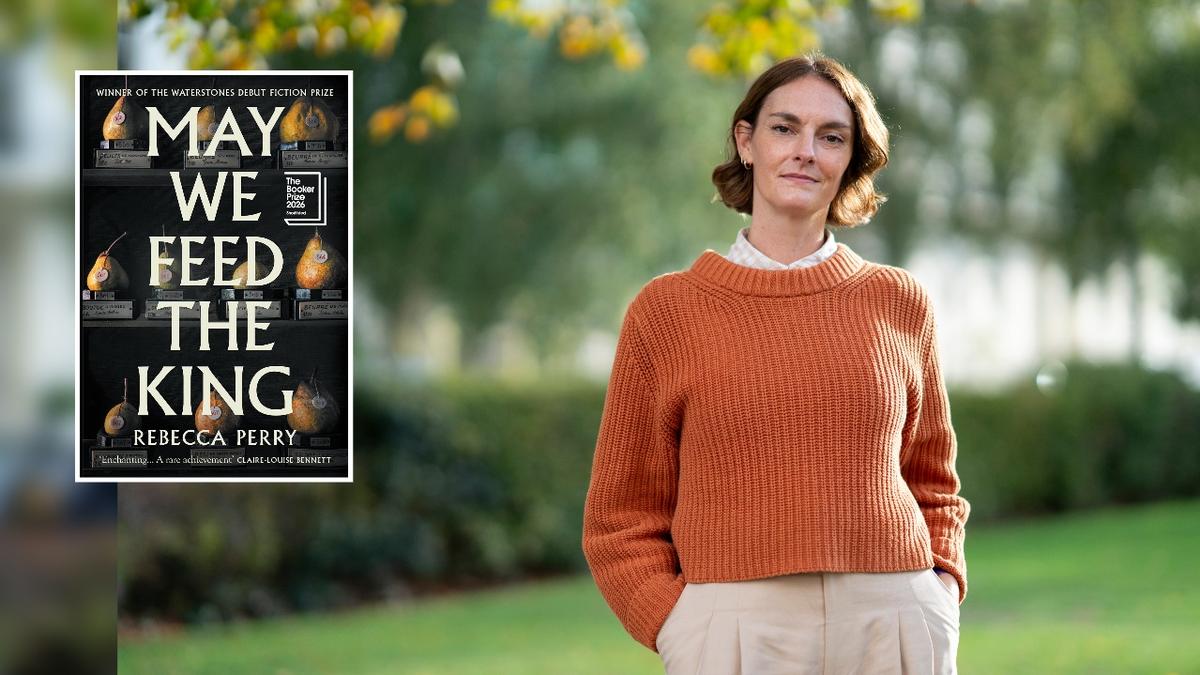
London-based poet Rebecca Perry is the only debut novelist on this year’s Booker Prize shortlist. | Photo Credit: Getty Images “Teasing out life in a dead space, though possible, is akin to making an animal from a folded paper napkin.”There is something deceptive about mistaking a folded napkin for an animal. And yet, in a world inundated by ‘constructed realities’, the greater challenge may be holding on to the capacity to believe. London-based poet Rebecca Perry, the only debut novelist on this year’s Booker Prize shortlist, compels us to do that with May We Feed the King (Granta Books).A genre-bending novel that Perry initially imagined as a “long poem”, even before writing a word of it, the book brings together an unlikely pair: a modern-day curator intent on recreating historical banquets through painstakingly sourced replica food, and a reluctant king who is watched at all hours of the day, powerless despite his position at the apex of a medieval kingdom. Perry creates a plot, and still inscribes gaps between what is seen and what is believed, what is staged and what is real. Here, the art of creation and curation, the limits of historical fiction, and the curious possibilities of making life out of a dead space come into view. Edited excerpts from a conversation with the author:How does it feel to write a book about artifice, and have that piece of artifice change your reality? I wanted the book to be upfront about the artifice of writing and examine how we piece together history. Now, experiencing the artifice around a prize, everything feels curated, and people’s responses are fascinating. Ever since the Booker announcement, it has felt like a big performance. I wrote this book without a publisher or any idea if it would ever be published. Coming from poetry, where not that many people read your work, writing felt private and intimate. After its release, things were fairly calm. I enjoyed it being a weird little book that booksellers recommended and people occasionally heard about. Then everything changed within a week. I’m grateful I had that experience, which I think most debut novelists have: writing and seeing what happens without knowing what’s waiting around the corner. You wrote this book in the bath with snacks and your cat Patsy. How did those material conditions help you in creating the mind space for this unusual book? It is one of my favourite physical states to be in. I like how it contains you. You can’t get up and walk away every five minutes, which I would do if I was sitting at a desk. It was a practical decision to stay in one place for two hours and focus. Being in the bath, with a lovely setup and my cat, was very calming. I’d look out over my garden and think about being in this space where you’re in the air, you’re in the real world, and then your body is also in the water, distorted and existing in a different state. On the spectrum of artifice and reality, where would you place history? Oh, that’s a very big question. I think of history as an incredibly sparse scaffold, mainly consisting of dates. And then basically everything else around that is where all the actual stuff happens, which we have no way of knowing, but we receive it as true. Someone probably wrote or recorded it, and people have perpetuated it over the years. Everything else is completely unknowable. We just create it. It’s surely mostly artifice. It has to be. How did you go about researching the book that reads like history but doesn’t even share the characters’ names? I didn’t do research in a traditional sense. I thought about two things a lot. One was that realisation you have when you’re quite young at school, when they give you two accounts of the same event written by two different people. And you realise everybody has an agenda, and everyone is telling their story for a reason. And you can’t really trust any of it. I also remember being taught a classic: a few lessons on the British Empire. I remember one map of the world on the left with all the territories we owned, and another on the right with fewer territories, but later. It was taught as a golden era versus our ‘downfall’. Even then, I thought this was the greatest spin. Looking back now, I can’t quite believe that was casually taught with no context or accountability. But I didn’t read about any kings because I didn’t want to be influenced. What I read were records of recipes and stock-takes from medieval kitchens — stuff that would be hard to imagine as propaganda. I also visited different historic buildings and stood in rooms that were staged to figure out what it was like to work there. The novel mirrors the anxieties of our times: history being politicised, our lives constantly contrived to look a certain way for social media, and then feeling a gaze that seems to have detached us from our place in the world. Did that strike you as you were writing? It’s hard for me to remember exactly when my preoccupations of the book presented themselves. With the curator, I wanted to explore storytelling, the reliability/unreliability of historical narratives, and what we’ve been told. I was also thinking about imagination, loneliness and devotion. With the King, I knew he’d be incredibly reluctant and a pacifist. But as I was writing the book, I realised the two stories existed together. One day, my whole feed was full of awful things that Netanyahu and Trump and Putin were doing. And the King was written in the shadows of such awful, totalitarian leaders. I probably had an idea of a novel existing in this pure way in my brain, but that isn’t true at all. The world started to seep into it. I think it’s impossible to imagine anyone writing a book about somebody who is watched all the time without thinking about those things. The interviewer is an independent journalist with bylines in Indian and international publications. Published - November 10, 2026 06:34 am IST
History is ‘mostly artifice’: Rebecca Perry, author of Booker-shortlisted ‘May We Feed the King’
Full Article
Original Source
Read the full article at Thehindu →KhanList aggregates and links to publicly available news content. We do not host full articles from third-party sources. Always verify important information with original sources.