
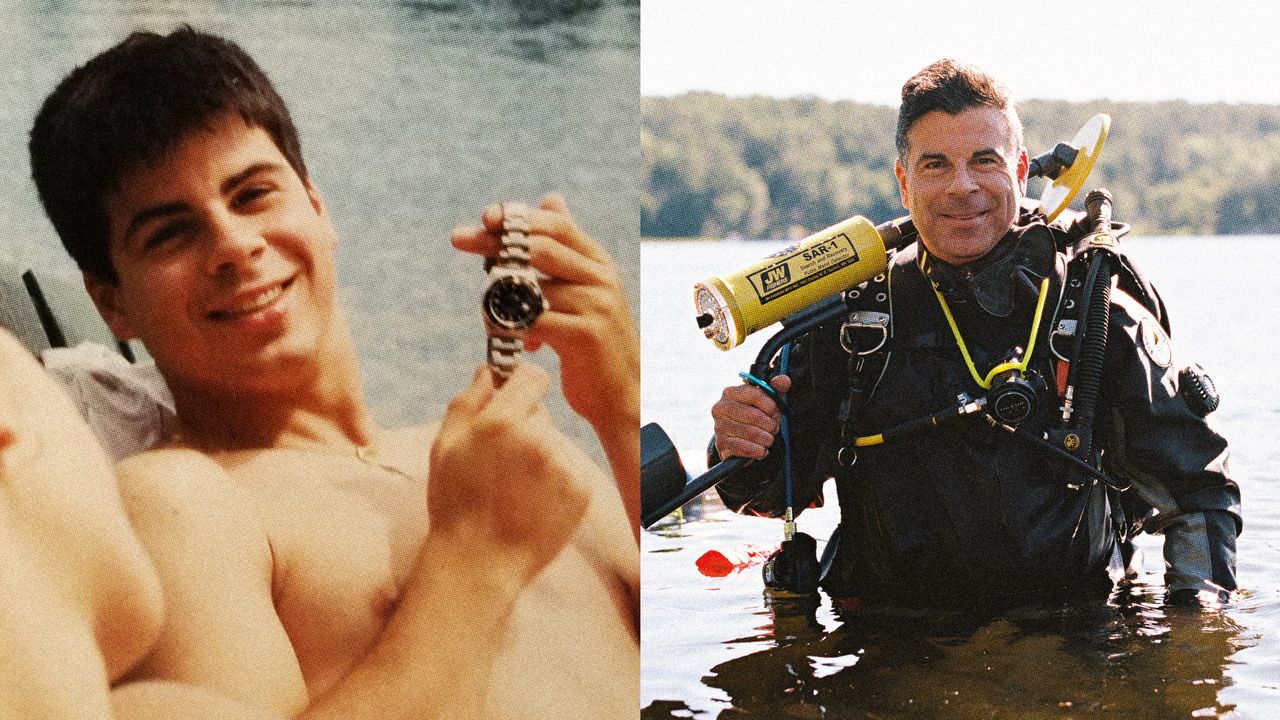
Nestled off a short dirt road in the Adirondack Mountains, just beyond the reach of cellular service, lies Trout Lake. Overlooking the water is a cabin owned by 48-year-old Hollywood stuntman Tom Place, something of a local legend, known more in this small Upstate New York community for his weekend recreational activities than his formidable IMDb credits he’s racked up as a Hollywood stuntman. Because for many years now, Place has been routinely diving beneath the lake’s surface in search of something he lost more than three decades ago: his Rolex Submariner.While at the cabin, Place often runs the six-mile perimeter of the lake in the early morning hours. Tom’s family has spent summers in the area since 1979, and built their own cabin in 1991. When he first broke into the film and television industry in the ’90s, Place, who maintains an athletic, sturdy build, noticed that the old heads would get winded pretty easily, especially during fight scenes. Now that he's an old head himself, he's determined not to suffer the same fate. The work is grueling on the body, the days are long, and there’s a genuine element of danger. Place has been a gun-toting henchman, a motion-capture carjacker, a precision driver, a New York City cop, whatever the script calls for. But on his days off, you’re most likely to find him with a SCUBA tank strapped to his back, as he plunges below the depths in search of the one that got away—his grail watch in the truest sense of the term.Austin RogersRolex watches were something of a Place family tradition. In the late 1970s, after serving in the Vietnam War, Place’s father found success as a commodity trader at the Cotton Exchange headquartered at #4 World Trade Center and bought a pair of matching Rolex watches for himself and his wife. “Those were basically their only watches for the next 20 years,” Place recounts. “That’s what I grew up seeing on their wrists.” The watches rarely came off, Place continues, “whether he was doing oil changes on the car or painting the shed. SCUBA diving even, he always had that DateJust on.” In 1996, Place followed suit, cashing in his life savings of $3,100 at a Mayor's Jewelers in Brandon, Florida, on a 16610 Rolex Submariner Date, an 18th-birthday gift to himself. He’d chosen it over a more affordable Tudor Submariner—only $990 at the time!—and a 16710 GMT-Master II with the signature red-and-black “Coke” bezel. He picked the watch for its hardwearing nature, a quality that would become indispensable in his future line of work.That same summer, Place and his brother regularly took his family’s 17-foot speedboat, dubbed the Calypso 2000, out for an activity they’d invented called “power jumping.” It’s the sort of thing only an 18-year-old future stuntman would come up with: the pair would take turns sprinting full-out across the cramped deck of the boat, before flipping, rolling, diving, or otherwise flopping into the lake below. And on this fateful occasion, Place was wearing the Submariner he’d drained his savings account for mere months prior. “My wet foot slipped on the wet boat,” he recalls now. “As I fell backwards and sideways, my Submariner caught somewhere on the railing. I still don’t know exactly where or how it happened, but the clasp got caught and pulled.” Place suspects the small spring bar within the clasp failed, releasing the watch from around his wrist. While he fell in one direction, Place says, “I could see the watch flying the other way into the lake.”Austin RogersPlace dove into the water after the watch, but immediate rescue efforts were futile; the lake was murky and more than 80 feet down at its deepest, with underwater vegetation in full bloom. Place had spent his formative years pining after the Rolex, like the DateJust worn by his father, only to have his Submariner disappear in a flash. “I felt horrible,” he says. “It was my life savings.” Returning to shore, a neighbor offered up an industrial magnet for an impromptu search. “It probably weighed 15 to 20 pounds—bigger than a softball,” he says. Place spent a couple of hours a day dragging the magnet across the bottom of the lake, tied to the end of a rope. He’d pull it up periodically to “get all the weeds off, the iron filings, the muck,” he says, before dropping it back down for another pass. “After hours and hours over the course of a week, I finally realized I was never going to find it.”The mural featuring Place's lost Submariner in the bottom-left corner News of his endless search has spread through the surrounding area over the decades. In the many summers since, Place has gotten countless hopeful inquiries from neighbors asking if he’d found the watch. A few years ago, in fact, when a young couple from the area got married, they commemorated their nuptials with a charcoal illustration of the lake, and right there in the drawing, hidden in the reeds, is Place’s Rolex.For around two decades, Place mostly moved on with his life. In the immediate aftermath, he sent an email to Rolex to suggest the brand beef up the spring bar, the small piece that fixes the bracelet to the watch. They offered him a discount on a new watch, and he landed on the GMT-Master II he’d previously considered. He left the Submariner in the past. “I’m never going to find it,” he told himself. “It’s in the muck.” Place went on to roles you’ve almost certainly encountered, even if you didn’t know it was him. As a stuntman and stunt coordinator, he's been involved in everything from Indiana Jones and the Kingdom of the Crystal Skull and The Dark Knight Rises to The Devil Wears Prada II and Mr. Robot.But if you're plugged into the right corners of the watch internet, you may also know him from his Instagram, @Expedition16610, where for the last six years he’s chronicled his dives for his missing Submariner. In 2020, Place found himself with some unexpected free time while his industry navigated the COVID-19 pandemic. “I had six months basically off,” he says, “and I was really able to launch the expedition in earnest.” Having spent the previous summer fixing up the family boat, adding a new, slightly-too-large outboard motor, and experimenting with a metal detector close to shore, Place decided to resume the search for his missing Submariner, setting up an Instagram account to keep friends, family, and neighbors up to speed with his new lockdown pastime. “That’s when I started diving and haven’t stopped since.” Once again on the hunt, this time with the help of 21st-century tech, Place reboarded the Calypso 2000 with SCUBA gear and an underwater metal detector. He has since logged approximately 60 hours of bottom time at the lake.Austin RogersThe process starts by placing a homemade marker at the center of his search site. The markers are made by carving a football-shaped foam buoy into disks about one-inch thick, labeling them with the date, and tying it off to something heavy like a fragment of cinderblock. The marker acts as the center of a bullseye from which Place will spend the next 45 minutes methodically probing the rocks, weeds, and silt with the metal detector, clearing a roughly six-foot radius from the center before returning to the surface. It’s slow, physically taxing, and risky, not unlike Place’s nine-to-five. Over his various dives, Place has found heavy-gauge aluminum beer cans from the ’70s and ’80s, discarded tires, and fishing hooks. Once, he even became ensnared in an anchor line that was, presumably, cut years earlier. At first, Place was concerned he’d encountered a sea monster but, after regaining his composure, cut himself free from the line using a hefty dive knife worn around his leg. The anchor is now mounted just outside the cabin garage like a hunting trophy.The expedition pauses each year during the winter months, and I joined Place for his first dive of 2026 in mid-June. We met over burgers and Buffalo wings the night before, talking watches, movies, and recounting the lore of his lost Submariner. “Once the weather’s cooperative, I can’t wait to get in the water,” he explains. I bunked in a spare room at his cabin and agreed to reconvene first thing in the morning for the inaugural dive. After brewing us coffee, Place carefully loaded the Calypso 2000 with dive gear and headed out towards a handful of rocks cresting the surface near the center of the lake. It’s impossible to say exactly where the watch was lost 30 years ago, but Place knows it’s somewhere in this general vicinity. After dropping anchor, Place clipped a mesh bag to the line and sent it to the bottom as a place to stash any findings. He also included a slate—a plastic tablet and pencil divers can use to communicate and take notes underwater. Then, he threw a leg overboard before sliding into the water below, a homemade search marker in hand. Roughly 14 feet down, Place began his search for the day.Despite an air temperature in the 50s, the water was surprisingly tolerable, thanks to the protection afforded by a drysuit and the relatively shallow operating depth. Unlike a garden-variety recreational dive, Place stood on the floor of the lake in his drysuit boots, a technique more akin to commercial diving. This gave him easy access to the rocky ground below, but the heavy footwear kicked up silt that clouded his vision. Place worked in silence, punctuated only by calm, steady exhales, and the cascade of bubbles they released. He could barely see further than the end of the metal detector as he swept the instrument in front of himself. Every once in a while, a wave of the device over a pile of rocks elicited a response and further investigation. Returning 360 degrees to where the search started, Place gave a thumbs-up to indicate his intent to return to the surface before slowly ascending.At the surface, Place inflated his BCD, a piece of kit that allows divers to control their buoyancy, and drysuit before doffing his gear. Despite being the expedition's de facto dive boat and despite being named after Cousteau's research vessel, the Calypso 2000 is not set up for the comings and goings of divers in drysuits and 50-plus pounds of gear. Place clipped his floating dive gear to a padeye on the stern of the boat so it wouldn’t drift away while he stepped onto the small lip of the outboard motor, pulling himself back on board.Courtesy of Tom PlacePlace’s search is up against tall odds. Over the course of each 45-minute dive, roughly 100 square feet of ground is covered. Even after more than 50 dives, an approximately six-mile-circumference lake leaves many stones unturned. This sort of Swiss-cheese approach relies on luck as much as skill. Nevertheless, Place remains optimistic. “I feel like I can find it,” he says. “If I can find a rusted-out small piece of a fish hook with the metal detector, I can find a big stainless steel watch. I know it’s down there, I know I can find it, and I’ve covered this much ground. How could I give up now?”Place knows in his heart that the Submariner is down there somewhere, waiting for him to find it. “I feel like I have unfinished business. I’m determined to one day have that watch back on my wrist.” That’s the magic of a watch: even if it’s crusted over with 30 years of grime, it may still be there, and may still be salvageable. And with it, the vessel that Place once poured not only his life savings but also his ambitions. The watch represented the fulfillment of his teenage dreams and should have served as an eager partner in crime throughout his career.Dive gear now collected and stowed, Place raised the anchor before making his way back to the dock. Soon, he'll be back in his magic mushroom-colored Ineos Grenadier for the drive home. As has become tradition, the stereo will be playing U2’s “I Still Haven’t Found What I’m Looking For.”
His Rolex Submariner Fell Into a Lake 30 Years Ago. He’s Still Diving For It
Full Article
Original Source
Read the full article at Gq →KhanList aggregates and links to publicly available news content. We do not host full articles from third-party sources. Always verify important information with original sources.