
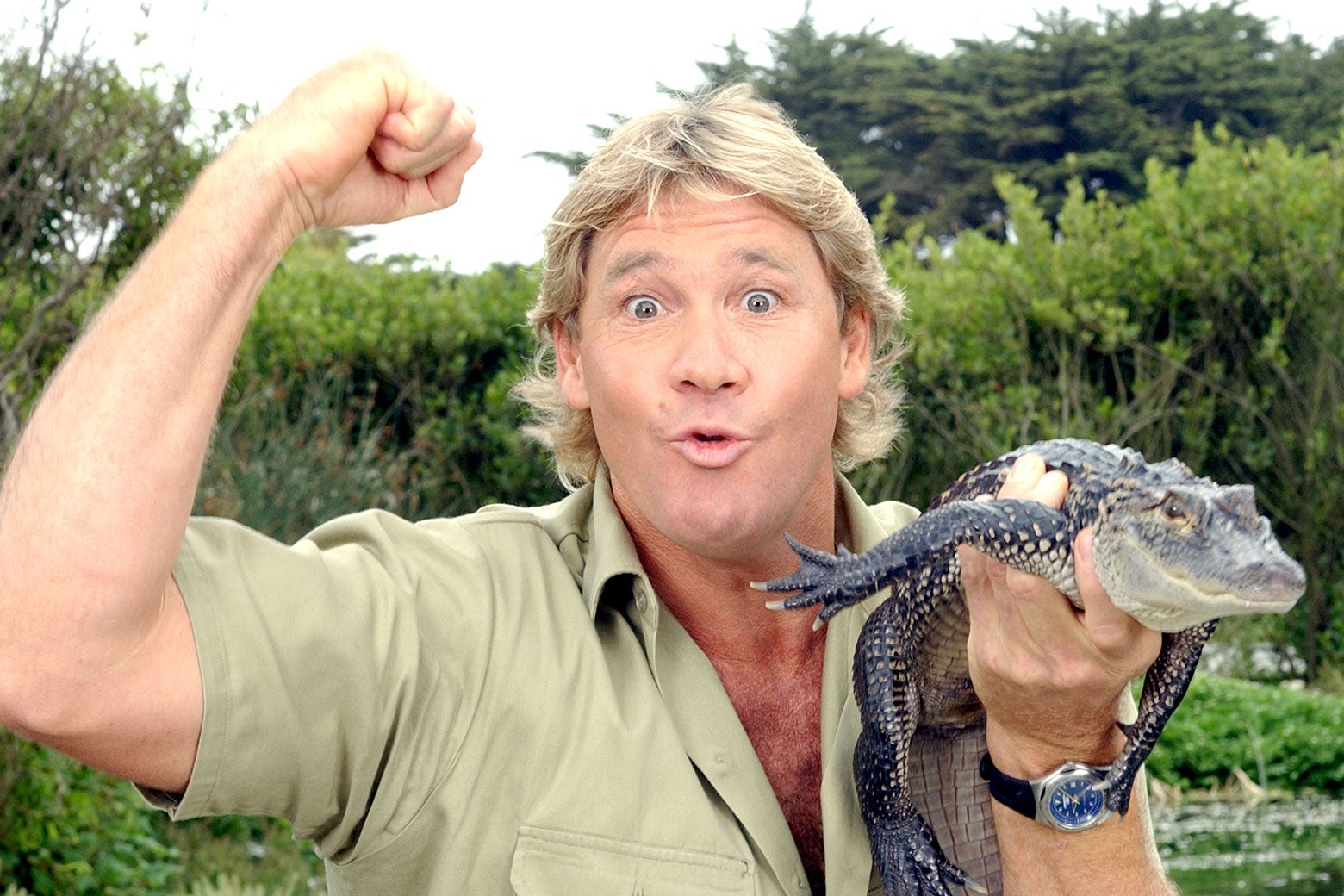
Family Steve Irwin and the Animals Who Raised Me When the famed Australian adventurer died 20 years ago, it devastated me. Now I understand why. Justin Sullivan/Getty Images Sign up for the Slatest to get the most insightful analysis, criticism, and advice out there, delivered to your inbox daily. I always thought Steve Irwin would live forever. He spent his life throwing his body on top of wild, carnivorous animals—living, breathing crocodiles—with apparent impunity. He called them “beautiful,” his “pretty girls,” even as they writhed around trying to eat him. His reverence for this misunderstood species and his dedication to the natural world occasioned some incredible television. The Crocodile Hunter premiered on Animal Planet in 1996, the same year I was born, and as a child, I watched obsessively. In the show, we followed a young Irwin, an Australian zookeeper, conservationist, and adventurer, who would, in each episode, mud-wrestle with various crocodiles in an effort to bring greater awareness to and preserve their species, alongside his conservationist wife Terry. Irwin had a distinct look to him; you could recognize that man anywhere, with his flippy middle part and the kind of dirty-blond hair one could only achieve from all those hours outside. He had crooked teeth and was always a little bit sunburned. You never saw him in anything other than his signature khaki-green short-sleeved shirt and shorts. He rose to prominence in the true heyday of Animal Planet, which was cranking out gold like Big Cat Diary, Animal Planet Zooventure, The Jeff Corwin Experience, and Growing Up Wild. These shows were about all the terrifying, flesh-eating creatures that roam around our planet. Viewers were transported to the Galapagos Islands, Borneo, and the most untouched stretches of the Amazon, all places the majority of us will never see with our own eyes. In suburban Orange County, where I spent my adolescence, “nature” was relegated to plants growing out of center medians. Save the occasional coyote sighting, I never worried about being eaten. I loved animals, but I was not impressed by the domesticated species, by anything you could keep in a cage on top of your dresser. That is probably because, like Irwin, I grew up surrounded by a staggering number of animals. It was normal to wake up to the sound of my mother coming into my room at 2 a.m.with a carrier full of kittens she’d brought home from work. She was a veterinary technician, her curly hair always up in a claw clip and her scrubs stained with blood and anal-gland secretions. There were never enough kennels or cages to sustain all the animals she personally felt deserved to stay alive, and therefore they remained in her care. I’d fall asleep to the sound of kittens crying and stumbling through the dark, figuring out how to walk for the first time. Our home became a menagerie of unwanted, injured, or otherwise troubled cases.Stray dogs were constantly arriving covered in burns, mange, or skin diseases. When our neighbors wanted to get rid of their cockatoo, Mrs. Daisy, she came to live with us. When my third-grade class pets were no longer needed, it was not even a question in my mind: I would take the frogs. Beyond the usual dogs and cats, we had possums, squirrels, hummingbirds, and crows. It was part of my chore chart to feed the bottle babies, any animal so young they didn’t know how to eat on their own yet. I would sit on the couch with my backpack on before school, a syringe of sugar water in one hand, waiting for the hummingbirds to fill their tiny little bellies so that I could go eat my breakfast. Despite my proximity to veterinary science, I did not want to be a veterinarian, one of the more common child-approved career options. I watched Animal Planet with animals curled up all around me, knowing in my bones that I was brought into this world to be like Steve Irwin. I wanted the real beasts. I spent hours training with my best friend (another Steve Irwin superfan), turning my upstairs playroom into a faraway ecosystem, scattering plastic crocodiles and iguanas my mother had bought us from Michaels all across the beige carpet. There was a true seriousness to how we practiced our Australian accents and the precision we deployed, lassoing the animals in Irwin’s signature style. Having seen him do it a thousand times, it all came down to muscle memory. We would take the plastic crocodiles by surprise, gingerly and quietly lassoing their mouths with shoelaces we’d carefully removed from our Converses. We’d jump on them, pretending they were huge and real and bucking us off. We would be breathless and sweating by the time we had wrangled all the reptiles. We’d tell them they were pretty girls right before we pressed them back into the plastic tube with our clammy hands, excited for when we would finally get the chance to do it for real. If you had asked us if we were afraid, both 8 years old and 64 pounds max, we would have laughed at you. What on Earth would we be afraid of? I dreamed of spending my life doing something daring and risky. I wanted to fall in love with the animals that could never love me back. I’ve always adored any creature that you could never truly understand, anything that could strike terror into the hearts of those not familiar with their many virtues. My mother is one of these creatures. My friends used to fear her and my high school boyfriend could not even look her in the eye, but my sisters and I loved her, claws and all. While she lives in domesticity, you could not call her domesticated. She is like those tigers that people become convinced might as well be kittens, only to make a misstep one day and end up mauled. Growing up, I rarely saw her sit down. She was always on her feet, pacing the perimeter of her cage. At work, she was fiercely protective of any animal deemed unsalvageable, and she had soft spots for all the toughest behavioral cases. She saw herself in them, saw her own troubles reflected, and insisted on their inherent goodness even while they scratched and drew blood. I remember being in awe of her heart; the hugeness of it filled every corner of my childhood. As I’ve gotten older, I find myself approaching her with caution, the back of my hand extended the same way I’d greet dogs with a bite history. She’s always been mercurial, not one to mince words or worry about how something she says might make someone “feel.” In short, her love is not for the weak. Before I could make sense of why that might be, before I knew anything about the war she escaped back home or the ways her mind played cruel tricks on her, it helped me to imagine that I was just like Irwin, with his penchant for expertly handling anything bigger and more powerful than him. Irwin seemed to take nothing personally, to fear nothing and no one. After hundreds of hours studying The Crocodile Hunter, I saw just how impossible it was to stoke goodwill with unpredictable creatures, to get on their good side and stay there permanently. No matter how much time you spent with them, you never knew exactly what was going on behind their glassy eyes. Yet somehow, against all the odds, it’s possible to love them regardless, to find an understanding with them without understanding why they do the things they do. Steve Irwin wasn’t the only animal wrangler in town in the ’90s and early ’00s—the era of cute blonde trainers balancing on the noses of killer whales and Siegfried and Roy’s lion-taming residency at the Mirage—but he was in a category of his own. He tended to move with more reverence for the animals he interacted with than some of his performer counterparts did. It was a lifestyle for him, not a trend. His parents were involved in wildlife rehabilitation before he ever was, gifting him a 12-foot scrub python on his sixth birthday. By the time Irwin was 9, he had wrestled his first crocodile, albeit under his father’s supervision. Among his imperfections was carrying that mantle to adulthood: He was widely criticized for feeding a crocodile with his baby son in his hands. (His son came out of that just fine.) He even won a season of Dancing With the Stars. It’s easy to toss Irwin’s wild antics aside as something done for shock value alone. But he clearly had a fascination with crocodiles that went beyond ratings. I found out about Irwin’s death on my second day of fifth grade. A classmate told me at recess, and I refused to believe it. A pit began to form in my stomach as the school day went on, and I started to count the seconds until I could access my family’s computer. The story I read that night explained the order of events plainly: He had been swimming over a stingray in the Great Barrier Reef when its barb (the three venomous spinal blades located in a stingray’s tail) pierced his heart. He was gone a few hours later. It was the very first death I remember vividly, the first time I tried to make sense of the finite nature of life. The first spell of grief for a man I had never even met. He died 20 years ago in September, but somehow, it still feels fresh to me. Watching The Crocodile Hunter as a kid made me less afraid of everything, starting with my own home, but extending to all the poisonous, deadly, and misunderstood species in our natural world. I stopped flinching when I heard branches breaking outside my camping tent. I didn’t worry I would get bitten by a shark every time I waded into the ocean. I guzzled down all of Irwin’s lessons, looking forward to the day I, too, feared nothing and no one. Then he was gone. I was adrift. The wildlife he spent his life trying to save would never know his name. Of all the animals he taught me about, crocodiles always seemed especially lonely to me. They’ve always been all by themselves at the top of the food chain with no one to have a laugh with. I see now that in my child’s mind, my mother bore a striking similarity to all the apex predators I obsessed over. She was beautiful and frightening. I rarely saw her eat or sleep, and she didn’t seem to have that motherly instinct to coddle her young. She’d kill for us, of course, but we were generally encouraged to fend for ourselves. I’ve grown to appreciate her scaled exterior over the years because it’s clear that underneath it all is a soft underbelly, one I too have a hard time exposing. It was sitting cross-legged in front of the TV, transfixed by Irwin’s endless adventures, I started to understand that most creatures tend to stay true to their nature. Crocodiles might be the greatest testament to this fact, having remained relatively unchanged for over 200 million years. Irwin loved them without expecting anything in return. I learned to do the same. “Crocodiles are easy. They try to kill and eat you,” Irwin said. “People are harder.” Animals Family TV
His Death Shocked the World 20 Years Ago. I Was in Fifth Grade. Years Later, I Know Why It Ruined Me.
Full Article
Original Source
Read the full article at Slate →KhanList aggregates and links to publicly available news content. We do not host full articles from third-party sources. Always verify important information with original sources.