
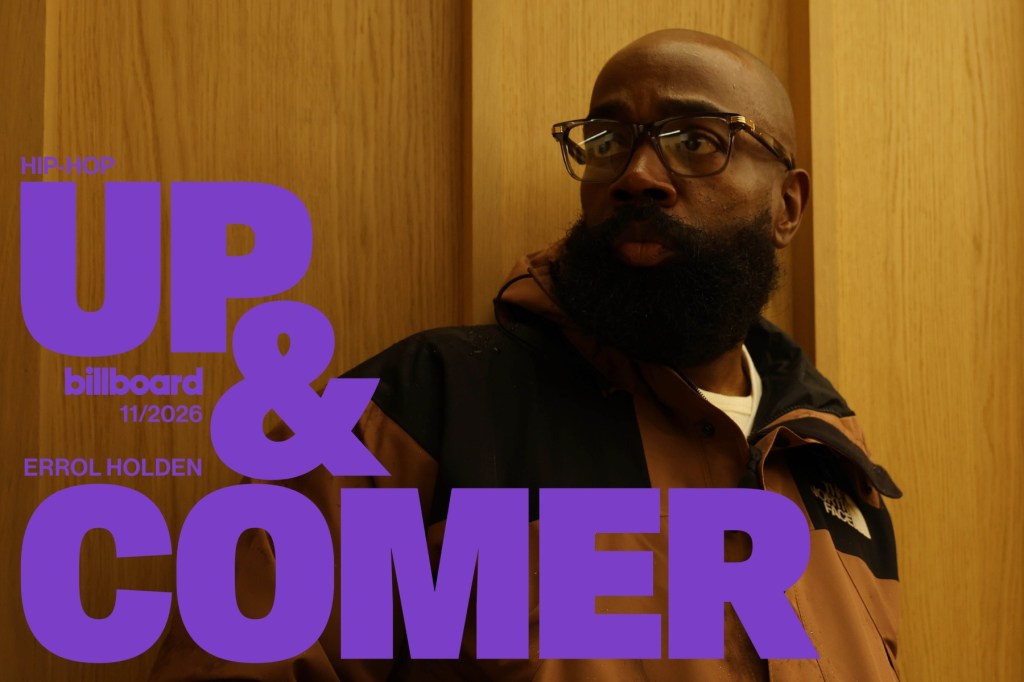
If you’re one of those people lamenting the downfall of mainstream rap music, then you should start lifting a few rocks on the world wide web and do some good, old fashioned music discovery. Explore See latest videos, charts and news Take Harlem’s Errol Holden for example. He seemingly came out of nowhere and was introduced to me by my former boss Noah Callahan-Bever back in 2022, showing that word-of-mouth still works. Since I was put on, he’s risen up the ranks be consistently dropping heat and eventually earned a cosign from the underground’s overlord Roc Marciano. Holden started rapping as a hobby around 2013 while he was still in the streets — something that he makes no qualms about in interviews like the one you’re currently reading and in his music. “I had one foot in, one foot out for quite some time,” he told me while we discussed when he started taking rap seriously. “It wasn’t until right before the pandemic, that I cold turkey’d the streets.” Holden doesn’t sound like anybody else in rap right now. If your favorite type of rap involves tales of getting money, kicking doors in, the art of drug dealing and slick, luxurious raps that sound like a conversation in a Harlem project staircase that reeks of Dominican Haze, then Errol’s music is for you. As a matter of fact, that’s exactly what I said when I first heard it. When NCB hit my line in April of 2022 and texted me his Joe Frog tape, I replied back saying that his distinct New York sound “makes me wanna go Uptown to cop some Haze on this beautiful day.” This is the type of rap that brings the feeling back. It’s the type of stuff that makes the charts, the numbers, the analytics obsolete. Thanks to the internet, regionality is fading away, slang is being co-opted on social media in real time and everyone is starting to sound the same. That’s why artists like Holden are important. He brings you into his world with a brutal honesty and makes no qualms about it. He raps like he’s giving you game on a street corner with a unique delivery that immediately catches your attention. “All the labels we speak about, we wearing that s—t right now,” he says of the autobiographical nature of his subject matter. “The cars n—as is talking about, motherf—kers is driving them right now. The b—thes, n—as is f—king them today.” He stopped by the Billboard offices in New York City to talk about his journey up until this point and how his latest album The Manhattan Project, which was fully produced by friend and business partner Roc Marciano and is only available in physical form at NearMint.com on vinyl, cassette and CD. Check out our convo below. Roc Marciano presented Mulberry Silk Road, the tape you put out last year, and that was the start of your business relationship with him. Now, you recently dropped The Manhattan Project with him, where he produced all nine tracks. Talk about how that project came together. It happened organically, with him just sending me a bunch of beats and me going to the studio and laying s—t down to it. He sent me probably about 20-30 beats and we had already did some songs together with us both rapping and s—t. Ironically, we did it right across the street in the Andaz Hotel. We had set up a mic and all that s—t right in the room, and we both was rhyming on different beats, but that album never came to fruition. So, we was gonna end up making an album called Mt. Magneto — but in the between time, he was just sending me beats, and that was the beginning of The Manhattan Project. Talk about your relationship with Roc. Are you signed to him? It’s more like family. Our thing is, we might be on the phone for hours and change, and then maybe the last five minutes a conversation might come up about our music. It started one way, but it evolved. to something else. It’s just a brotherhood. Are you guys planning on using some of those leftover songs that you have in the stash? Yeah, we may do Mt. Magneto and he’s about to drop Mt. Marci 2. I’m on that three times. And you decided to go hand-to-hand first instead of making it available of DSPs. Will it hit steamers eventually? Because right now, you can only get a physical copy of it. Nah, it’ll be on streaming platforms probably in about a year. Word, so you could get your bread back. Roc has used this strategy before. Exactly. We did the vinyls and those are doing real good. I had already did six or seven albums where I just gave it away on streaming platforms to build some sort of fandom. With this one right here, we decided collectively give it to him this way. My former boss Noah put me on back in 2022. He sent me Joe Frog and I told him that it made me want to go Uptown to cop some Haze. Was Joe Frog the first project where you were able to cultivate that style? Nah, that was the fifth project with that style. It was the four projects that I was speaking to in regards to selling them through the DM. I’m Not Wearing a North Face Unless It Says Supreme on It. Then it was Volume 2, then it was I Had 20 pairs of Cartiers Before Adam Sandler. Around what year was this? 2020. You were trying to come up with a style that didn’t sound like anybody else’s. So, was it just a trial and everything? I’m curious about how you came up with your rhyme structure and your cadence. A friend of mine had told me was like, “Yo, man, that s—t you doing is okay, but you talk slicker than that.” I was just trying to come up with a way where I can convey my message in totality. I didn’t want anything to be missing like, “Damn, I wish I could have said this.” I didn’t want to be constricted by rules, which would be the 16 bars then a hook. I had to come up with a way that was conducive to what I was trying to say and this picture I was trying to paint, and this is what happened. I know you said you always played around with raps since you were a kid, but did you always know that you had a way with words? Yeah. Was it mostly writing, or the gift a gab? It was both. Because, you know, I talk s—t on the corner. I talk s—t in the block, just in the neighborhood, wherever I’m at. That’s what we do. We just stand around and talk s—t, so I kind of built that on them corners, but the writing was something that I would do in secrecy. And I wouldn’t even really call it secrecy, it’s just I had nobody to tell, so I just was doing it. I had a friend of mine that he was a little bit more into trying to make it with rap than I was, and we would call each other, and he would rhyme his bars to me, and then I would do mine. That would be the only person that knew I was rhyming. I kind of fell into writing. I didn’t seek out to be one. But I look back and there were instances in high school and in college where teachers were pushing me towards writing a little bit. Looking back, was there instances like that for you as well? In elementary school, I was real good in school. I was a good student, I was good in everything. I was good in every subject in school, especially in elementary school. But the ninth grade, that was the end of my scholastic career. My father was an avid reader, and he always impressed upon me the importance of reading. I didn’t really take heed until I went to prison. And then once I got there, I would start reading — and then once I came home, I would find little books and s—t that struck my interest. I would take some of his books, and then me and him would sit around at times, and we’d discuss the books and s—t like that. And then as time progressed, I just kept on with the reading and all that. It wasn’t just the reading, though. It’s the movies, compounded with the reading. Its TV shows compounded with that. It’s just my love for the King’s English. If we could sit down and talk, most of the people that’s my close friends, we all have that in common. We like to talk. Just hearing the structure of your raps, you can tell that you’re a reader because that’s the way to get better at writing. What type of books do you like to read? History, philosophy. When I was in the joint, I used to like to read s—t like The Coldest Winter Ever, B-More Careful. I was a kid, so I’m reading that type of s—t, and then I outgrew it, and then once I outgrew it, I would get my hands on anything. I kind of fancied the Bible, the Quran and then the dictionary. Sometimes me and other guys that thought they were slick with words would go back and forth. I would say a word to you and you would have to give me a synonym. Iron sharpers iron that way. It was always something like that with words. I love words. Word, because I’ve been fascinated with rappers that come from rough backgrounds. I grew up around kids that were smart but would lose their way, or use those smarts on the street instead of something constructive. Like I always think about how Nas made Illmatic at 17 after he dropped out. He was naturally gifted. Then you see Nas’ father was into jazz, and his mother was a working-class woman. My father was into books, and he eventually passed that love for literature down to me. But unbeknownst to me, when I was watching certain things, even as a kid, what would always grab me was the dialog, the back-and-forth. I used to just like listening to people talk. There’s also humor in your writing style. You mentioned that you’ve cooked coke or whatever with Bacardi 151 and another one where you said you used Bacardi Límon. Those lines reminded my of when Jada said he cooked base on a Foreman Grill. 151, I could see, because that straight alcohol — but you’ve really used Límon too? I’ve done it several times. Whenever I would get some cocaine and it didn’t taste good, it could be potent, but what you do is you just drop it in some water, so the water dilutes it, and all you trying to do is trying to alter the taste. Because no matter how strong the cocaine is, if it tastes nasty, they ain’t gonna want to f—k with it. I also like lines like “I made history in Iceberg History” — but it’s not just about slick lines. You also talk about the ups and downs, and stuff like that, and I’m curious to know if you have survivor’s remorse or survivor’s guilt about your past. Is it therapeutic when you’re telling these stories in your raps? It’s definitely therapeutic, but survivor’s remorse or guilt? Nah, I’m gonna tell you why. I went through it far longer than most people I know. I was probably a bit slow in leaving the lifestyle. I was one of the last people that I know that to leave. I went through hell. I’m talking about I went through hell for almost three decades in the street, so hell no, I ain’t got no remorse, man. My only remorse is I ain’t embarked on this earlier. That’s my only remorse. It’s like going to war. I had read this thing one day, and I don’t know to be honest with you, I don’t know if it’s true or not, but it was this Korean or Japanese soldier that had hid off in a cave. Do you know what I’m talking about? That he still thinks it’s World War II. The war had [already] been over for 30-40 years. So that’s how I was with the streets. Like, d–n, I didn’t realize this s—t had been over with for me. Nobody told me like, “Yo, you should try something else. This is not working.” Is it like a little PTSD? Quite possibly, because even now, if I hear walkie talkies in my hallway, I’m thinking maybe somebody’s coming — but I ain’t doing nothing, so I quickly snap out of that. So yeah, I would definitely say that. I feel like 20-30 years ago, it would’ve been harder for someone your age to break through. Did you have any doubt? Are you surprised by how fast it happened? Nah, because it didn’t happen fast. I started going to the studio in 2013, 2014. That’s when you really hunkered down and focused on the music. Yeah, I left that alone and dedicated my time full time to this, and when I did that, I had already began the groundwork years prior by going to the studio and having a plethora of songs, and and just building the confidence within myself to say, “At least I feel like I could rhyme pretty decent.” Now the litmus test, so to speak, was when I started DMing people. That was my whole thing. I just wanted people to tell me what they thought, and it was far beyond my belief — because they started paying me for it, and then the response I got after they paid me… Once you give your money up, now the truth gonna come out, “Man, I don’t like this s—t,” because you paid for it. You paid for the right to tell me the truth. Their responses was paragraphs upon paragraphs. They were taking their time to tell me. If only one person would have sent me a response, that would have been enough to get me through another four or five years. But I had tons of people, you know what I mean? I built the confidence through repetition. You applied what you did in the street to this, basically like giving out samples. Exactly. Do you have a goal or vision for your career? Nah, yeah. I’m not just haphazardly doing this s—t. Hell no. I want to be known as probably one of the greatest, if not the greatest — and eventually I want this s—it to evolve into something a lot bigger than just being underground. And whatever it takes to get there is what I’m gonna do. So, I’m not sure if you’ve been aware of the conversation surrounding Jay-Z on social media, but a lot of the younger generation try discredit his legacy because their obsessed with numbers. But his most of his best songs are his album cuts and loosies. We’re of a certain age and when we argued about rap, numbers were rarely brought up. I saw an interesting tweet where they had a theory that said, their favorite rappers are users and they’re uses while guys like Jay were sellers. And I wanted to try to connect that to the song you have called “The Junkies Won.” You do sophisticated street talk like Jay. Where I’m from, I’ve seen a lot of junkies get their life together, and then I’ve seen most of the drug sellers, myself included — our lives went to shambles. You see the junkies that was in the street getting high and doing whatever they had to do, they ultimately got their life together, and became counselors or went and got jobs and curated their life like a regular civilian. Us, on the other hand, we just never could seem to leave this drug-selling s—t alone, so now we in the same position we was in when we were serving them. Their life was together, so the junkies won. The drug sellers is just here in limbo, in purgatory. That’s essentially was Jay was explaining at the beginning of “Can I Live.” That’s the little talk that the little rant that he has in the beginning. When you were still f—king around in the street, were addicted to the money or the lifestyle? You’re making bread hand over fist and spend it as fast as you’re getting it. When you getting fast money in the streets, you get accustomed to everything that comes along with it, but you don’t realize your addiction to something until it runs out. If you’re a millionaire fiend, you don’t really see yourself as a junkie, because you always got it there to get it. So, a lot of the s—t that you see the low, bottom-of-the-barrel fiend doing, you don’t have to do. Did you feel a sense of needing or wanting to be depended on in terms of your regular customers? It wasn’t so much that. With me, I used to love selling drugs, man. And I think to be good at something, you gotta love it. I used to like every aspect of it. I used to like to go cop, I used to like my money compounding, I used to like the smell of cocaine as it’s cooking. I used to like bottling up, watching people. I used to like every aspect of this s—t — until I didn’t. The money is definitely a driving force behind what I was doing, but it was always everything else. It was the competition. The n—as up the block, around the corner. ‘Oh, they got something good? Mine’s gotta be better. They got a flow. I want to get a flow so heavy that they got to close up.” It was always that level competition. But what about your relationship with your customers? You’ve talked about how you used to talk to them about life and just regular, everyday s—t. Because they’re human beings and a lot of them got a lot of knowledge and wisdom, and they came from somewhere. And besides the drug-using s—t, a lot of them had a lot of insight to a lot of different things. Most of them was a lot older than me, so they had their perspective. I’ve always been interested in people’s perspective and how they see things. Then, you know, they’re working a n—a. A lot of them conversations just be so they can get something on the arm, or they don’t have enough, but I was getting something out of it too. It f—ked me up when you and Noah were talking about how that relationship might’ve influenced the way you interacted with with the custies. I didn’t feel a way about my customers until later on toward the end of my career. When you started looking back and reflecting on those days? Yeah, as I got older and I started seeing the world a bit different. That’s when I sat down and really looked at everything from that perspective. Another interesting thing about your past is — usually, in my hood, it was the stick-up kids and it was the hustlers — you were both. Was that a normal thing in Harlem? Nah, but you know, I always had some courage. I came up around hustlers, and I came up around guys that robbed, and they both had an influence on me. I just never wanted to be without, so if I had no drugs to sell, I would go rob. And sometimes, even when I had drugs to sell, I would still rob. See, I was gonna ask if you robbed whenever you fell off. I would rob at times when I was getting money. I would be lying if I told you that [I didn’t]. I did it a lot less frequently, but I definitely robbed when I was getting plenty money. Are you planning on making that early stuff available on streaming or in physical form? Definitely gonna put all them s—ts on vinyl, and I probably will eventually put them on streaming, but I’m working on so much new music, that s—t will come down the trough. That’s part of your lore. And that s—t there, I’ma have them remix because as I was saying to you, my engineer wasn’t as good then as he is now. When I look at the notes and like, old phones and s—t — even in this phone — I see some of the rhymes from those projects, and I’m like, “Godd–n, this is some crazy rhyming here.” You have a show coming up? Yup, on Dec. 30 at S.O.B.’s and then January 6 or 7 in Philly. That’s where you could say it’s “vintage hip-hop,” because I’ma give them a vintage grand assf—king you. How these n—as used to kick ass in the ’90s. That’s what my show is. What else to have on your slate? Planning on dropping more music? Joe Frog 3. I’m just getting ready for 2027. Do more shows, and just get the brand out there a lot more. A lot more content when it’s time to drop music.
Hip-Hop Up & Comer Errol Holden Quit the Streets Cold Turkey to Become a Rap Star: ‘Whatever It Takes to Get There Is What I’m Gonna Do’
Full Article
Original Source
Read the full article at Billboard →KhanList aggregates and links to publicly available news content. We do not host full articles from third-party sources. Always verify important information with original sources.