
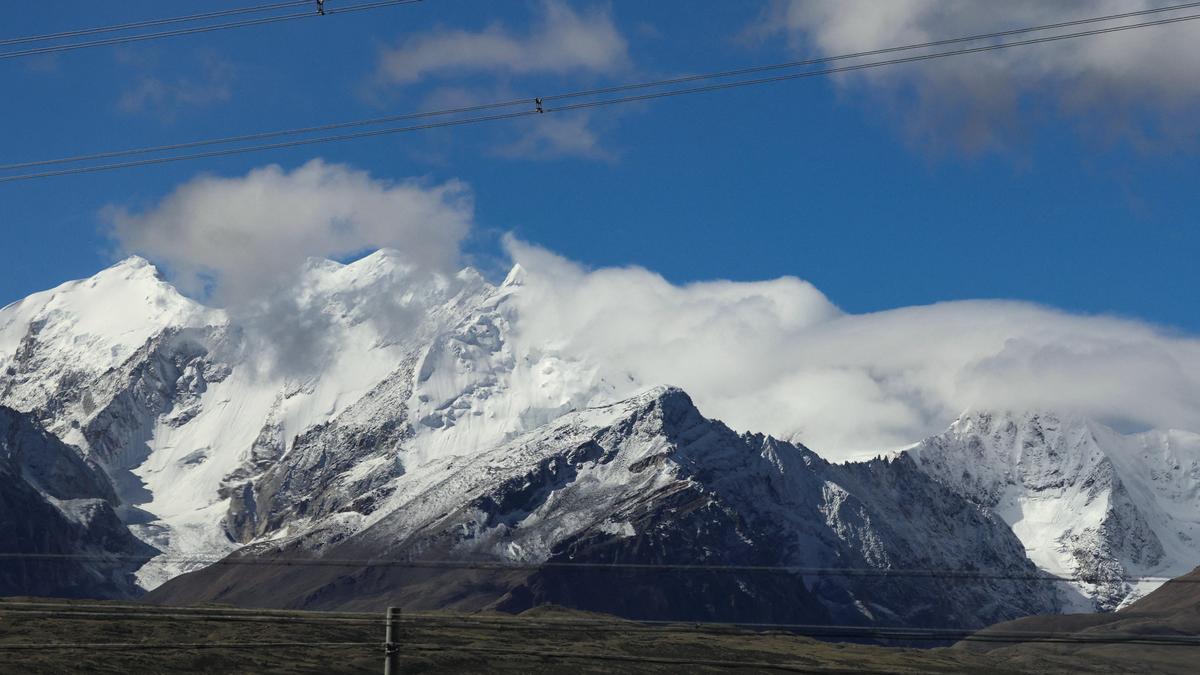
Snow-covered peaks of the Himalaya are visible in Shigatse, Tibet Autonomous Region, China, September 6, 2026. | Photo Credit: REUTERS The Himalaya are approaching a tipping point as glaciers melt faster than a decade ago, threatening water security as the region approaches “peak water“ by mid-century, according to a study released this month.The findings come after the collapse of a Himalayan glacier in late August along the Nepal-Tibet border, which caused cascading landslides and flash floods in the valleys below. At least 1,300 people have been confirmed dead and more than 5,300 are missing across Nepal and China’s Tibet region.As glaciers retreat, they are leaving behind unstable glacial lakes held back by little more than loose rock and ice, above valleys where millions of people live, the study found.Peak water is the point in time when river flows stop rising and start declining. It is expected to have profound implications for water security. As the Himalaya underpin more than 20% of India’s GDP, the region makes up a key piece of the country’s national economic infrastructure, upon which hundreds of millions of people depend.The study was produced by Systemiq, a sustainability advisory firm, together with the Integrated Mountain Initiative, the International Centre for Integrated Mountain Development, and India’s G.B. Pant National Institute of Himalayan Environment.Himalayan glacier mass loss had accelerated in recent decades, while only 21 glaciers were currently monitored on the ground out of an estimated 40,000 glaciers across the Hindu Kush-Himalaya region, a vast mountain system spanning eight countries from Afghanistan to Myanmar, the study found.Though making up around 18% of India’s land, the Himalayan region accounted for roughly 35% of the country’s natural disasters. Published - September 15, 2026 03:02 pm IST
Himalaya approaching tipping point, report says
Full Article
Original Source
Read the full article at Thehindu →KhanList aggregates and links to publicly available news content. We do not host full articles from third-party sources. Always verify important information with original sources.