
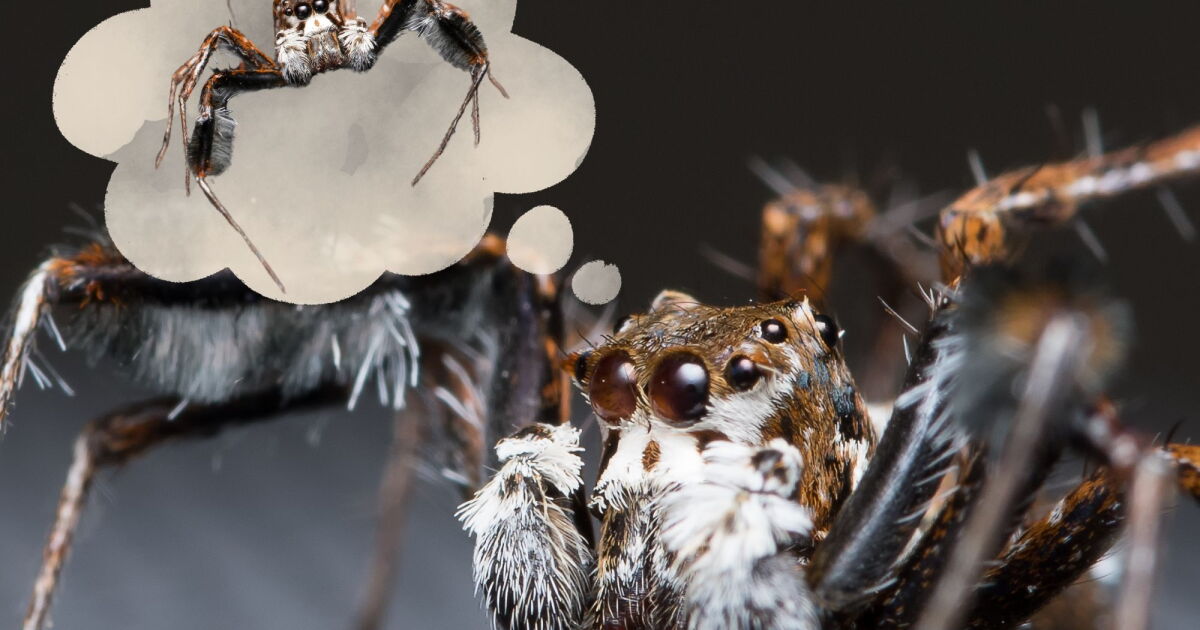
Somewhere in Australia’s tropical northeast, a tiny spider twitches in its sleep. Whether it’s imagining sinking its fangs into a delicious meal or fearing the business end of a rolled-up newspaper will forever be between the arachnid and its therapist.Yet new research provides compelling evidence that fringed jumping spiders (Portia fimbriata) experience two distinct sleep states, including one that looks suspiciously like the rapid eye movement (REM) sleep associated with our own vivid dreams.Led by University of Bonn behavioral biologists Nadja Geiger and Daniela Rößler, the study supports a wonderfully intriguing possibility: dreaming might have evolutionary roots far beyond humans, other mammals, or even animals with backbones.“Sleep is one of the most widespread behaviors in the animal kingdom, yet its origins and functions remain poorly understood because experimental evidence comes almost entirely from vertebrates and a few laboratory model species,” the authors point out in their recently published report.The invertebrate at the centre of the investigation is surprisingly intelligent for a spider. It uses its braininess to hunt other spiders and is capable of navigating detours and adjusting its predatory tactics.Previous research by the researchers documented twitching limbs and moving retinas in another jumping spider species. As curious as it was, watching an animal twitch while it seems to be in a state of sleep doesn’t establish that its brain is switched into screen-saver mode, much less picturing an imaginary landscape.To make that distinction, the researchers combined detailed video recordings with tests of responsiveness and recovery after disrupted rest.Each night, Portia settles upside down beneath its silk abode, alternating prolonged stillness with brief episodes of retinal movements, twitching, and occasional leg curling. The researchers found these REM-like bouts averaged roughly 83 seconds across a selection of ten test spiders.Importantly, the spiders were slower to respond to an acoustic stimulus during these episodes than when they were awake. Four of ten failed to respond within the ten-second testing window, yet responded immediately when tested again while awake.Then came the roommates from hell. The researchers introduced dozens of fruit flies into each enclosure overnight, using their buzzing to interrupt the spiders’ slumber. Following the restless night, the animals’ sleep windows lengthened while their total REM-like time jumped from roughly nine minutes to seventeen.That compensatory response suggests a regulated biological need, rather than a spider simply deciding to spend the evening patiently waiting for dawn to break.None of this proves that spiders dream as we do, or even that any state of rest should be defined as dream-like. The study measured behaviour, not brain activity, and REM-like movements aren’t a readable account of what, if anything, an animal experiences.Still, jumping spiders may be in good company.A 2023 study found sleeping octopuses alternate between quiet periods and bursts of twitching, rapidly changing skin patterns, and wake-like brain activity. Some patterns resembled those displayed while awake, raising possibilities ranging from neural maintenance to rehearsing experiences. An octopus might effectively wear its nocturnal brain activity on its sleeve. All eight of them.Sleep itself is likely to be older still. In 2017, researchers demonstrated a slumber-like state in upside-down jellyfish, animals possessing nerve nets rather than centralized brains. That places the need for some good ol’ shut-eye on surprisingly ancient evolutionary ground.Why would animals add imagined experiences to the business of sleeping?One possibility is that dreaming accompanies the sorting and strengthening of memories, reinforcing neurological pathways while they aren’t in active use.Another proposes that dreams provide simulations in which brains can safely practice responses to potentially threatening situations. Evidence remains mixed, and dreams could also be an experiential by-product of useful sleeping-brain activity, rather than an adaptation with its own job description.Comparing distant animal relatives could help distinguish ancient shared machinery from similar solutions that evolved independently. For now, the evolutionary history of dreaming remains tantalizingly unfinished.The spiders, predictably, are keeping their dream journals to themselves.The research was published in Proceedings of the National Academy of Sciences.Source: Phys.org
Highly intelligent spiders may dream like us
Full Article
Original Source
Read the full article at Newatlas →KhanList aggregates and links to publicly available news content. We do not host full articles from third-party sources. Always verify important information with original sources.