
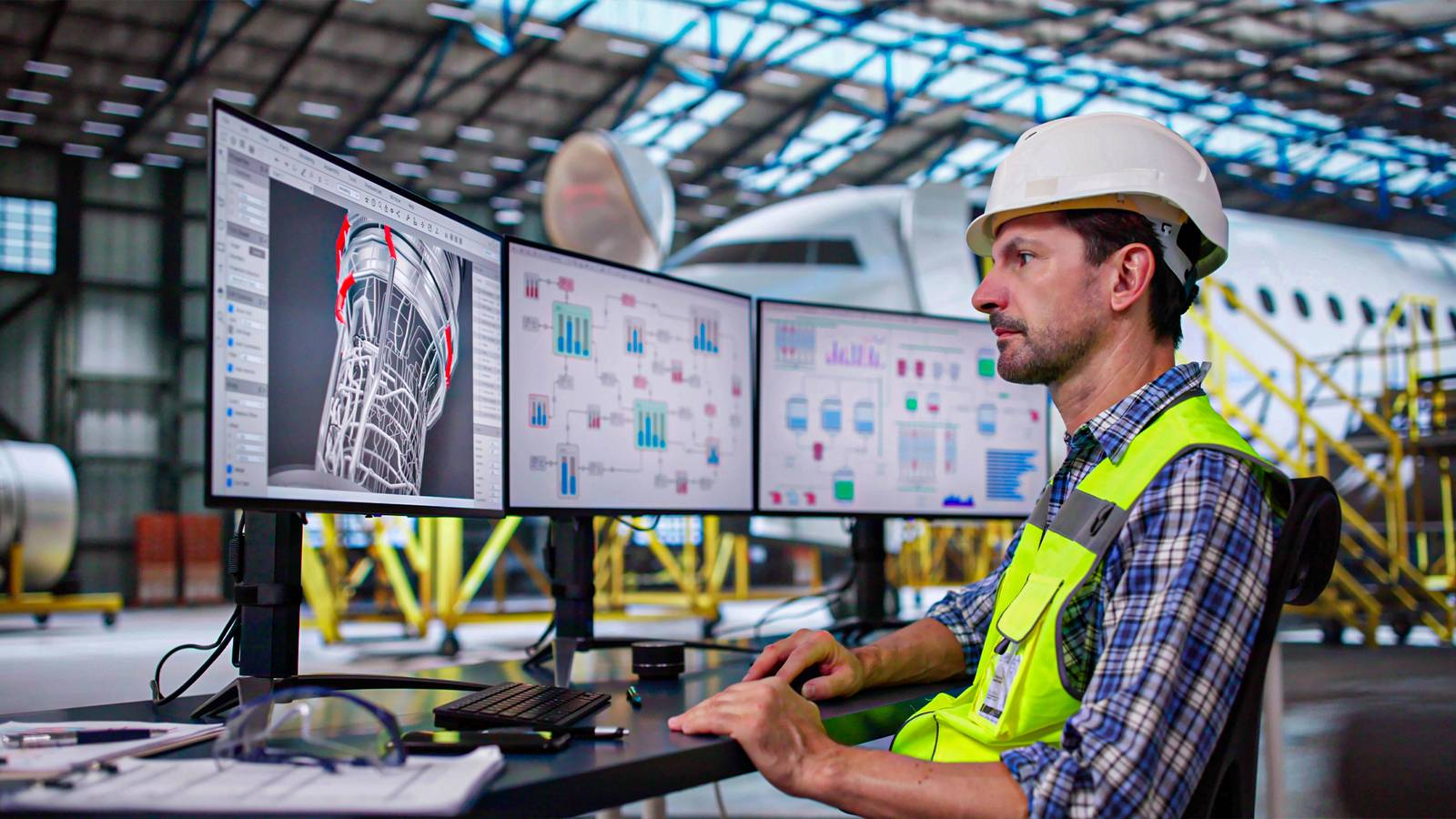
Credit: Andrey_Popov | Shutterstock, Simple Flying Published Nov 22, 2026, 9:00 AM EST Chris earned a Master’s degree in Defense and Strategic Studies (Highest Honors) from the University of Texas at El Paso. His graduate work concentrated on Global and National Security, Low-Intensity Conflict, Modern Warfare, and US grand strategy. He also undertook extensive regional studies, analyzing how key regions integrate into the broader US security architecture. This rigorous program provided him with a comprehensive understanding of U.S. military operations, global strategy, and weapons systems. Additionally, he gained a strong appreciation for great power competition.—an increasingly central force shaping international relations and conflict for the foreseeable future. Sign in to your Simple Flying account The aviation industry depends on far more than pilots and cabin crew to keep its aircraft flying and its global operations running smoothly. Behind every departure is a network of highly skilled professionals responsible for flight planning, aircraft maintenance, complex electronic systems, engineering, and the financial decisions that keep airlines competitive. Many of these essential roles take place well away from the passenger cabin, yet they offer rewarding career opportunities and considerable earning potential. From FAA-certificated aircraft dispatchers and experienced maintenance technicians to avionics specialists, aerospace engineers, and airline revenue analysts, these professionals bring specialized knowledge to one of the world's most demanding industries. Here are five aviation careers that offer attractive salaries without requiring individuals to become pilots. 5 Revenue Management & Pricing Analyst The specialists maximizing airline profitability Airlines must do more than fill seats to remain profitable. Behind the ticket prices passengers see when booking a flight is a team of revenue management and pricing analysts, whose job is to determine how much an airline should charge for each seat and when. These professionals study passenger demand, booking trends, competitor fares, and historical sales data to help airlines maximize revenue across their networks. According to JetBlue Airways, its revenue management team is responsible for maximizing ticket revenue on every flight, with analysts working across two main areas: pricing and yield management. Pricing analysts monitor competitor fares and adjust the airline's own pricing strategies, while yield analysts manage seat availability and fare levels to make the most of passenger demand. American Airlines similarly describes the role as using data-driven pricing and inventory strategies to improve revenue performance across assigned markets. The work is highly analytical and generally requires a degree in finance, economics, business, mathematics, or a related field, alongside strong data analysis skills. JetBlue lists a salary range of $58,000 to $86,000 (£44,200 to £65,700) for its Associate Analyst Revenue Management position, while ZipRecruiter lists airline revenue management analyst salaries across a range of current vacancies. 4 Aircraft Dispatcher Their critical role in keeping flights on a safe course An aircraft dispatcher is an FAA-certificated airline operations professional. These individuals are closely involved in the planning, releasing, monitoring, and continual support of flights during ground, in-air, and arrival operations. GlassDoor states that these aviation professionals earn between $73,000 (£55.500) and $137,000 (£104,200K) per year. Adding to this, Thrust Flight School says that their salary primarily depends on the airline they work for and how many years of service they have under their belt. They state that first-year pay at most regional carriers is between $41,000 (£31,200) and $52,000 (£39,600) a year. However, major US airlines will pay a first-year airline dispatcher approximately $95,000 (£72,300), with the top of the pay scale reaching around $170,000 (£129,300) for an 11-year veteran. According to the US Aviation Academy, "the dispatcher and pilot in command share defined responsibility for preflight planning, delay, and dispatch release." Additionally, a dispatcher "monitors each assigned flight, provides information needed for safety, and participates in cancellation or redispatch decisions when a flight cannot safely operate or continue as planned." A Typical Workday For a Dispatcher Likely Activities Beginning an Assignment Reviews relevant weather, NOTAMs, operational issues, aircraft information, and flights assigned to the desk. Planning Upcoming Flights Evaluates route, fuel, weather, alternates, aircraft information, and other dispatch requirements. Monitoring Active Flights Tracks several assigned flights and watches for information or conditions that may affect their safe operation. Communicating Exchanges operational information with flight crews and coordinates with other airline operational resources as required. Handling Disruptions Evaluates weather, airport, routing, aircraft, or other changes and helps determine the applicable operational response. Handover Transfers relevant information about active flights and operational concerns when responsibilities move to another qualified dispatcher. Generally, dispatchers perform their work in centralized airline operations environments rather than airport control towers. Airlines use different terms for the areas in which they work, including Operations Control Centers (OCCs), System Operations Control Centers (SOCCs), and Network Operations Centers. To grasp the scale of the daily operations managed by dispatchers, American Airlines, generally considered the largest airline in the United States, notes that it maintains a staff of 600 dispatchers and operations specialists. American states that it operates "6,000 daily flights to more than 350 destinations in more than 60 countries," with its dispatchers playing an integral role in supporting these global operations. 3 Aircraft Maintenance Technician The skilled personnel that maintain and repair modern aircraft Flight safety involves numerous overlapping and interconnected layers of responsibility, expertise, security, and regulation. A crucial component of the aviation ecosystem is the generally unseen aircraft mechanic. USAFacts explains that the oft-stated expression "flying is safer than driving" is absolutely valid. The site states that in "2023, 33 plane passengers were injured over 773 billion miles of air travel. Put another way, you could circle the globe over 940,000 times for every one airplane injury." This level of consistent safety depends a great deal on the skill, proficiency, and training of aircraft mechanics, as well as their continual learning and honing of their skills. These professionals ensure that every aircraft, from nose to tail and fuselage top to wheel, is rigorously inspected, repaired, and cleared for flight. For their essential services and expertise, US Aviation Academy reports that the median annual salary for an aircraft mechanic was $79,870 in May 2025. Further, they add that the mean annual wage was $84,740 (£64,742), while the median hourly wage was $38.40 (£29.34). The bottom 10% of this skill pool earned less than $48,780 (£37,263), while the highest 10% earned more than $128,890 (£98,498). While the pay for this line of work is rewarding, North America is facing a growing shortage of aviation maintenance personnel. The Aviation Technician Education Council reports that there is a widening deficit of certificated aircraft mechanics, which is expected to increase from approximately 9,100 this year to 20,000 by 2030, representing 12% of anticipated demand. Fortunately, the Council reports that the FAA issued 11,103 new mechanic certificates in 2025, 23.2% more than in 2024 and the highest annual total since the agency began publishing the data. 2 Avionics Technician Maintaining the sophisticated technology that keeps aircraft above the clouds On a daily basis, major airlines entrust their $306 million to $442 million (£234 million to £338 million) Boeing 777s (or similar aircraft) to the capable hands of their avionics technicians. These men and women install navigation, radio, radar, and autopilot systems. They also repair or replace faulty wiring, sensors, and instrument panels, and carry out post-repair testing. One miswired transponder or uncalibrated altimeter can render an aircraft unfit to fly or affect crucial systems while airborne. Modern passenger jets are equipped with hundreds of interconnected electronic components, and a failure in one can potentially affect others. Like maintenance technicians, their counterparts in avionics require a great deal of training, usually 18 to 24 months. Their courses cover circuit analysis, digital electronics, and the proper use of diagnostic equipment. Upon completion, the US Bureau of Labor Statistics (BLS) states that these skilled workers earn a median annual wage of $82,280 (£62,862), based on 2025 statistics. Further, the BLS reports that there were approximately 19,800 avionics technicians employed in the US in 2025, and the future outlook for this profession is encouraging. To this point, the Bureau notes that employment among avionics technicians is projected to grow by 9% between 2025 and 2035. It also projects about "13,100 openings for aircraft and avionics equipment mechanics and technicians. . .projected each year, on average, over the decade. Many of those openings are expected to result from the need to replace workers who transfer to different occupations or exit the labor force, such as to retire." 1 Aircraft Engineers The engineering expertise behind modern commercial aircraft Credit: US Air Force When we watch an aircraft fly overhead, land at an airport, or enter the cabin, everything we look at and touch has been meticulously designed with ergonomics, functionality, mechanical integrity, and comfort in mind. Those behind this specialized planning are aeronautics engineers. These men and women earn a median annual salary of $134,960 (£103,126), according to the BLS. Employment in this field is projected to grow by 8% between 2025 and 2035, with approximately 3,800 openings across the industry each year over the decade. Many of these openings are likely to result from the need to replace engineers who transfer to different occupations or retire. The Museum of Flight states that there are five types of engineers within the field of aviation who contribute to the design, manufacture, and support of aircraft. These include industrial, structural, avionics, acoustics, and sales engineers. Each brings a different area of expertise to the industry, from improving manufacturing processes and ensuring structural integrity to developing complex electronic systems and reducing aircraft noise. Together, these specialists help ensure that modern aircraft are not only capable of flying safely but are also efficient, functional, and commercially viable. Industrial engineers plan and improve how aircraft are manufactured, ensuring they are produced as efficiently and safely as possible. Structural engineers design the frame of an aircraft, making sure it is structurally sound enough to withstand the rigors of not only flight but also harsh landings and taxiing. Avionics engineers map out the electrical systems that span the aircraft, from the cockpit to the tail. Finally, acoustics engineers use testing to identify ways to reduce noise inside and outside an aircraft. Sales engineers, meanwhile, work directly with customers, explaining aircraft capabilities and helping airlines, governments, and other buyers select aircraft that meet their operational requirements.
Highest-Paying Airline Jobs: 5 Roles That Earn Six Figures Without Flying
Full Article
Original Source
Read the full article at Simpleflying →KhanList aggregates and links to publicly available news content. We do not host full articles from third-party sources. Always verify important information with original sources.