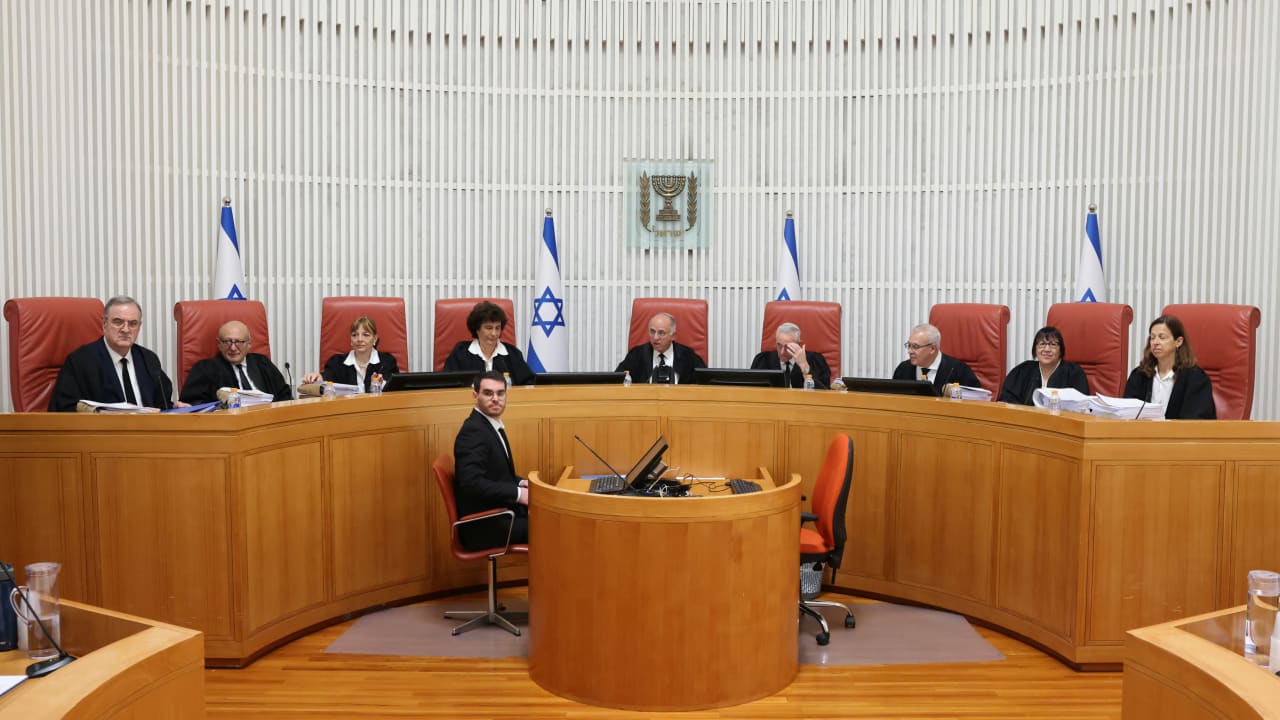
BySARAH BEN-NUN, KESHET NEEVJULY 28, 2026 18:32Updated: JULY 28, 2026 20:23The High Court of Justice on Tuesday froze a law that limits enforcement measures against eligible haredi (ultra-Orthodox) men who fail to report for military service, with a final ruling expected soon.The interim order was issued several hours after a hearing in which the nine-justice panel heard arguments from the parties represented in the case.“After considering the parties’ arguments, in writing and orally, an interim order is hereby issued,” the court said, suspending the law’s entry into force until a further decision. “The judgment will be issued soon.”The law freezing draft enforcement measures against ultra-Orthodox (haredi) men eligible for military service passed on July 14. However, it was frozen the following day by Justice Ofer Grosskopf after five petitions were filed against it, including by opposition faction heads Yair Lapid of Yesh Atid and Avigdor Liberman of Yisrael Beytenu.Grosskopf, in his short decision, focused on two aspects of the law: the court’s longstanding rulings on the enlistment of yeshiva students and the unequal treatment the law grants to “only certain sections of the population.”Haredi men are seen protesting the effort to draft ultra-Orthodox Israelis into the IDF. (credit: FLASH90)Attorney-General Gali Baharav-Miara on Friday asked the court to strike down the law, arguing that it retains the duty to enlist while removing the consequences for refusing to do so.She called it a “group immunity mechanism” that protects one sector from arrest, investigation, and prosecution while leaving other draft evaders exposed to the full force of the law.Knesset focuses on defects in law instead of constitutional argumentThe Knesset’s position, filed on Sunday by its legal advisers, focused more on defects in how the law was enacted than on the broader constitutional argument raised by Grosskopf and affirmed by Baharav-Miara.Representing the Knesset in court on Tuesday, attorney Yitzhak Bart clarified the legal advisers’ position, explaining that committees debating a bill have broad authority to change it as long as their amendments do not introduce a “new subject.”That boundary, he said, allows committees to make the changes needed to improve legislation without forcing the Knesset to restart the legislative process each time a bill is amended.The fundamental subject of a bill, however, cannot be changed.“There is no escaping the conclusion that the new law introduced a new subject,” Bart said.The difference, he explained, was between legislation intended to integrate yeshiva students into military service and legislation freezing enforcement measures against those who fail to report.Had the committee continued discussing the original bill and added a clause dealing with enforcement, “that might have been okay,” Bart said. Instead, it created what he described as a new branch unconnected to the root of the original bill.The scenario in which the Knesset’s own legal advisers conclude that defects in the legislative process require a law to be annulled is “extremely rare,” Bart said.Representing the Attorney-General’s Office, attorney Aner Hellman said there was merit in strengthening the authority of legal advisers so that lawmakers understand the implications of disregarding their opinions, particularly when it comes to the procedural rules governing legislation.These technical requirements, Hellman said, “are what make laws laws.”“The red flags were raised all along” the legislative process by the Knesset legal advisory, he added.“There are certain procedural lines that cannot be crossed – particularly ones that outline how a bill becomes law.”Hagai Kalai, representing Israel Hofsheet, argued that the government had ignored the criminal and enforcement consequences of the draft crisis from the beginning and, through the law, had sought only to tie the hands of the authorities responsible for enforcing the existing duty to enlist.The only argument presented in defense of the legislation came from attorney Natan Rosenblatt, representing the haredi Emet L’Yaakov organization, which sought to join the proceedings as a respondent.Rosenblatt argued that a haredi man could not enlist because “the Torah forbids him from doing so,” prompting an incredulous response from Justice David Mintz.“I simply cannot believe what I am hearing,” Mintz said, questioning the assertion that Jewish law prohibited military service.When Rosenblatt said that “all the great rabbis of Israel” opposed enlistment under the current circumstances, Mintz interrupted him.“Not all the great rabbis of Israel,” he said. “You are speaking in sectoral terms.”The government filed its own two-page position Monday, explaining that it had declined to hire a private attorney to defend the law because the outcome of the case was “known in advance.”Rather than provide a legal response to the petitions, the government’s position focused largely on accusing the court of violating the separation of powers and the Attorney-General’s Office of obstructing efforts to increase haredi enlistment.Uri Keidar, CEO of Israel Hofsheet, one of the petitioners, said that “the attempt by the government to torpedo equality before the law and grant immunity to haredi draft evaders will not succeed.”“The time for equality has come,” he said.Opposition condemned legislation to freeze haredi draft arrestsOpposition party leaders in the bloc seeking to replace Prime Minister Benjamin Netanyahu in the upcoming election strongly condemned the legislation to freeze haredi draft arrests that had been passed in the Knesset, and welcomed the High Court’s decision.Former prime minister Naftali Bennett, who leads the Together Party, vowed that, if elected, the next government would repeal legislation that critics say encourages haredi draft evasion.He also slammed the government for passing the legislation earlier this month.“The very fact that this draft-evasion law has reached the High Court of Justice tells the story of this failed government,” he stated.“In a properly functioning and well-governed country, this law would have been stopped long before it got this far,” he added.“We will repeal all draft-evasion laws and ensure that those who serve are placed at the top of the national priorities. Anyone who does not serve will not receive a single shekel from the state,” Bennett continued.Yisrael Beytenu leader MK Avigdor Liberman said that he welcomed the High Court’s decision to halt the legislation. His party had also filed a petition to the High Court to strike down the bill after it was passed.“No one can be above the law, and certainly not those who evade military service.”“It is unacceptable that while those who serve bear the burden, the government responsible for the October 7 massacre is granting protection to draft evaders from a particular sector,” Liberman added.Follow us on Google
High Court maintains freeze on law limiting enforcement against haredi draft dodgers
Full Article
Original Source
Read the full article at Jpost →KhanList aggregates and links to publicly available news content. We do not host full articles from third-party sources. Always verify important information with original sources.