
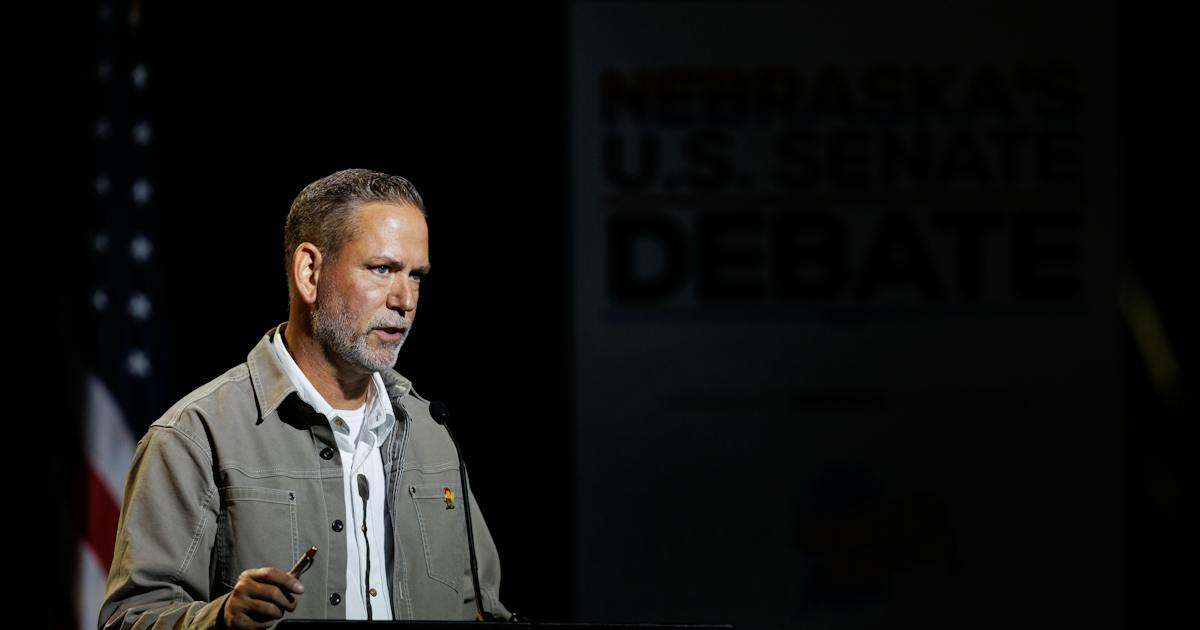
Outside the BigIron Events Center at the State Fairgrounds in Grand Island, Nebraska, the midway blinked with lights and rippled with the faint shrill screams of happy children. At the JBS Show Barn—named for the largest meatpacking company in the world—farm kids unloaded sheep from trailers into straw-lined metal pens to be shown for ribbons. Inside the events center, seating for the lone debate of the Nebraska Senate race had been capped at 200 members of the public. Reporters and cameras were crowded into the back of the cavernous hall. As the 6 p.m. start time approached, everyone shifted impatiently.The incumbent, Republican Senator Pete Ricketts, and his independent challenger, Dan Osborn, could hardly offer Nebraska voters more different options: Ricketts, the former governor, is a multimillionaire and the son of the founder of TD Ameritrade, the stockbroking firm acquired by Charles Schwab in 2020 for a reported $24 billion; Osborn, a Navy veteran and an industrial mechanic, got into politics after leading a 2021 workers’ strike at the Kellogg’s cereal plant in Omaha. At a moment of populist backlash around the country, recent polls put Osborn neck and neck with Ricketts in a state that Donald Trump carried comfortably. Ricketts has responded by relentlessly portraying Osborn as a Democrat in disguise. One young reporter from the Lincoln Journal-Star, sitting cross-legged with her laptop open, waiting for the debate to begin, leaned over to a colleague and asked how long he thought it would take Ricketts to call Osborn “Democrat Dan.”Osborn has been fending off this characterization for years—and has grown more pointed in his denials over recent weeks, as the race has tightened. “I don’t like either party,” he told The New York Times. “I think they both kind of suck.” Yes, he has made core Democratic issues for the midterms a centerpiece of his campaign—health care, corruption, affordability. But he has cleverly framed those issues in terms that are distinctly Republican, even MAGA. Health care? Defend rural Nebraska, he says. Corruption? Drain the swamp. Affordability? Cut waste and “fight to restore real markets in our agricultural system.” Maybe more important, Osborn has sought to sidestep old partisan divides by emphasizing the economic difference. His campaign T-shirts read: “REPLACE A BILLIONAIRE WITH A MECHANIC.” The candidates entered. Osborn, dressed casually, shifted behind the podium, becoming animated when he spoke. “I’m a mechanic, I’m a veteran, and I’m a lifelong independent,” he said in his opening statement. “And I’ve worked 60, 70, 80 hours a week to put food on the table.” Ricketts stood behind his podium in a blue blazer, head tipped slightly back. His hooded eyes blinked impassively. He gave off an air of near-boredom, like a man checking a required box. “My opponent, Democrat Dan”—33 seconds, the young reporters blinked in amazement—“is going to lie to you, trying to hide his liberal beliefs,” Ricketts said. “He was recruited by democrat socialists; Democrats fund him.”There was a grain of truth to the charge. The Democratic Party in Nebraska—recognizing the impossibility of electing a Democrat in a statewide race—had selected Cindy Burbank as its official standard-bearer, but solely so she could withdraw immediately and clear a path for Osborn’s candidacy.Ricketts called Osborn “Democrat Dan” nearly 40 times before the debate concluded an hour later—once about every 30 seconds. Eventually, Osborn suggested that the organizers should have supplied another podium for this Democrat Dan character, because he had never met him. The line got a laugh, but Ricketts kept going. (Full transparency: Ricketts doesn’t like me, either.) The strategy was clear: Osborn could say what he wanted, but Ricketts was determined to tell the audience—most of all the audience watching at home—who he wanted them to think Osborn really was.In a normal midterm cycle, this race, in a bright red state, might be nothing more than a political footnote: Anyone with an R after their name would win, and that would be that. But this year feels different. Across the middle of the country, in agricultural states that have long gone solidly Republican, voters are enraged. Suddenly, Iowa is in play. Kansas is in play. Texas is in play. While coastal punditry tends to see this as a referendum on President Trump, the ground-level issues reveal the degree to which Americans feel abandoned by their government and their politics at all levels—issues that embody what decades of disinvestment and trickle-down economics have wrought: farm failures, dwindling support for cattle and commodity grain markets, the closures of rural hospitals and schools, soaring prices of gas and food, poisoned water and soil, and rising rates of cancer and other health issues. That anger, and those issues, mean “Democrat Dan” may have a shot—regardless of his party affiliation.Republicans aren’t blind to the problem—nor is the problem limited to the Senate. House races have tightened. Gubernatorial margins are narrowing. Party insiders understand that this is largely the product of outrage over affordability. Gas prices, food prices, and housing prices have all risen by 25 to 30 percent in the last year, while wages have remained more or less flat and the unemployment rate has climbed. In simple terms, everything is more expensive, and people are understandably angry.During the debate, Ricketts told a story that was designed to channel some of that populist rage, but it seemed to backfire. “I just went to the grocery store to pick up a pound of hamburger for my mom,” Ricketts said, “and it was $6.99 a pound. Before Joe Biden, it was $4.99 a pound.” The image of the multimillionaire, whose family owns the Chicago Cubs, strolling the grocery aisles looking for bargains on chopped meat for his parents—also billionaires, who, by the way, claim their primary residence as Wyoming—seemed absurd. A ripple of laughter moved through the audience. (Later, Osborn mimed Ricketts holding an iPhone, tapping in a Google search, How much … is … a pound … of ground beef?) Osborn agreed that the number of cattle is down, but blamed the industry’s problems on the concentration of meat processing into the hands of the four companies that dominate it: Tyson, JBS, Cargill, and National Beef. In particular, he denounced the recent news that the CEO of Brazilian-owned JBS had met with Trump just hours before a White House announcement that tariffs would be lifted on lean fine beef trimmings (commonly known as “pink slime”) imported from the South American country. “Bringing in 300,000 metric tons of foreign beef—and beef, mind you, that China wouldn’t even touch—undercuts our actual producers here in the state,” Osborn said. He likened the move to Ricketts allowing vertical integration laws to be repealed so Chinese-owned Smithfield could purchase hogs and farmland.On September 3, Osborn spoke to voters during a town hall meeting at Pals Brewing Company in North Platte.Austin Johnson/AFP/Getty ImagesMeat, therefore, embodies the central contradiction of the moment and this race: Consumers are angry about expensive hamburger; ranchers fear that the government’s attempt to make it cheaper will undercut the value of their cattle. Nebraska—like Iowa and Kansas, the other Plains states suddenly in play for the midterms—sits directly at the intersection of that contradiction. At the beginning of 2026, Nebraska had moved ahead of Texas in cattle, with 2.8 million head in feedlots. The state is third in corn production, fifth in soybeans. Meat ties together ranchers, farmers, feedlot owners, immigrant packinghouse workers, and every small-town business and supermarket consumer dependent on them.On the debate stage in Grand Island, that contradiction played out as an argument about policy. Less than 100 miles west on Interstate 80, in the small town of Lexington, a whole community was experiencing it much more directly.On the edge of Lexington, a city of about 10,000, stands the Tyson beef plant that had once employed roughly 3,200 people. Back in November 2025, workers had been summoned at the end of first shift and told the plant was closing. They emerged into the gravel parking lot crying and calling relatives, panicked over how they would pay their bills. Tyson released a statement saying that the closure was “designed to right-size” its beef business as the American herd remained near historic lows and its beef division lost money. Two days after the debate, Osborn appeared for a campaign event at Big Johnson Brewery in Johnson Lake, a small town about 10 miles south of Lexington. The plant closure had dramatically changed the circumstances of the local people. Former Tyson workers were commuting west to new jobs; charities and churches were helping families make rent and utility payments; businesses were confronting the disappearance of thousands of paychecks. One audience member described the surge in requests for assistance and worried about what would happen when the emergency money ran out. Osborn listened and folded the account into the argument he had been making about corporate concentration.“When Tyson closed the plant, I took an antitrust lawyer out there for a press conference, and I accused Tyson of breaking the law—specifically, the Packers and Stockyards Act of 1921,” he said. “There are four big packers. They strategically close down plants so they can control what they pay for products, and they’ve vertically integrated the entire system.” Several ranchers turned to each other and nodded. “I think what a senator should be doing is what Pete Ricketts said he was going to do but didn’t,” Osborn continued. Ricketts had promised to lead an investigation of Tyson. “That week, according to [Federal Election Commission] reports, Tyson donated to Pete Ricketts, and he didn’t find any wrongdoing. Of course.” Osborn’s answer was typical of his town halls: A question from a rancher leads him toward packers; a hospital bill toward insurers; a Tyson layoff toward antitrust law and campaign finance. The audience can watch the connections form in real time.The major packers have denied unlawful coordination, and the economics of high beef prices include drought, a historically small herd, disease restrictions, and strong consumer demand. But Osborn’s point had a powerful simplicity: If shoppers were paying more, workers were losing jobs, and ranchers feared losing leverage, who was capturing the value in between?After Trump’s order in August that temporarily expanded low-tariff imports of pink slime from Brazil, Osborn argued the answer was obvious: “Brazilian-owned JBS.”After the Johnson Lake event, Osborn and I went outside and sat at a picnic table. Osborn is compact and was dressed in a workshirt, his sleeves rolled up, exposing the tattoos on his right arm: nautical imagery from his Navy years mixed with the names of his daughters. He rarely held still for long, sitting sideways at the picnic table, leaning toward a question and then back again as he answered, his eyes often drifting into the distance as he searched for just the right words. Much like at his town halls, Osborn talks by association, often seeming to begin a reply before he knows exactly where it will end. It’s part of his appeal: Like many voters, he seems to be searching for answers. When I asked why he thought political discontent seemed to be spreading across the middle of the country, however, he answered simply, with certainty: “I think it’s their pocketbooks, really, at the end of the day.” After his failed 2024 Senate campaign—he was defeated by the Republican incumbent, Deb Fischer, by nearly seven points—a reporter told Osborn that he had run as an economic populist. “I’m like, ‘I did?’” Osborn said. “I don’t really know what that means.” What he understood was a paycheck. “My whole life, I’ve gotten a paycheck, and I’ve lived pretty much week to week and month to month.” He started to call his politics “paycheck populism,” tracing the phrase back to a worker at Kellogg’s who had pulled him aside during his first days on the job. “I don’t care what your politics are,” Osborn remembered the man saying, “but when you go into the voting booth, you need to vote your paycheck.” Osborn still carried the lesson: “Who’s going to be the best for your paycheck? Everything else is just noise to me.”The town hall inside the brewery had demonstrated both the strength and the limitation of that political approach. For Lexington families, a paycheck had disappeared while the rent remained. But immigration, culture, and party identity were not “noise” to everyone, even here, and Ricketts was betting that those issues could define Osborn before Osborn could define the race economically. Osborn kept returning to money and power. I told him about the political access enjoyed by the Batista family, the owners of JBS. “I did not know that,” he said, seamlessly pivoting to a theme he had been returning to all day: “Our politics have gotten to this place where cash is king.”Nowhere more so than in his race against Ricketts. Campaign reports showed that Ricketts had put more than $5 million of his own money into his campaign between April and June, while corporate PACs contributed heavily across his donor list. “If we’re only watching TV commercials and listening to radio ads,” Osborn told me, “Ricketts is going to win by a landslide, because he’s got all the money to stay on there.” His answer was a 93-county barnstorming tour: small rooms, big questions, conversations that might travel through families and neighbors. “It’s not about some cute little thing that we can put on Facebook,” he said. “It really is about getting out here and listening to people, telling them my ideas, exchanging ideas.”I was surprised in talking to Osborn that afternoon in Lexington at the ways in which his paycheck populism was less anti-rich than his public rhetoric about billionaires would suggest. After describing the “funnel of money to the top” and wondering whether the country was becoming “a caste society of haves and have-nots,” he told me about seeing wealth and poverty side by side during a visit to Dubai. “My vision is to have the haves and the have-mores,” he said. “I think there’s enough here for everybody. No ceilings, but a strong floor.” In Lexington, however, that floor had suddenly given way.Some of the workers who had fallen through that floor in Lexington were now traveling roughly 60 miles west to jobs at Sustainable Beef and a Walmart distribution center in North Platte. After long shifts, some climbed onto buses and slept against the windows on the long ride home. Sustainable Beef complicated Osborn’s concentration argument. It was a small, new processor—the newest in the U.S., according to the company—entering an industry dominated by four giants, and it was now employing some of Tyson’s former workers. But it also made visible the economic geography of a plant closure. Jobs had not simply vanished; they had moved, and workers had to move with them or spend hours chasing them down Interstate 80.At Pals Brewing Company on the southern edge of North Platte, Osborn held another town hall, where his remarks ranged across Iran, oil, diesel, fertilizer, tariffs, immigration, agriculture, data centers, water, and beef. To him these were not separate policy buckets. War affected fuel; fuel affected farming and freight; trade affected crop markets and feed; packer concentration affected ranchers, workers, and consumers. U.S. diesel prices had reached record levels, intensifying pressure on farmers during harvest. Nebraska growers were producing enormous crops of corn and soybeans while waiting on the next turns in U.S.-China trade policy. The state’s feedlots held more cattle than those of any other state at the start of the year. The same voters confronting high grocery prices were therefore tied economically to cattle values, feed costs, export markets, and packing capacity. The price of a hamburger contains multitudes.But by North Platte, Osborn was being forced to talk about something else: himself. Recordings of private or less-public conversations had leaked to the media. One captured him discussing what he could safely say about ICE; another recorded him calling Trump’s border wall “a symbol of racism.” A week later, a third recording surfaced, in which Osborn tried to explain Trump’s appeal by imagining a voter in Red Cloud, whom he called “Billy Bob,” waving a Trump flag and enjoying the feeling that he was on the winning team. Osborn then said the man’s life “probably sucks.” The comments seemed to cut against his claims of feeling the pain of working people whom professional politicians have ignored. (And polls suggested that the leaked audio may have had at least a short-term effect.) When CNN’s Dana Bash played the recording and asked whether the voice was his, Osborn answered, “It sure sounds like me.” He apologized to anyone offended, then almost immediately began trying to diagnose the anger beneath the remark: farm bankruptcies, consolidation, input costs, people who felt economically abandoned. Asked moments later about high beef prices, he snapped back onto familiar terrain. “We got to break up the meat-packers,” he said.That juxtaposition captured the campaign’s central tension. Osborn wants to make big corporations like Tyson and JBS the bad guys—the single biggest culprit for why ordinary people are feeling such pain at the gas pump, grocery store, feedlot, and factory floor. Ricketts is arguing that Nebraska and the country are broadly on the right course under Trump and that Osborn running as an independent conceals positions voters would reject if they only knew about them.For Osborn, the challenge is to convince Nebraska voters that he truly is an independent, not a secret Democrat. And his best chance may be to keep the race focused on the issues where he is strongest: an economic crisis unfolding inside a food system under extraordinary strain.Yes, consumers want cheaper beef. But also: Ranchers want cattle prices high enough to rebuild their herds; packinghouse workers want plants that stay open and offer fair wages; rural towns want the revenue that economy provides. In a Senate race with national consequences, each candidate is offering a different explanation for who has benefited from the system and who has been asked to absorb its failures. The balance of power in Washington may come down to something as ordinary, and as politically loaded, as what a family pays for a pound of hamburger.This story was produced in partnership with the Food & Environment Reporting Network, an independent, nonprofit news organization.
He’s Attacking Big Ag. He’s Running in Nebraska. Somehow It’s Working.
Full Article
Original Source
Read the full article at Newrepublic →KhanList aggregates and links to publicly available news content. We do not host full articles from third-party sources. Always verify important information with original sources.