
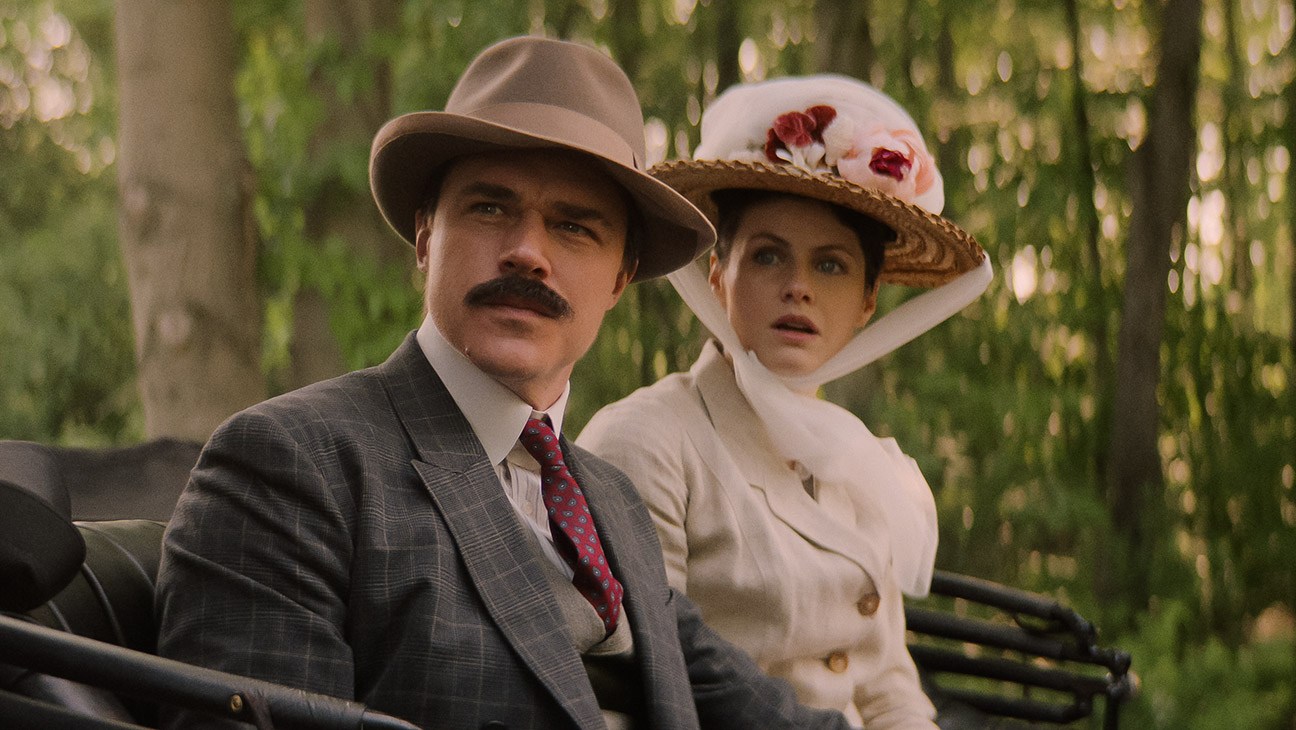
The new film about the founder of the Hershey Company begins with a loving, beautifully lit close-up of one of the company’s signature products, a Hershey’s Kiss. That tells you pretty much everything you need to know about this effort produced in part by Hershey Entities and distributed by Angel Studios. Starring Finn Wittrock (American Horror Story) in the title role, Hershey is a blandly sanitized biopic that’s as sickly sweet as the candies the company sells. Being released for Thanksgiving, it essentially serves as a feature-length product placement. The film, which an opening title card informs us is “based on the unlikely true story,” begins in 1870 with a young Milton (James Kelly) growing up in a Mennonite community in rural Pennsylvania. After the tragic death of his younger sister and the abandonment of the family by his dreamer father (Alan Ruck), he begins working for a kindly confectioner, Joseph Royer (Richard Kind, at his most twinkly), who teaches him candy-making methods. Hershey The Bottom Line Will give you cavities. Release date: Wednesday, November 25Cast: Finn Wittrock, Alexandra Daddario, Alan Ruck, Richard Kind, David Costabile, James Kelly, Michael Moreland Milligan, Daniel David Stewart, Joel Brady, Francesca Faridany, Dina Spybey-Waters, John Hans Tester, Heléne Yorke, Mark Ashworth, Isabel Van NattaDirector: Mark WatersScreenwriters: Sharon Paul, Timothy Michael Hayes Rated PG, 1 hour 50 minutes Milton is soon inventing original candies and eventually opens his own shop specializing in (oh, the irony) caramels. The shop fails but the young entrepreneur is undeterred, and he tries again with a store in Lancaster, Pennsylvania, that takes off after a bulk order from a visiting Englishman. The episodic screenplay by Sharon Paul and Timothy Michael Hayes chronicles Hershey’s rise to prominence in dutiful fashion, including his eventual transition to producing chocolates. This comes about after a visit from a salesman representing a German chocolate company, who, after being rejected by Hershey because the product tastes bitter, warns him, “I think you’re missing out on what’s next.” Sure enough, Hershey changes his mind, realizing that all the chocolate needs is some milk to make it taste better. The rest, as they say, is history. “Caramels are a fad, but chocolate is permanent,” Hershey confidently tells his associates. On his way to becoming a chocolate titan, Hershey meets the adorable Kitty (Alexandra Daddario), with their love story fueling much of the film’s second half. He turns the village where he grew up into the company town that still bears his name, treating his employees benevolently (the violent labor disputes that occurred in later years are ignored) and, at the urging of his wife, opening a school for impoverished youth that still exists today. (Left unmentioned is the fact that admission was restricted to whites; Black students weren’t admitted until 1968.) Another major plot element is Kitty’s serious illness, which prevents her from having children and results in numerous scenes that find her nearly collapsing while Milton looks on concernedly. Flavorlessly directed by Mark Waters (far past his Freaky Friday and Mean Girls glory days), Hershey never succeeds in coming to life, playing like the sort of candy-coated dramatized film that would find its most receptive audiences at the Hershey Story Museum in Pennsylvania. Every scene plays out exactly as you’d expect, with conflicts resolved serendipitously and Hershey benefiting from fortunate strokes of luck, including a malfunctioning machine producing what became the Hershey’s Kiss and the couple miraculously avoiding a planned voyage on the Titanic (they dance to their good fortune, which, considering what happened to the poor souls onboard, seems a bit tacky). Wittrock, eventually outfitted with a period-perfect moustache, does a reasonably good job but is ultimately unable to overcome the script’s deficiencies. Daddario fares better, conveying a tender warmth and playfulness that infuse the film with much of its heart. (Strangely, Wittrock eventually receives old age makeup treatment while Daddario looks virtually the same throughout). The supporting players, including David Costabile (Billions) as a composite business competitor, do exactly what’s expected of them. The film ends in predictable fashion, with vintage photographs of the real-life figures and present-day footage of the school and its grateful students. That’s followed by one of those annoying “Pay It Forward” pitches, gamely delivered by Wittrock and Daddario, urging us to pour more money into the studio’s coffers under the guise of philanthropy.
‘Hershey’ Review: Finn Wittrock Plays the American Chocolate Titan in a Sickly Sweet Biopic
Full Article
Original Source
Read the full article at Hollywoodreporter →KhanList aggregates and links to publicly available news content. We do not host full articles from third-party sources. Always verify important information with original sources.