
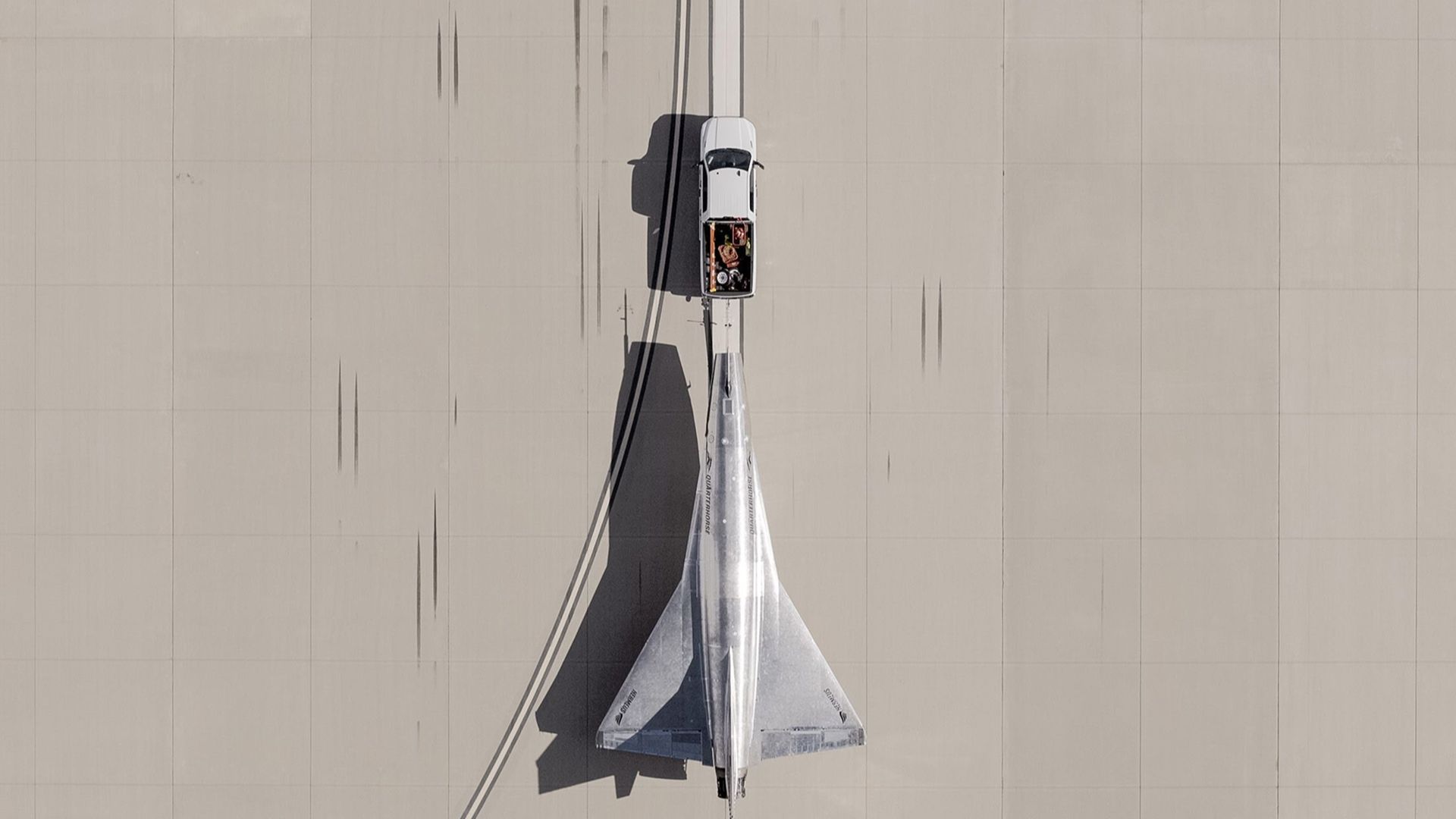
Hermeus has selected Anduril to integrate its mission autonomy technology with the Quarterhorse Mk 2, bringing autonomous and collaborative flight capabilities to the company’s high-Mach aircraft program. Under the agreement, Anduril will integrate its Lattice for Mission Autonomy software with Quarterhorse Mk 2. The system is intended to allow multiple aircraft to collaborate on missions while giving human operators a common interface to interact with the aircraft throughout the mission. High-Mach flight meets autonomous aircraft According to Hermeus, the partnership will combine two rapidly developing areas of military aviation. High-speed flight and mission autonomy. Lattice for Mission Autonomy is designed to provide an end-to-end software environment through which operators can interact with autonomous systems. Hermeus says it covers activities including operational analysis, threat modeling, training, mission planning, execution, and post-mission debriefing. Operators will use Anduril’s Menace-T C4 system as the physical interface for interacting with the aircraft. Hermeus says the interface is intended to help operators work with autonomous aircraft throughout the mission rather than treating autonomy as a capability that operates separately from human control. The companies are already integrating the systems, with the first mission-autonomy flight on Quarterhorse Mk 2 planned for 2027. The agreement is also notable for Anduril. Hermeus says it is the first commercial agreement in which Anduril will integrate its mission-autonomy solution with a third-party Group 5 aircraft. It will give the company an opportunity to demonstrate its autonomy software on an aircraft operating at high Mach speeds. Quarterhorse is moving rapidly toward flight testing Hermeus has been developing Quarterhorse as part of its effort to rapidly design, build, and test high-Mach and hypersonic aircraft. The company says it flew its first aircraft in 2025 and reached supersonic speeds with the Mk 2.1 aircraft 364 days later. The program has also recently demonstrated the ability to deploy a payload, while the next aircraft, Mk 2.2, was built in less than a year. The Quarterhorse Mk 2 aircraft are being developed as test platforms for technologies relevant to future high-speed flight. Adding mission autonomy gives Hermeus another capability to evaluate as the aircraft program progresses. The companies say the eventual objective is not simply to make an individual aircraft autonomous, but to enable coordinated, collaborative missions involving multiple aircraft. That could change how high-speed aircraft are employed. Instead of relying entirely on a pilot to control each aircraft and manage every action, autonomous systems could potentially coordinate aspects of a mission while human operators retain oversight and control. Building an autonomous aircraft ecosystem The Hermeus partnership also connects Quarterhorse to a wider effort to establish common technologies for autonomous military aircraft. Anduril’s Lattice autonomy technology is already being used in the U.S. Air Force’s Collaborative Combat Aircraft (CCA) program, according to Hermeus. The company says the Air Force’s Autonomy Government Reference Architecture (A-GRA) is intended to promote compatibility between autonomy software and aircraft hardware. Hermeus argues that this modular approach can help create a broader ecosystem in which autonomy technologies can be transferred between different aircraft rather than being developed separately for every platform. For Quarterhorse, that means the aircraft’s high-speed capabilities could eventually be combined with an autonomy system already designed around collaborative robotic flight. The first autonomous Quarterhorse mission is still planned for 2027, so the combined system has yet to demonstrate this capability in flight. But the integration marks a significant step for Hermeus as it moves from demonstrating high-speed flight toward testing how autonomous aircraft could operate at those speeds. This effort could offer a glimpse of a future in which speed and autonomy are developed together rather than as separate capabilities, allowing high-Mach aircraft to become participants in larger coordinated missions. Get the latest in engineering, tech, space & science - delivered daily to your inbox.Kaif Shaikh is a journalist and writer passionate about turning complex information into clear, impactful stories. His writing covers technology, sustainability, geopolitics, and occasionally fiction. A graduate in Journalism and Mass Communication, his work has appeared in the Times of India and beyond. After a near-fatal experience, Kaif began seeing both stories and silences differently. Outside work, he juggles far too many projects and passions, but always makes time to read, reflect, and hold onto the thread of wonder.
Hermeus and Anduril team up to boost the autonomy of Quarterhorse Mk2 supersonic aircraft
Full Article
Original Source
Read the full article at Interestingengineering →KhanList aggregates and links to publicly available news content. We do not host full articles from third-party sources. Always verify important information with original sources.