
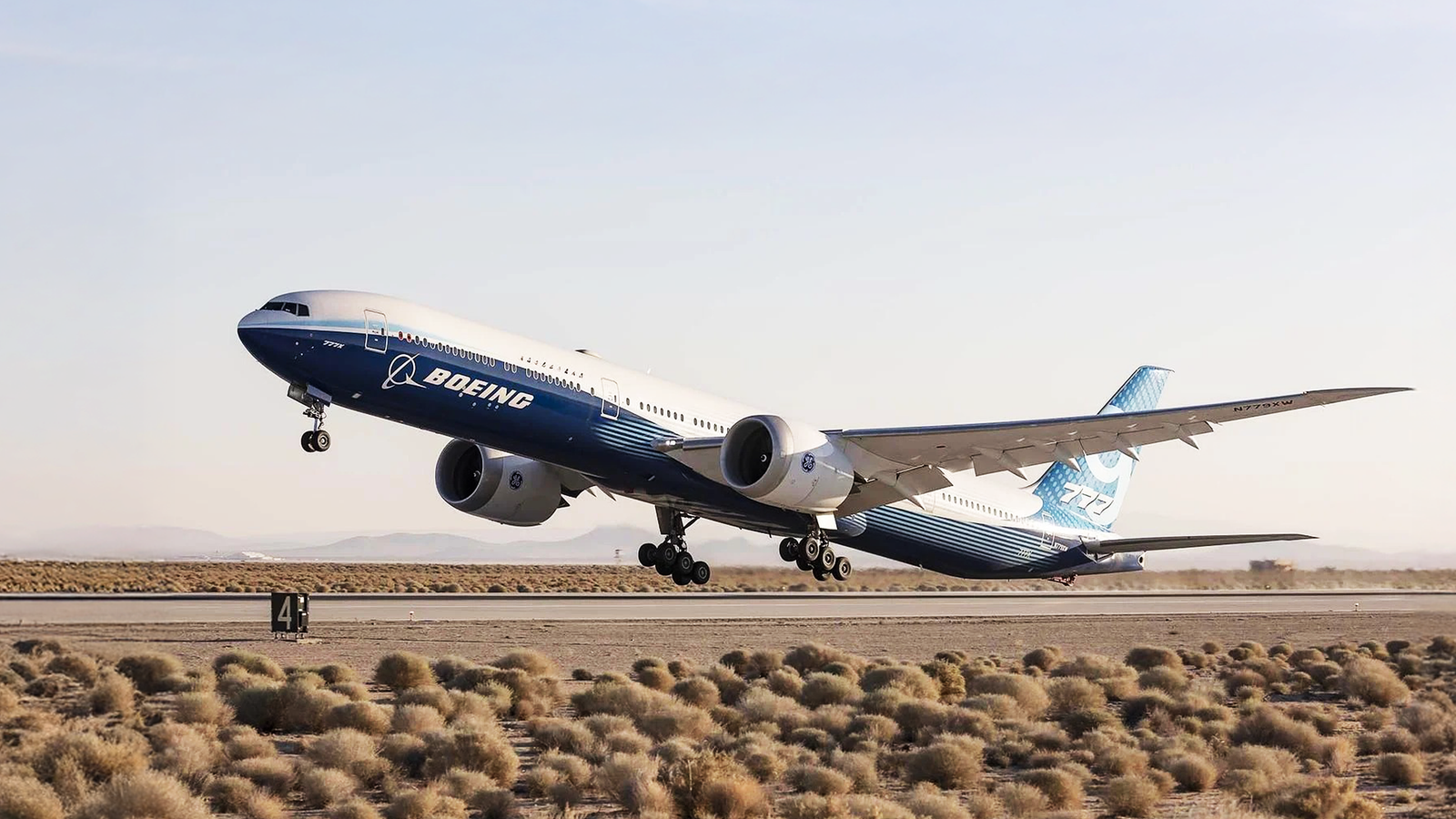
Published Sep 3, 2026, 2:02 PM EDT An aviation geek at heart, Channing enjoys the thrill of covering some of the industry's top headlines. With nearly a decade of professional experience, his longtime passion for traveling and airplanes brings a unique approach to his reporting. Channing holds a degree in broadcast journalism and spends some time freelancing in local news. US West Coast-based. The Boeing 777X cannot take off with its wingtips folded due to critical safety and aerodynamic reasons. The extended wingtips are essential for the 777X's designed lift and fuel efficiency. Taking off with them folded would significantly increase drag and reduce lift, potentially compromising the aircraft's safety during the critical takeoff phase. While the 777X is physically capable of remaining airborne with its wingtips folded, it is strictly prohibited and operationally restricted from doing so by both design and regulation. The aircraft is equipped with escalating warning systems that alert pilots if the wingtips are not extended and locked before entering a runway. Federal Aviation Administration (FAA) certification requires these systems to effectively prevent the aircraft from taking off in a folded configuration. The Nuts & Bolts Credit: Coby Wayne | Shutterstock The 777X uses a revolutionary wingtip folding system designed and manufactured by Liebherr-Aerospace at its center of excellence in Lindenberg, Germany. This system is a first for commercial aviation and allows the aircraft to maintain high-efficiency aerodynamics in flight while fitting into standard airport gates designed for smaller aircraft. The 3.5-meter (approx. 11 feet) wingtips are operated by a complex actuation system that transitions them between folded (vertical) and extended (horizontal) positions. The movement is driven by a hydraulic power drive unit (PDU) and geared rotary actuators. The full transition takes approximately 20 seconds. Once extended, the wingtips are secured by latch-pin and secondary-lock actuators. During flight, the mechanism is mechanically locked with a large bolt and electronically isolated. This ensures the wingtips cannot move even if there is a power failure. 777X: Made For The Ride Credit: Falcons Spotters | Shutterstock A wider wingspan moves the wingtip vortices further away from the fuselage. This reduces the downwash on the wing, allowing it to generate more lift with less drag. The larger surface area creates more lift, reducing the thrust required from the GE9X engines to stay airborne. This results in a roughly 10%-12% improvement in fuel efficiency compared to previous generations and competitors. The 777X integrates advanced aerodynamics with digital flight controls to deliver a ride that is significantly more efficient and comfortable than its predecessors. The extra span enables the 777X to climb faster and cruise at higher, more efficient altitudes where air resistance is lower. Made from carbon-fiber reinforced plastic, these wings are thinner and lighter than traditional aluminum wings. This allows for the massive span without a prohibitive weight penalty. With GE9X engines, these aerodynamics result in lower fuel burn than competing aircraft like the Airbus A350, and a 20% lower fuel consumption rate than the legacy 747, which it is designed to replace. The 777X features Smooth Ride Technology, an advanced fly-by-wire system adapted from the 787 Dreamliner, designed to neutralize turbulence actively. Hundreds of sensors detect air disturbances in real-time. The flight computer then automatically actuates the control surfaces, specifically the flaperons, to damp vertical motion and pitch that passengers feel during turbulence. The highly flexible composite wings act like giant shock absorbers, bending and flexing during flight to absorb gust loads rather than transmitting those forces directly to the cabin. Beyond the ride quality, the 777X offers a lower cabin altitude (6,000 feet) and higher humidity. These environmental improvements, combined with 40% less engine noise, help reduce jet lag and physical fatigue on long-haul flights. Averting Aborted Takeoff Credit: Falcons Spotters | Shutterstock The folding mechanism is not designed to handle the massive aerodynamic loads encountered during takeoff and flight while in the "up" position. Attempting a flight with them folded could lead to mechanical failure or the tips breaking off. Boeing integrated multiple fail-safes into the flight systems to prevent such an occurrence. If the wingtips are not extended and locked, the aircraft's takeoff warning system (required by the FAA and EASA) will trigger a loud alarm when the pilot adds power. Boeing implemented an electronic checklist that confirms the position of the wingtips. If the flight crew attempts to initiate a takeoff procedure, the system will indicate “incomplete” until the wingtips are extended. If the pilots begin to take off roll without extending the wingtips, the avionics in the 777x will no longer trigger an aborted takeoff once the plane reaches 50 knots ground speed. Interestingly, Boeing had already explored folding wingtips for the original 777 in the mid-1990s, even patenting a design. However, that version was heavy and complex; the technology only became commercially viable with the advancements in materials and actuation seen in the 777X. Combining advances in new material science with the newly acquired archives of McDonnell Douglas made it a natural evolution to develop the next-generation Boeing widebody with folding wings. Forged By Battle Credit: US Navy In its 1997 merger with McDonnell Douglas, Boeing inherited the F/A-18 Super Hornet program. The pivotal deal that integrated decades of naval aviation expertise into Boeing’s defense portfolio. By combining with the storied warplane manufacturer, Boeing inherited a rich legacy of naval fighter jet engineering and design. Looking past the hornet, the annals of the McDonnell portfolio include the most mass-produced supersonic naval fighter ever made, the F-4 Phantom II. In naval aviation, wing folding is often a manual pilot action verified by ground crews. For the 777X, Boeing automated the process to reduce pilot workload: the wingtips automatically fold when ground speed drops below 50 knots after landing. Unlike the Super Hornet, where a significant portion of the wing folds, the 777X only folds the outer 3.5 meters (11 feet) of its tip. This minimizes the weight penalty and places the hinge where structural loads are lower compared to a mid-wing fold. The 777X incorporates "spill-over" benefits from military R&D, specifically in the use of high-redundancy sensors and fail-safe locking pins that ensure the wing is structurally one piece before the engines can reach takeoff power. Boeing had to prove to the FAA that its new commercial mechanism could withstand aerodynamic loads equivalent to a fixed wing, leveraging testing methodologies honed over decades of military carrier operations. The First Time Around Credit: AlfonsoSM | Shutterstock In 1995, Boeing patented a design for folding wingtips on the original 777, but the proposal was abandoned because airlines rejected the idea. The primary reasons for its abandonment were the added weight, reduced fuel capacity, and increased maintenance costs associated with the design. The main objective was to allow the widebody aircraft to fit into existing "Code E" airport gates, as initial designs anticipated a wingspan that might exceed standard limits. The original proposal featured a hinge positioned closer to the wing root, with the outer 21 feet (6.4 meters) of each wing designed to fold upward. Airlines found the engineering solution overly complex. The hinge's location negatively affected fuel capacity and added significant structural weight, making the trade-offs in performance and cost unacceptable at the time. The concept was not entirely discarded and was later refined and implemented in the current Boeing 777X program, which features a much larger, more fuel-efficient carbon-fiber composite wing. The folding mechanism on the 777X is placed further out on the wing, which minimizes the impact on fuel capacity and adds less weight than the 1995 design. The 777X's wingspan is significantly larger than the original 777 and would fall into the restrictive ICAO Code F category without the folding tips. The 777X's 11-foot (3.36 meters) folding wingtips reduce the wingspan to within Code E limits when on the ground, allowing it to use most existing airport gates. This makes the aircraft more versatile and avoids costly airport infrastructure upgrades that competitors like the Airbus A380 require. The Reward Of Innovation Credit: Thiago B Trevisan | Shutterstock The 777X program is famously delayed by nearly a decade. Originally slated to debut in 2020 for launch customer Lufthansa, the enormous twinjet is not expected to enter full-rate production until 2027. Boeing CEO Kelly Ortberg said this year that the company has “a mountain of work” ahead of it for certification. These delays are in no small part due to the 737 MAX disasters, with two fatal crashes in 2018 and 2019 that caused the death of 350 Souls. As the legendary American planemaker has course-corrected in the years following the tragic mishaps of the latest and greatest iteration of the 737, narrowbody mainline airliner, the 777X program has faced additional headwinds. The company refocused on quality control and pushed ahead to ensure that all airframes remain as high-quality as they have always been, since the days when passengers would say, "if it's not Boeing, I'm not going.” The Dubai Airshow 2025 reaffirmed customer confidence in the 777X, as the colossal twinjet offers the only viable replacement for the world's aging fleets of jumbo jets, such as the Airbus A380 and the legacy Boeing 747. Emirates, which is the world's leading widebody operator, upped its order for 65 more of the forthcoming 777X. The aircraft promises to usher in a new era of commercial aviation, which we look forward to witnessing when the day comes.
Here’s Why The Boeing 777X Won’t Let Pilots Take Off With Its Wings Still Folded
Full Article
Original Source
Read the full article at Simpleflying →KhanList aggregates and links to publicly available news content. We do not host full articles from third-party sources. Always verify important information with original sources.