
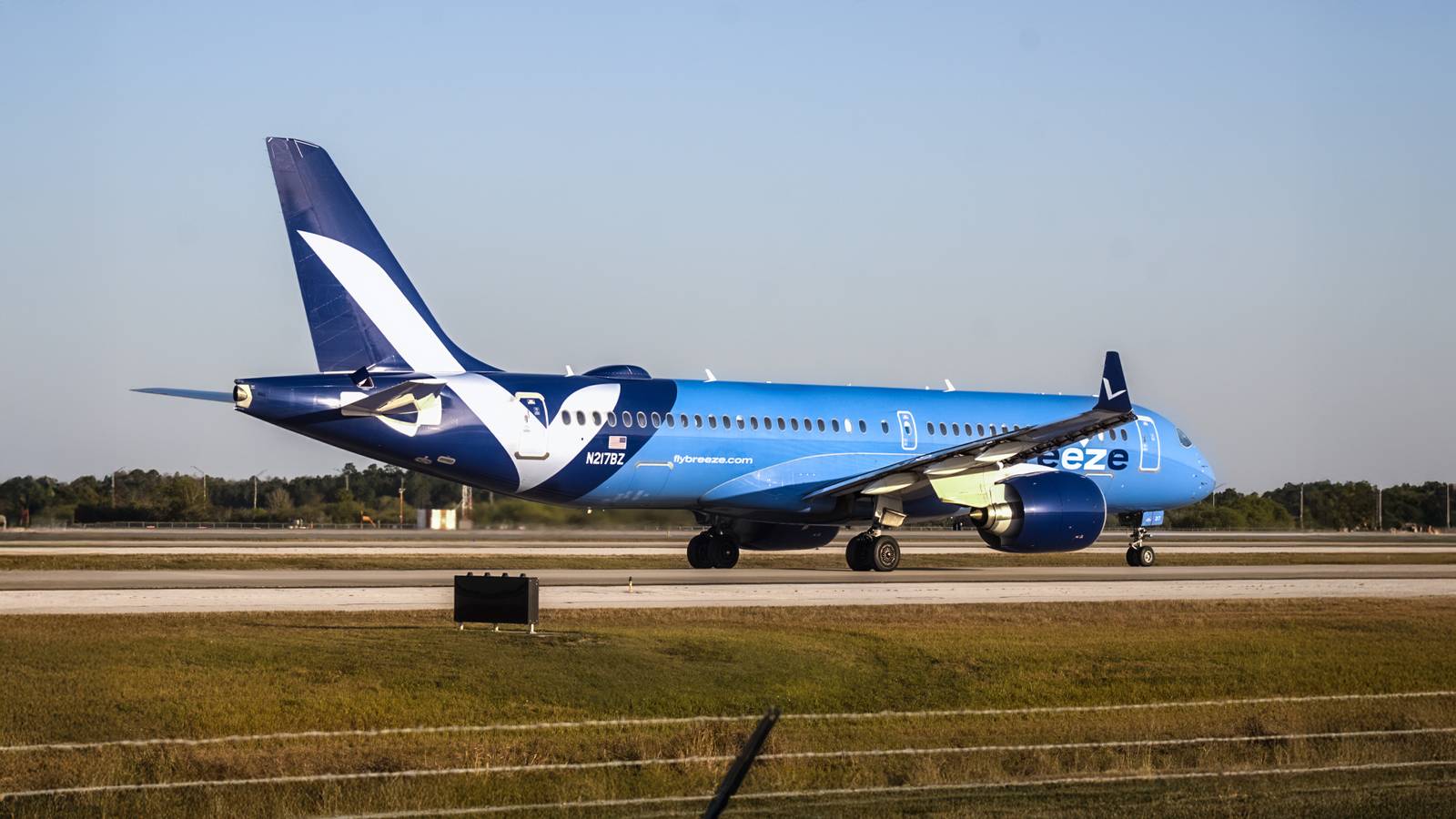
Published Oct 24, 2026, 7:00 AM EDT Luke Diaz is a freelance military writer with experience with active duty experience in the US Navy as well as defense and industrial engineering. He is a former Naval Flight Officer who performed tactical air control on the carrier-based E-2 Hawkeye. Originally developed as the Bombardier CSeries, Airbus' increasingly popular small single-aisle jet was only able to achieve the success it is seeing today after it was rescued and rebranded by the European aerospace juggernaut as the A220. Despite an origin story that started in the clutches of abandonment, the A220 has since collected 1,107 orders and delivered 550 aircraft as of September, according to MRO Business Today. The Montreal planemaker that first developed the plane that became the A220 had never built anything larger than a regional jet and envisioned the CSeries as its 'moonshot' to break up the Airbus-Boeing duopoly. Ultimately, making the 100 to 150-seat narrowbody proved to be too great a challenge, as development delays and cost overruns nearly bankrupted Bombardier. Airbus acquired a 50.01% controlling stake in the program for just $1 in 2018. Bombardier fully withdrew after transferring its remaining 25% stake to Airbus in 2020. Today, Airbus owns 75% of the program, and the government of Quebec owns 25%. In the past six years, airlines worldwide have made the A220 a core pillar of their short-to-medium-haul networks because it occupies a highly profitable niche. Although the plane's creator did not achieve its dream of competing with the titans of commercial aviation, it remains a historic Underdog success story. The Rising Success Of The A220 In A Narrow Market Credit: Airbus Airbus delivered its 500th A220 in late March. The global fleet now flies with 25 operators on more than 1,900 routes. Airbus has also reported operational reliability of roughly 99%, numbers akin to a mature airliner rather than a risky new design. As one of the leading operators, Delta Air Lines shows what an A220 fleet looks like at scale. The small narrowbody has become a key tool for connecting hubs, not just a niche airframe for thin routes. Cesium schedule data shows DAL scheduled 97,438 flights for its A220s in 2026, which produces an average of 267 every day. Few airlines would commit that much traffic to an aircraft they consider a dubious product. Likewise, JetBlue, Air France, airBaltic, and smaller regional lines like Breeze Airways have heavily invested in A220 orders to bolster their flightlines. In May, AirAsia signed the program's largest single firm order, 150 A220-300s, according to the Canadian Press. All of those aircraft will be built at the Mirabel plant north of Montreal despite Bombardier's departure from the factory floor. What began as a multi-billion-dollar corporate gamble for an ambitious Canadian maker has matured into one of the single most industrially disruptive airliners in modern history. Building A Plane For An Empty Airframe Class Credit: Airbus The transformation of the Bombardier CSeries into the Airbus A220 stands as one of the most unusual chapters in modern aviation. While the infrastructure, sales, and supply chain of Airbus ultimately saved the aircraft from ruin, the airplane flying today is mechanically the exact machine designed by Bombardier. Airbus made virtually no changes to the clean-sheet design after taking the helm. Airbus describes the A220 as the only aircraft purpose-built for the small end of the single-aisle market. The advanced aerodynamics, heavy use of weight-saving lithium-aluminum alloys, and carbon-fiber composite wings were all developed during Bombardier’s tenure. The integration of the Pratt & Whitney Geared Turbofan engine was already decided. The aircraft was already certified and carrying passengers when program ownership was abdicated by Montreal's famed planemaker. The program's irony is that Bombardier achieved total engineering success but suffered total industrial failure. By absorbing the program into its global network, Airbus brought immediate credibility to the order book. It also applied its immense supply chain leverage to drive down production costs. To bypass crippling American tariffs that threatened the program, Airbus even established a second assembly line in Mobile, Alabama, a move only its industrial might could replicate. The Winning Combo Of Low Operating Costs And Cabin Comfort Credit: Airbus Cost is where the case becomes convincing. Airbus claims the A220 burns 25% less fuel per seat than the previous generation of small single-aisle jets, with a similar cut in emissions. However, in the cabin, passenger comfort is the first thing travelers notice. The CSeries, and the A220 that followed, was designed as a regional jet that delivers a single-aisle cabin experience. The company also says it offers up to 20 more seats than some competitors and up to 14% lower operating cost per seat. Business class cabins on an A220 offer four seats across at 21 inches (53.3 cm) wide, and extra-large overhead bins add 20% more volume. Meanwhile, economy seats measure more than 18 inches (47 centimeters) wide, and the middle seat in each row of five stretches to 19 inches (48.3 centimeters). Two seats sit on one side of the aisle and three on the other. The windows measure 11 by 16 inches (28 by 41 centimeters), and the ceiling is four inches (10.1 centimeters) higher than on competing jets. The A220 Goes The Distance With JetBlue Credit: Airbus The A220 has proven especially well suited to replace the venerable Embraer E190, a popular regional plane in the US domestic market for decades. JetBlue, for example, was the launch customer of the Brazilian-built workhorse, but it has already received over 50 A220s to modernize the smaller end of its fleet, and that's just half of its total order. Not only does the A220 offer superior fuel efficiency and more legroom, but it also provides greater seat capacity and longer range, which means it is an upgauge and an upgrade over the legacy E-jets it often replaces. Operating a specialized 140-seat configuration on its A220-300 variants, JetBlue purposefully keeps the passenger count below the aircraft's maximum exit limit to augment the plane's transcontinental range. That allows for flights from JetBlue's primary hub at New York JFK to secondary western fields like Reno-Tahoe and Hollywood Burbank in California. The carrier has also been able to deploy A220s on long-range coast-to-coast flights from Boston Logan to West Coast destinations like Sacramento, California, and Portland, Oregon. Delta Maximizes Network Flexibility With Airbus' Light Single-Aisle Credit: Airbus Delta has pushed the A220 to its maximum potential, using it as the backbone for Midwestern and West Coast inter-hub 'puddle jumps' as well as a connector between large fields and regional airports. Salt Lake City International Airport (SLC) has become the world's largest hub for A220 operations, as DAL designed the airfield as the jet's primary launchpad while overhauling its entire regional operation. While the regional E190 pioneered the sub-mainline aircraft concept, its high maintenance requirements and thirsty engines increasingly squeezed airline profit margins. The high-frequency shuttle between Salt Lake City and John Wayne Airport in Orange County, California, exemplifies how the A220 excels on busy, capacity-constrained routes. OC's John Wayne Airport (SNA) is notorious for its strict noise curfews, short runway, and steep departure profiles. The A220's refined aerodynamics and GTF engines have been extremely valuable, allowing Delta to fly heavy passenger volumes using maximum takeoff power out of the airport without triggering local noise violations. At the same time, the A220 has also allowed DAL to avoid the financial penalty of flying a larger, partially empty Boeing 737 or Airbus A320 on routes like SLC and Minneapolis-Saint Paul International Airport (MSP). When a route has soft or highly variable passenger traffic, airlines can substitute the A220 for larger narrowbodies to shield against financial hemorrhaging while keeping routes on schedule. The Small Narrowbody Advantage Credit: Airbus The fundamental issue with flying a standard-sized narrowbody Airbus A320 or Boeing 737 on a soft-traffic route is the high trip cost. There is ultimately a floor that cannot be lowered every time one of these industry-standard single-aisle Jets takes off. Regardless of how many passengers are on board, Mainline narrowbodies have heavier baseline weights, higher landing fees, and larger engines that burn substantial fuel just to get into the sky. The A220 lets operators lower that break-even floor further than any variant of the A320 or 737. If passenger demand drops, an A220 can fly with a modest passenger load and still comfortably turn a profit, whereas a larger aircraft would bleed cash on the same itinerary. Today, no other plane offers what the A220 does. That allows JetBlue to take more risks with long and thin routes. Delta can swap out its larger airframes as traffic changes without changing its schedules, while smaller carriers can use a low-cost airframe to break into the market. Although the name Bombardier didn't adorn the A220's fuselage, its legacy lives on in the engineering that made Airbus' littlest jet a disruptive, historic success in a notoriously impenetrable industry.
Here's Why Airlines Now Can't Live Without The Aircraft That Was Developed By A Regional Jet Maker
Full Article
Original Source
Read the full article at Simpleflying →KhanList aggregates and links to publicly available news content. We do not host full articles from third-party sources. Always verify important information with original sources.