
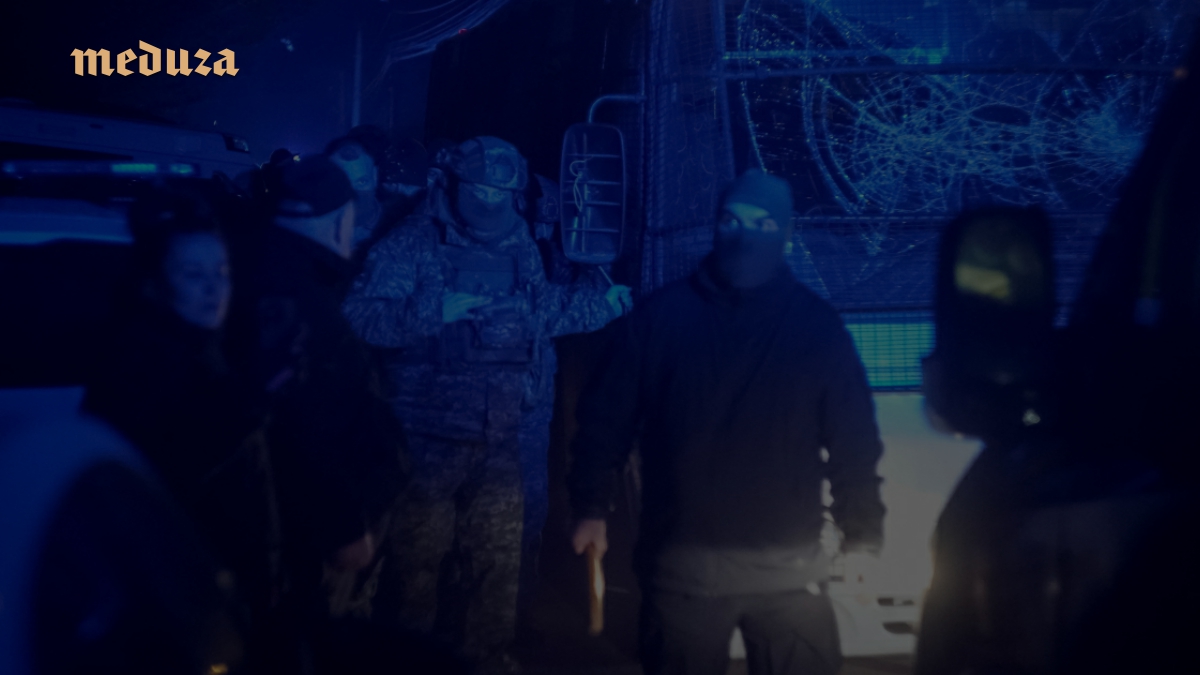
On November 2, several dozen people gathered outside a private home in the village of Petropavlivska Borshchahivka near Kyiv. Claims had circulated earlier on social media that armed individuals were holding about 40 people against their will in the basement and torturing them. Those allegedly held included soldiers who had left their units without permission and men who had been mobilized.By 3 p.m., about 100 people had gathered outside the house. They tried to break down the gate and force their way into the building to get the soldiers out. A woman in a paramedic’s uniform, Valentyna Moloda, was the most active person in the group trying to get inside.She said four people inside needed help and one person had died. (Her account could not be confirmed.) A video circulated on social media showing Moloda kneeling outside the house and asking to be let inside to reach the “illegally detained mobilized men.” Ukrainska Pravda reported that Moloda was livestreaming on social media throughout the incident.Police said they came to the house after receiving a call from employees of a “private ambulance service.” The Interior Ministry dismissed as false the claims that people were being held illegally in the house.The authorities said the house was a temporary base for a unit of the Azov Corps, the Ukrainian National Guard’s 1st Corps. Men who had been mobilized and soldiers detained after leaving their units without permission were being held there.That evening, National Guard Commander Oleksandr Pyvnenko arrived at the house, followed by Kyrylo Budanov, the head of the Ukrainian president’s office. Four injured soldiers were brought out of the building and handed over to medical workers. Pyvnenko and Budanov tried to defuse the confrontation, but clashes outside the house continued until midnight. At one point, the crowd blocked a bus that was supposed to take soldiers from the house to the hospital.Who is Valentyna Moloda?On her social media accounts, cited by Ukrainian media outlets (1, 2), Moloda, 49, describes herself as an “investigative journalist” and says the authorities benefit when people do not hear what she has to say. Her accounts also say she works at a plastic surgery clinic. According to Ukrainska Pravda, Moloda calls for “peace” on social media, even if that requires friendship with Vladimir Putin.Moloda arrived at the house in an ambulance that had previously belonged to the company Medprestige. Mykhailo Furman, who owned Medprestige, said the company closed in 2023 and its vehicles were sold. He said the buyers were required to remove all Medprestige logos from the vehicles.What happened after the unrestValentyna Moloda was detained on November 3. The following day, a Kyiv court ordered her held in pretrial detention. The court also ordered Tetiana Kireieva held in pretrial detention. A man she knew was at the military unit’s base in Petropavlivska Borshchahivka. Investigators allege that Kireieva was the “instigator of the unlawful actions.”The Security Service of Ukraine (SBU) alleges that on October 30, Kireieva hired Moloda to get a National Guard soldier out of the temporary base. To do so, Moloda posed as a medical worker. Viktor Yena, whom Moloda knew, agreed to pose as a paramedic. A court also ordered Yena held in custody.Moloda is accused of obstructing the lawful activities of Ukraine’s Armed Forces, spreading information about the soldiers’ whereabouts, and organizing large-scale rioting. She denies the accusations.In an interview with Ukrainska Pravda, Pavlo Kurchenko, the commander of a unit in the Azov Corps, said the unrest in Petropavlivska Borshchahivka began because of one of the four injured soldiers, Andrii Kuleshov.Kurchenko alleges that Kuleshov’s relatives were trying to get him out of military service. Kuleshov’s mother visited the temporary base and, according to Kurchenko, offered a bribe to have her son released.During the confrontation outside the house, a video widely circulated on social media showed Kyrylo Budanov, by then inside the building, talking to a 14-year-old boy. The boy sits on a couch wrapped in a thermal blanket and looks frightened as he watches Budanov.The teenager took part in the clashes outside the house, climbed the fence, and somehow managed to get inside the building. According to one account, he fell off the fence onto the property. He told Budanov he had come to the house “with the guys.” His sister later came and took him out of the house. Child welfare officials from the Borshchahivka village council spoke with his parents about preventing similar incidents.The teenager was also added to the database of the Ukrainian website Myrotvorets over allegations that he tried to disrupt mobilization efforts and attacked soldiers. On November 3, a video appeared on TikTok in which the boy says that after he fell off the fence, people dressed in black and wearing balaclavas dragged him inside the building and beat him.Police and the SBU say they have identified 130 people who may have been involved in the unrest in Petropavlivska Borshchahivka. They say 27 people actively participated in unlawful acts, while another 24 behaved aggressively.Ukraine’s military ombudsman, Olha Reshetylova, said the troops inside the house included defenders of the Azovstal steel plant and soldiers released from Russian captivity. Her office is examining whether the rights of mobilized men and soldiers who had returned after leaving their units without permission were violated.Dmytro Lubinets, the Ukrainian parliament’s human rights commissioner, said he had sent requests to all law enforcement agencies demanding, among other things, that they establish the “legal grounds” for the soldiers’ presence in the house. He also condemned those who attacked police officers and National Guard soldiers.What people are saying about the incidentFrancis Farrell, a correspondent for The Kyiv Independent, said that when he arrived at the house in Petropavlivska Borshchahivka, about 100 people were there, “shouting at the police officers and National Guard soldiers guarding the building.” In his view, “Every time there was an attempt at dialogue, things escalated, in what felt like a very artificial way.” He came away with the impression that “there were certain main characters of the story, as if they had clear roles to play.”The Ukrainian outlet Strana, which is often described as pro-Russian, said that shortly after the confrontation outside the house, Ukrainian authorities “launched a campaign to counter the negative fallout from the story” about the National Guard facility in the village.Strana’s journalists said the Interior Ministry and the National Guard essentially maintain that no torture or beatings took place and that the gathering outside the house was organized to get a soldier out after he left his unit without permission and was detained. Strana said that “signs of beatings are clearly visible” on the faces of the soldiers who were hospitalized and that “the authorities are being very vague” about what caused those injuries.Citing research by LetsData analysts, Ukrainska Pravda said that as the clashes unfolded in Petropavlivska Borshchahivka, pro-Russian Telegram channels and bloggers described the building as an “unofficial prison where people are held for ransom,” alleging that soldiers were tortured there and released only in exchange for money. Pro-Russian channels said that the National Guard’s 13th Khartiia Brigade, the police, and territorial recruitment centers (Ukraine’s equivalent of military enlistment offices) were responsible.Commenting on the events in Petropavlivska Borshchahivka, Budanov said there had been some “influence” on what happened. He promised to punish those responsible, including the instigators, and said the security agencies would draw lessons from the incident. “No one has the right to run wild and act with impunity. Each of us must remember that Ukraine’s survival right now depends, above all, on our defense forces. Let us honor their daily heroism,” he said.At Meduza, we are committed to transparency about our use of artificial intelligence in the newsroom. The story you’re reading was written by one of our living, breathing journalists and translated from Russian using an AI model configured to follow our strict editorial standards. This translation process is the result of extensive testing and refinements to ensure our English-language coverage is timely and accurate. A Meduza editor reviews every draft before publication.If you find any errors in this translation, please contact us at [email protected].To read Meduza’s exclusive content in English, please subscribe to our newsletter.
Here’s what we know three days after the clash at a temporary base for the National Guard’s Azov Corps outside Kyiv
Full Article
Original Source
Read the full article at Meduza →KhanList aggregates and links to publicly available news content. We do not host full articles from third-party sources. Always verify important information with original sources.