
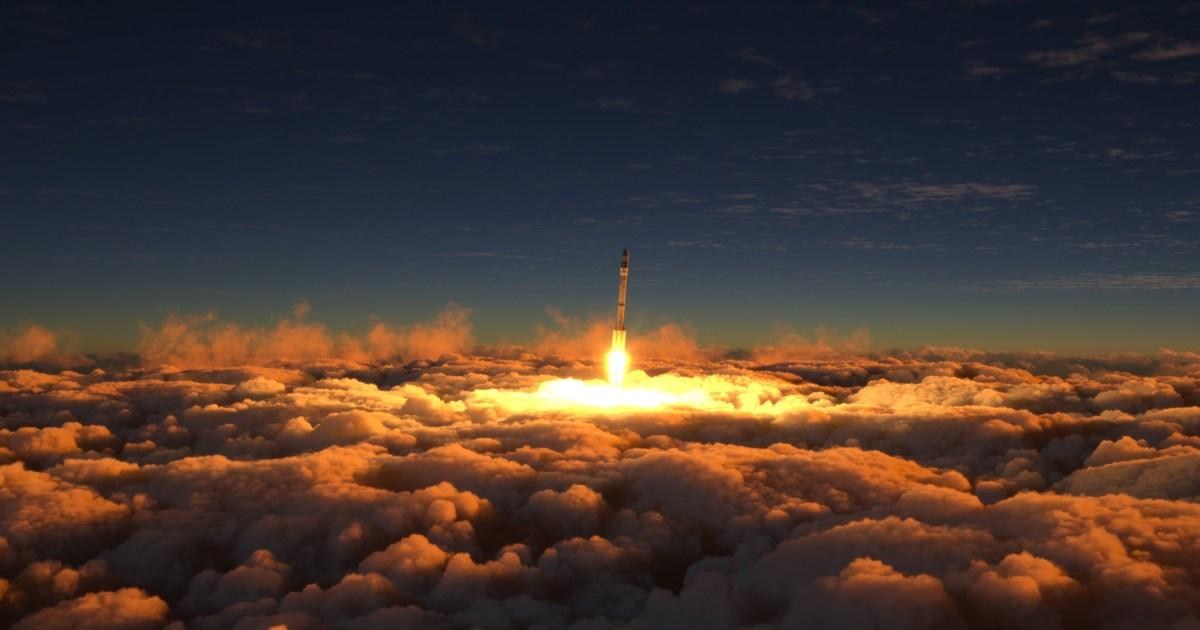
What would happen if a nuclear bomb was launched into space? (Credits: Getty Images/iStockphoto) Russia could launch a nuclear-armed satellite into space by the end of the year – but what would happen if Vladimir Putin went ahead with his plans? Earlier this week, Western intelligence found that Russia is likely to launch the satellite into space following years of warnings about the country’s capability to attack or interfere with other satellites. Known as ‘Sputnik S’, it’s equipped with a nuclear warhead. If launched, the US Defence Intelligence Agency has warned there are no effective countermeasures. Tens of thousands of satellites in the sky could fall if a nuclear weapon is detonated in space, but what else would happen? What happens if a nuclear bomb is launched into space? Experts have claimed that Putin has wanted to send a weapon into space for years. (Photo by Contributor/Getty Images) Well, we actually have quite a good idea of what would happen, because the US has already done it. On July 8, 1962, the military launched a rocket carrying a fusion bomb from the tiny Johnston Atoll in the middle of the Pacific while people around the region gathered to watch, expecting to see a small burst of light like a shooting star. Instead, the entire sky lit up, bringing daylight to the middle of the night. A giant ball of plasma erupted above them, particles of radiation raining down on the atmosphere. ‘It looked as though the heavens had belched forth a new sun that flared briefly, but long enough to set the sky on fire,’ said one account in the Hilo Tribune-Herald. The Starfish Prime explosion was seen from Honolulu. The bomb was launched from Johnston Atoll in the South Pacific. This was Starfish Prime, a 1.4 megaton bomb, 500 times as powerful as Hiroshima. Its aim was to examine how a nuclear bomb in space would affect Earth’s atmosphere. But the thing is, space is already radioactive. Astronauts, animals, and plants in space are all subjected to cosmic radiation. This could come from distant stars or weird phenomena like quasars, but the biggest, most dangerous source is the Sun. However, the protective cocoon of the atmosphere – specifically the magnetosphere – stops this radiation from reaching life on Earth. Instead, the radiation jiggles molecules in the atmosphere and creates one of nature’s most awesome spectacles, aurora – seen as the Northern Lights across Europe, Russia and the US. Human-made nuclear radiation can have the same effect, earning Starfish Prime and subsequent high-altitude nukes the deceptively lovely name ‘rainbow bombs’. The explosion lit up skies across the Pacific around 11pm at night. High-altitude bombs have already been tested (Picture: Getty) But even if the radiation could not reach Earth’s surface, nuclear bombs in space could still have catastrophic consequences on the ground. The assumed aim of a Russian nuclear weapon is to destroy satellites. How this may be achieved is not known. The bomb could target one particular satellite and consider it mission accomplished. However, the damage from a nuclear bomb is not easy to contain. In 1962, fallout from Starfish Prime caught up in Earth’s magnetic field formed a band of radiation around the planet that lasted for a decade. Nicknamed the ‘Starfish belt’, it continued to destroy satellites long after the initial explosion, including Ariel-1, the UK’s first satellite, and Telstar 1, the first to broadcast a live television signal. The Starfish Prime explosion as seen from a plane. Space is a much busier place today, and if the same radioactive band formed following a nuclear blast, countless satellites from numerous countries would be at risk – not just the target, and possibly those from the aggressor. However, a scientist from the Los Alamos National Laboratory in New Mexico designed a way to eliminate such radiation belts. Radio waves, blasted from a satellite-mounted transmitter, could push the charged particles into the atmosphere, which would harmlessly absorb them. ‘So now, if you had a Starfish belt and you had the right technology in space, you could get rid of that belt in a couple of weeks,’ said its designer Geoff Reeves, speaking to National Geographic. The US wanted to nuke the Moon The moon could have been nuked. (Picture: Getty) Yes, you read that right. During the height of the Cold War and the space race, the US and the Soviet Union were locked in a fierce battle of one-upmanship. In order to gain an edge, the US considered the top-secret Project A119, bombing the moon in a bid to ‘frighten’ the Soviets. However, rumours also swirled that their rivals had a similar plan, codenamed E4. Thankfully, both were shelved on account of the risks outweighing the benefits, especially in the case of a failed launch. But satellites aren’t the only thing up there. Starfish Prime was tested decades before the International Space Station (ISS) was built, but detonated at around the same altitude, some 250 miles high. Russia is a vital part of the ISS programme, and in 2023 agreed to stay in the partnership until at least 2028, suggesting Russian cosmonauts will also remain on board, and should expect their country to keep the spacecraft safe. There is one more potential issue from a nuclear weapon in space, a global one. The most powerful blasts of solar radiation have the ability to knock out communications on Earth. Could a nuke do the same? In 1859, Earth was hit by the biggest solar storm ever recorded. Known as the Carrington Event, it was so powerful it gave telegraph operators electric shocks. Technology has moved on a fair bit since then, so it isn’t hard to imagine the damage that could be done by a similar-sized or even bigger blast of radiation. ‘A lot more things depend on computer chips and power than they did in 1962,’ said Nasa scientist David Sibeck, speaking to National Geographic. ‘Things in your house, things in your car, communications. It would be much worse.’ And like the radiation cloud crippling passing satellites, communications blackouts caused by nuclear fallout in the atmosphere would be impossible to contain or target. Whoever set off the bomb could end up in the dark too. Arrow MORE: Donald Trump’s son-in-law says Putin is a ‘grand man of politics’ Arrow MORE: Structures spotted on Mars by Nasa ‘proof’ of alien life, says Ufologist Arrow MORE: ‘I stumbled across a Russian man hiding in remote Thai jungle for two decades’ News Updates Stay on top of the headlines with daily email updates.
Here’s what could happen if Putin launched a nuclear bomb in space
Full Article
Original Source
Read the full article at Metro →KhanList aggregates and links to publicly available news content. We do not host full articles from third-party sources. Always verify important information with original sources.