
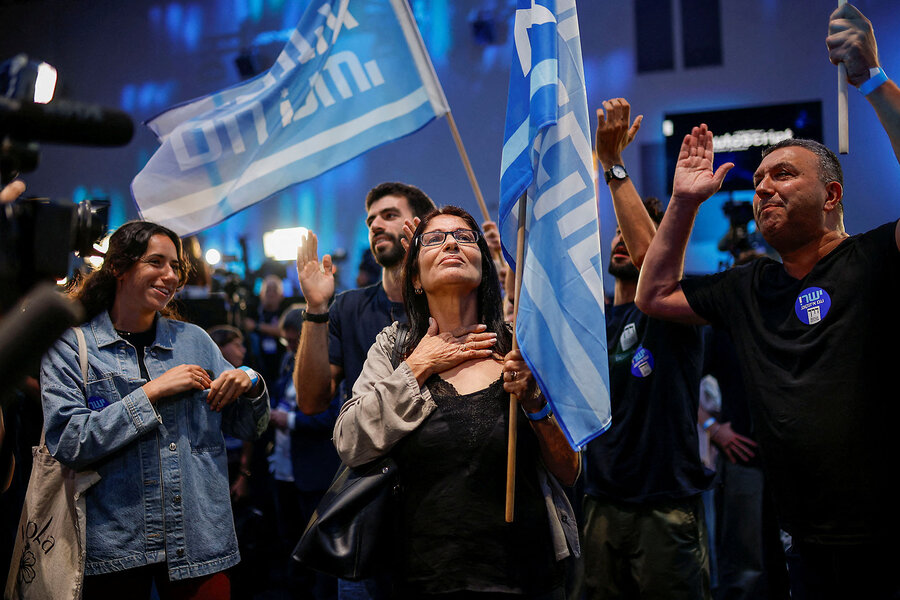
Haifa, Israel | Oct. 28, 2026, 5:15 p.m. ET | 6 min read After an intense campaign rife with AI slop ads, threats of renewed conflict with Iran, and appeals to voters to save the country from certain doom, Israelis woke up on Wednesday to a murky outcome.Israel finds itself in a political deadlock. That’s because neither Benjamin Netanyahu and his allies, nor a bloc of Jewish opposition parties seeking to oust the prime minister, managed to win an outright majority in the first parliamentary elections since Hamas’ Oct. 7, 2023, attack. Late Tuesday night, exit polls indicated that Mr. Netanyahu’s opponents had him on the ropes. But Wednesday morning’s headlines said the prime minister’s Likud party and its allies were projected to win the most seats.The path to a new Israeli government is unclear. With nearly 85% of the votes tallied, Mr. Netanyahu’s outgoing coalition of religious and ultranationalist parties plummeted from its current 68 seats to a projected 54, a stinging rebuke for the man who has dominated Israeli politics for most of the last 30 years.Parties opposed to Mr. Netanyahu were projected to capture as many as 66 seats, an outright majority in the 120-member Knesset. Tuesday’s vote was widely viewed as a referendum on Israel’s longest-serving prime minister and his administration, which attempted to overhaul the judiciary, governed during the Oct. 7 attack and hostage crisis, prosecuted Israel’s wars in Gaza, Lebanon, and Iran, and allowed violent West Bank settlers to run amok. Ronen Zvulun/ReutersA supporter reacts to exit polls with a campaign poster depicting Israeli Prime Minister Benjamin Netanyahu at the Likud party's election headquarters in Jerusalem, Oct. 27, 2026. Nonetheless, Yashar party leader Gadi Eisenkot and his allies were slated to win 48 seats total. That’s not enough to form a government without help from Arab parties, which, meanwhile, pulled off a historic showing in the polls.Spurred to vote on Tuesday by a combination of outrage over the war in Gaza, settler violence in the West Bank, and unchecked violent crime in Arab communities, Israel’s Arab citizens turned out in unprecedented numbers. They could win a similarly unprecedented 19 seats, making them potential kingmakers – if they’re treated as full partners. No Israeli political party has ever won an outright majority in the Knesset, forcing parliamentary factions to build sometimes unwieldy political alliances. The coming weeks will be brimming with horse-trading between party leaders deeply divided on key issues: military enlistment of ultra-Orthodox Jews, the dichotomy of religion and state, and above all, Mr. Netanyahu’s fitness to serve after Oct. 7, and all while his corruption trial drags on.Nonetheless, three possible outcomes lie ahead following a round of elections widely regarded as critical for Israel’s future.A Jewish-Arab coalitionMr. Eisenkot and two of his key allies – B’Yachad’s Naftali Bennett and Yisrael Beytenu’s Avigdor Liberman – pledged not to form a government supported by Arab parties that don’t share their Zionist ideology.Mr. Bennett and Mr. Liberman both served in a short-lived government with the Islamist Ra’am party in 2021. But they kept mum throughout the day as election results trickled in. Their most liberal ally, however, welcomed the prospect of joining forces with Arab parties to unseat Mr. Netanyahu.“We must no longer accept Netanyahu’s racist division between Jewish votes and Arab votes,” Yair Golan, party leader with the Democrats, said Wednesday. “We have a responsibility. And we have an opportunity to form a change government in partnership with Arab citizens of Israel – a government that serves all Israeli citizens.”For years, Mr. Netanyahu has campaigned on delegitimizing Arab voters and the parties that represent them. Likud’s election campaign repeatedly smeared Mr. Eisenkot by saying the former military chief of staff would support the creation of an independent Palestinian state. Campaign ads read “Yamin o Falastin,” in Hebrew, which means “the Right or Palestine,” while party operatives shared AI-generated videos of Ra’am party leader Mansour Abbas smoking a hookah pipe while nixing national security decisions in a future government. Less than 24 hours after polls closed, a statement from Likud charged that the elections “were stolen by Arab parties” through “bribery, threats, violence, fraud, and use of forbidden applications to encourage voters,” and called for an investigation.Arab party leaders have already extended a hand to the rest of the anti-Netanyahu opposition.“We are ready and prepared to pave the way for deposing the Netanyahu government,” said Yousef Jabareen, head of the Joint List. “Change passes through Jewish-Arab cooperation, true and equal partnership.” Ammar Awad/ReutersVoters wait outside a voting room during the national election in the Arab city of Umm al-Fahm, in northern Israel, Oct. 27, 2026. Israel's parliamentary elections this week saw record turnout among Arab voters. Sara Yael Hirschhorn, a historian and political analyst at the University of Haifa, says that for such an alliance to work, both the Arab parties and the Zionist anti-Netanyahu coalition will have to make ideological concessions.“We’ll have to see whether everyone has the ability to affect change and show courage to do these things,” she says.But especially after yesterday’s high turnout among Arab voters, Dr. Hirschhorn says Israel will face tough questions at home and abroad about “what kind of state is this where Arab Israeli citizens are promoted as equal citizens who have the right to the vote, but then don’t have a seat at the table?”A new unity governmentAnother possible outcome would be for Mr. Netanyahu and Mr. Eisenkot to set aside their differences and form a broad Zionist unity government “that doesn’t depend on ultra-Orthodox or extreme-right votes, and doesn’t depend on the Democrats or Arabs,” says Gideon Rahat, a senior fellow at the Israel Democracy Institute, a Jerusalem-based think tank. What kind of agreements and compromises that would entail remains uncertain. But this scenario would require several of the prime minister’s staunchest opponents – among them Mr. Liberman and Mr. Bennett – to break their promises never to join forces with Mr. Netanyahu. They would also need to embrace political amnesia about Mr. Netanyahu’s failure to honor a similar power-sharing agreement just a few years ago.“There’s a man who has one aim, and typically achieves it, and that’s to remain in power, and he is prepared to go to more elections and more elections and more elections until he has a majority,” Professor Rahat says.Another election: Rinse and repeatWith Mr. Netanyahu’s opponents predicted to hold a majority in the Knesset, Mr. Eisenkot and company, along with the Arab parties, could take action to thwart the prime minister’s power while negotiations drag on.Leaders of the change coalition were already discussing choosing a new speaker once the Knesset is sworn in, according to a Channel 12 report. That would give Mr. Netanyahu’s opponents control over the parliamentary agenda, allowing them to advance bills even before a government is formed.Professor Rahat says Mr. Netanyahu’s opponents could also pass a law imposing term limits, or barring a lawmaker accused of a crime from serving as prime minister. Both options could invalidate Mr. Netanyahu from running in a repeat election – or launch a state commission of inquiry into Oct. 7, something the prime minister has refused to do for three years. Deepen your worldviewwith Monitor Highlights.Politics with respectGet political stories with respectful analysis.There‘s a world of new ideas in everyBooks newsletter.There‘s more to life, enrich yours withCulture & Learning weekly.Follow humanity‘s discoveries withScience & Nature stories in your inbox.Gain a spiritual perspectivefrom the stories in your inbox.Want to understand the deeper impact of critical events? Learn the Monitor‘s insight.Already a subscriber? Log in to hide ads. The final official results of Tuesday’s contest will be published in the coming days, after which Israeli President Isaac Herzog will have one week to tap a member of parliament he deems most likely to cobble together enough seats to reach the magic number of 61.President Herzog said Wednesday that Israel “must not return to repeat elections,” referring to the political deadlock that saw Israelis go to the polls five times between 2019 and 2022, and said party leaders should “come here with an open mind.” ALREADY A SUBSCRIBER? LoginReal news can be honest, hopeful, credible, constructive.The Christian Science Monitor was founded in 1908 to lift the standard of journalism and uplift humanity. We aim to “speak the truth in love.” Our goal is not to tell you what to think, but to give you the essential knowledge and understanding to come to your own intelligent conclusions. Join us in this mission by subscribing.
Here’s what could follow Israel’s bitterly contested elections
Full Article
Original Source
Read the full article at Csmonitor →KhanList aggregates and links to publicly available news content. We do not host full articles from third-party sources. Always verify important information with original sources.