
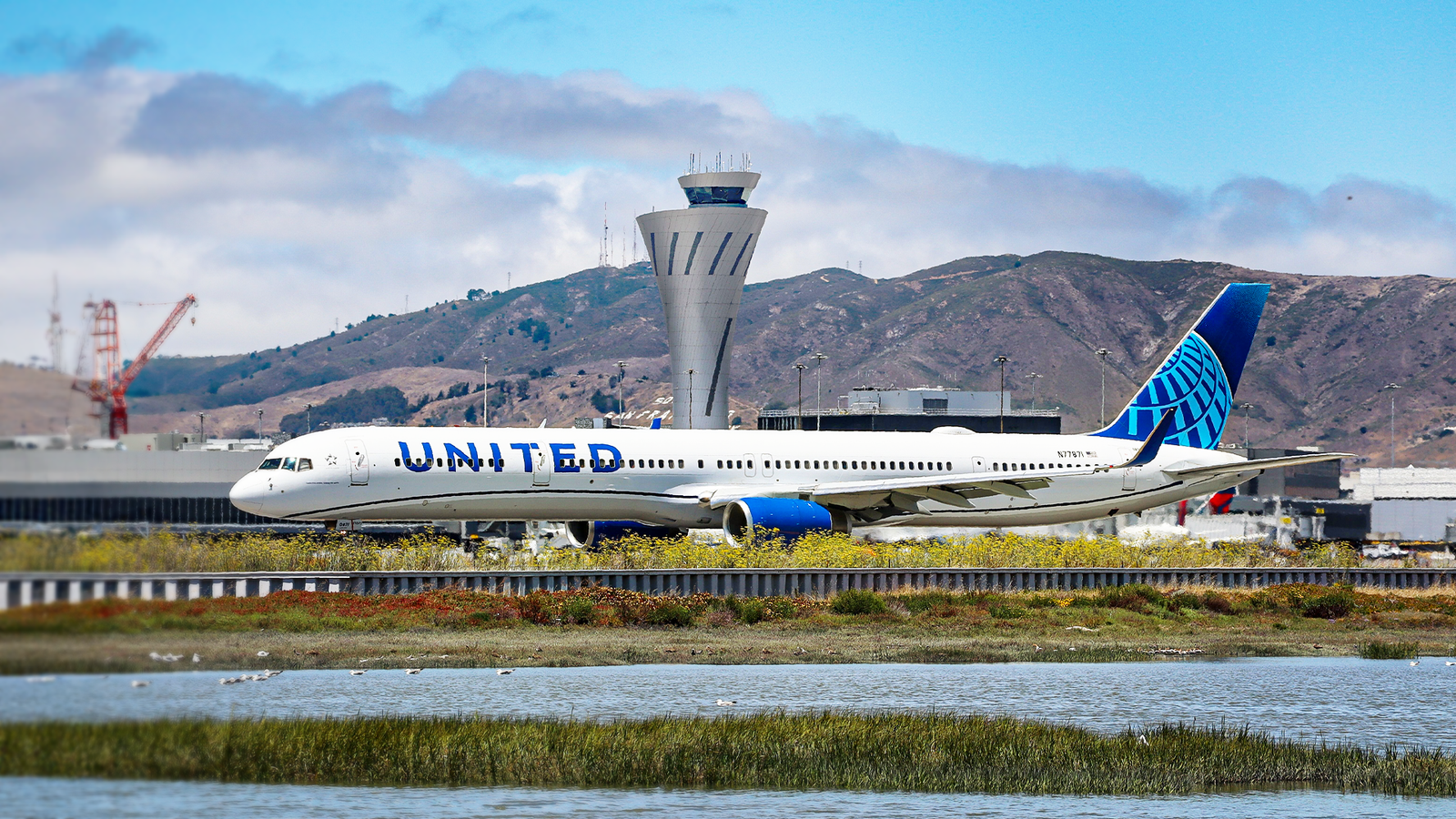
Published Nov 16, 2026, 5:00 PM EST Passionate about promoting aviation, the beauty of flight and the science behind it, Antonio is an avid reader of aviation magazines and books, and he loves visiting airshows all over the world, taking photos and writing about airplanes and helicopters as well. He is currently based in Palermo, Sicily. At 178 feet, seven inches (54.43 meters), the Boeing 757-300 is the longest single-aisle twinjet ever built. Yet its extra length created an unexpected engineering challenge that had little to do with seats, range, landing gear, or engines. It was the runway. Boeing stretched the 757-200 by 23 feet, four inches (7.11 meters), and every extra foot behind the main landing gear increased the distance between the aircraft's pivot point and its tail, making ground clearance during rotation a critical consideration. So how does an airplane so long get airborne without tail strikes? Boeing's answer is layered: a crushable tailskid, a sensor that tells the crew when the fuselage itself has touched the ground, a pitch cue on the attitude display, and a quiet change to the elevator controls that most passengers will never know exists. Understanding why Boeing needed several layers, and why one of them lives entirely in the pilot's hands, explains how a 178-foot airplane earns its nickname without earning a reputation for dragging its tail. The problem starts with a simple geometric disadvantage. According to Ready For Take-Off Book, Boeing built the -300 by inserting a 13-foot, four-inch (4.06-meter) plug ahead of the wing, and a 10-foot (3.05-meter) plug behind it, leaving a fuselage 23 feet, four inches (7.11 meters) longer than the 757-200's 155 feet, three inches (47.32 meters). That aft plug is particularly important during rotation. As the nose pitches upward, the airplane pivots around the main landing gear. The farther the tail extends behind that pivot point, the more quickly it moves toward the runway. The situation required Boeing to account for what that extra fuselage would do during the most critical seconds of takeoff. Weight and speed make the geometry less forgiving. Boeing's own airport planning document lists a maximum design takeoff weight of 270,000 pounds (122,449 kg) for the 757-300, along with engines rated at 43,100 pounds of thrust (about 192 kN) for the Rolls-Royce RB211-535E4B and 43,850 pounds (about 195 kN) for the Pratt & Whitney PW2043. The longer fuselage also meant Boeing had to protect the aft structure against a tail strike. When Condor became the 757-300's launch customer, Boeing incorporated structural reinforcement in the rear fuselage to accommodate the protection system fitted beneath the tail. The aircraft's greater length and higher rotation speeds made that additional protection particularly important during takeoff. The program also moved quickly. Ready For Take-Off Book dates Condor's launch order to September 2, 1996, and the first flight to August 2, 1998, leaving little room for design surprises. The structure around the tail had to be prepared before the airplane ever reached the runway. But strengthening the fuselage was only the first layer. What actually hangs under that tail, waiting to take the hit? The 757-300 Uses A Crushable Tailskid As Its First Line Of Defense Credit: Media_works | Shutterstock As detailed in the 757 technical reference, the tailskid is a retractable, crushable cartridge that extends for takeoff and landing and folds away in flight, shielding the pressurized part of the fuselage from the runway. The system is powered by the left hydraulic system and rides on the main landing gear actuation system, so extension happens automatically with gear selection. That makes the skid part of the airplane's normal configuration rather than something the crew has to deploy separately before every takeoff and landing. There is an important difference between the 757-300 and other Boeing widebody/narrowbody design detailed here: the 767-300's skid uses a compressible oleo strut, while the 757-300 relies on a crushable cartridge. That distinction explains what happens if the skid actually makes contact. The cartridge is supposed to deform and absorb energy that would otherwise be transmitted into the airframe. Instead of asking the fuselage structure to take the entire impact, Boeing gives the impact a sacrificial component. Even a contact leaves evidence behind: a red pop-out indicator at the bottom of the shock absorber shows whether the drag shoe touched the runway, and maintenance crews then check the cartridge through two inspection holes. What could have been a structural repair may instead be handled as an inspection item. One caveat: the skid does not extend when the alternate gear extension system is used. That detail becomes important because the tail skid itself is not the complete tail-strike protection system. Boeing also had to tell the crew when the airplane had gone beyond what the skid was designed to absorb. Boeing Gave The 757-300 Separate Warnings For The Skid And The Airframe Once the physical protection is in place, the next question becomes one of information. A pilot cannot always know from the cockpit whether a brief scrape involved only the skid or whether the fuselage itself contacted the runway. That is why the 757 uses separate indications for those two situations: per the 757 technical reference, a TAILSKID light and an Engine Indication and Crew Alerting System (EICAS) advisory appear whenever the skid’s position disagrees with the landing gear lever. That tells the crew about the hardware. The airplane also has a separate tail-strike indication system in the aft body that detects ground contact capable of damaging the pressure hull. When that system detects contact, it posts a caution-level TAIL STRIKE message on the EICAS. A tail strike indication system installed in the aft body detects ground contact that could damage the pressure hull, and it posts a caution-level TAIL STRIKE message on the EICAS. In practical terms, the red pop-out indicator is useful after the aircraft is back on the ground, while the cockpit indications tell the crew what the airplane believes happened. Ready For Take-Off Book also lists a body-contact indicator and modified spoiler logic among the -300's identifying features. From the maintenance side, the Scribd-hosted Advanced Maintenance Techniques for the 757 document and a long-running Airliners.net tailskid discussion provide additional context. Alert Trigger Meaning TAILSKID light and EICAS advisory Skid position disagrees with the gear lever The skid is not where it was commanded to be EICAS caution: TAIL STRIKE Ground contact detected in the aft body Possible damage to the pressure hull Red pop-out indicator Drag shoe contacted the runway Check the cartridge on the ground Those warnings, however, all have something in common: they tell the crew that a problem has already occurred. Boeing's more interesting solution was to make the airplane less likely to reach that point in the first place. The 757-300 Changes The Control Feel To Reduce Rotation Risk A longer fuselage and a smaller tail-clearance margin made the 757-300 particularly sensitive to what happens during rotation. The aircraft's protection therefore could not rely entirely on a skid absorbing the consequences of a tail strike. Boeing also had to consider how pilots controlled the airplane during those critical seconds, especially since excessive rotation rate and early rotation are among the most common factors in takeoff tail strikes, according to Boeing data cited by the Australian Transport Safety Bureau. That concern led to changes in the 757-300's flight-control system. According to Advanced Maintenance Techniques for the 757 document, the stretched variant's Yaw Damper/Stabilizer Trim Module combines the rudder ratio changer, stabilizer control module and yaw damper, while adding an Elevator Feel Limit (EFL). Introduced to address the -300's higher rotation speeds, the feature limits control-column forces during rotation and for seven seconds after liftoff. An AAIB investigation reproducing Boeing takeoff data also shows a different range of takeoff flap configurations: Flaps 5, 15 and 20 for the -300, compared with Flaps 1, 5, 15 and 20 for the -200. These changes must also be understood in the context of takeoff performance. The AAIB investigation into a 757 tailstrike highlights how rotation technique, pitch attitude and tail clearance are closely connected, particularly on the longer 757-300. Boeing's Elevator Feel Limit addresses one part of that problem by modifying control-column forces during the most critical moments of departure. Its intervention lasts only seven seconds after liftoff, but the timing is deliberate. Phase What the EFL does Why it matters Rotation Limits column forces Keeps -200-style feel at higher speeds Liftoff Continues limiting forces Tail is still closest to the runway Seven seconds airborne Limit ends Normal feel resumes once clear This is what makes the 757-300's solution more interesting than a simple tail skid. Boeing was protecting the airplane at several points in the chain: the structure could accept contact, the skid could absorb some of it, and the flight controls could make excessive rotation less likely. The question is whether all that engineering makes sense in the environment where the 757-300 spends much of its life. The 757-300’s Long Routes Put Its Tail Protection To Work Credit: InsectWorld | Shutterstock Generally, the 757-300 does not spend its career making short, lightly loaded hops. Some of its most demanding work is exactly the sort of operation that makes the aircraft's takeoff protection relevant. All 10 of United's longest narrowbody routes are flown by the 757-300 and fan out from just six hubs. San Francisco to Washington Dulles, for example, covers about 2,085 nautical miles (3,860 km). A long sector means more fuel, a heavier airplane, and generally a higher rotation speed, exactly the conditions the -300’s protections were built for. Fill the cabin, which Boeing sizes at 243 passengers in two classes or 279 in all-economy, and the departure weight climbs accordingly. Economics makes the same point from another direction. 757 operating costs, including maintenance labor, can reach $1,700 per hour in demanding use, with parts adding roughly $1,400 per hour. A tail strike can trigger exactly the kind of inspection and maintenance work that makes a relatively simple sacrificial cartridge look like cheap insurance. Landing strikes require special attention. SKYbrary warns that landing strikes tend to cause more damage than takeoff strikes. Boeing's solution extends beyond the physical skid. As Ready For Take-Off Book explains, the manufacturer tied a pitch-attitude sensor to the spoilers so that if the airplane approaches touchdown too nose-high, the three outboard spoilers on each wing are held down, creating a corrective nose-down moment. That gives the 757-300 another layer of protection at the opposite end of the flight. The airplane uses its flight-control system to reduce the chance of creating a tail strike during landing. Thus, the protections make sense in the context of the aircraft's job. But the 757-300 is now entering a different phase of its life, and that shifts the question from how Boeing protects it to how long operators will maintain that protection. The 757-300’s Tail Protection Will Matter More As The Fleet Shrinks Credit: Robin Guess | Shutterstock There is no tidy ending to the 757-300 story because the fleet is gradually disappearing. Ready For Take-Off Book reports that Condor retired its last 757-300 in November 2025, leaving Delta with 16 aircraft and United with roughly 18 to 21 as the main operators of a type of which only 55 were ever built. The earliest 757-300s, delivered in 1999, are now past their 27th birthday. As the fleet becomes smaller, each remaining aircraft represents a greater concentration of the type's operational history. The question is whether operators will continue giving those systems the attention they require as the aircraft themselves become increasingly unusual. The 757-300 may eventually disappear as a commercial aircraft, but its solution to the problem created by its extraordinary length remains a neat example of how an airliner can solve one aerodynamic and structural problem several times over. The next generation of long single-aisle jets may borrow some of that layered approach, or avoid the problem by keeping their fuselages shorter. Either way, the little skid under the tail is only the most visible part of a much bigger engineering story.
Here's How The Boeing 757-300 Protects Its Ultra-Long Fuselage On Rotation In The Cockpit & Externally
Full Article
Original Source
Read the full article at Simpleflying →KhanList aggregates and links to publicly available news content. We do not host full articles from third-party sources. Always verify important information with original sources.