
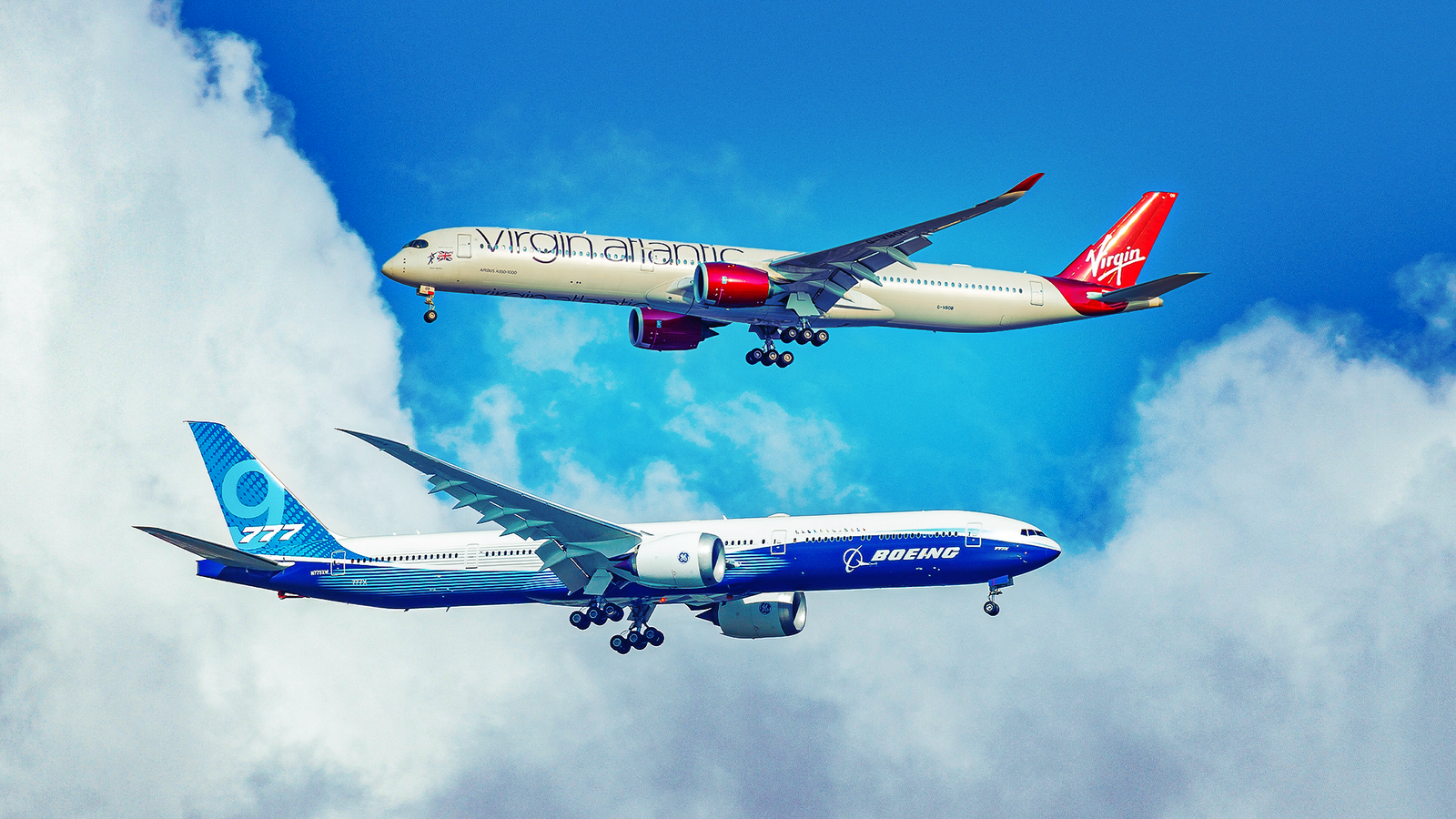
Credit: Kate Scott & Wangkun Jia | Shutterstock, Simple Flying Published Nov 12, 2026, 9:00 AM EST Luke Diaz is a freelance military writer with experience with active duty experience in the US Navy as well as defense and industrial engineering. He is a former Naval Flight Officer who performed tactical air control on the carrier-based E-2 Hawkeye. Sign in to your Simple Flying account The two powerhouses of aerospace that divide the global industry of jetliner building are locked in a years-long struggle for domination of the next-generation widebody airliner market. Boeing has promised to revolutionize the size and scale of twinjets with its 777X, which integrates the legacy 'triple seven' airframe with 787 Dreamliner technology and industry-first folding wingtips. Meanwhile, Airbus has already delivered many A350 jets and is now working on an ultra-long-range variant. The problem for Boeing is the fact that all three variants of this 777X remain uncertified for full-scale production. Seven years after the original launch date, it still has just a handful of examples sitting on the flight line in Washington; there are no jets ready to be delivered. Airbus may not have handed over many of its largest A350 variants, but the airframe has proven itself in revenue service and remains in full-rate production with continued orders coming in. The A350 represents a lightweight, highly optimized, all-composite platform built for flexible point-to-point networks, while the 777X is a massive, metal-composite hybrid giant designed to unlock maximum passenger and cargo volume on high-density trunk routes. Boeing aims to have the 777-8 and 777-9 certified next year, but Airbus will already be moving on to deliver Qantas' A350-1000ULR for the unique 'Project Sunrise' that will pressure any new era of ultra-long-haul flying. The Efficiency Paradox: Wing Design Versus Weight Credit: Coby Wayne | Shutterstock The next decade of long-haul flying will be defined by how airlines choose to route their passengers. Airbus has optimized the A350 family for a fragmented market, betting that travelers prefer direct, point-to-point flights between mid-tier cities. Because the A350 is inherently lighter due to its carbon-fiber fuselage, it does not suffer a massive financial penalty if a flight is only 70% full, giving the carrier 'right-sized' versatility to open new, experimental long-range routes. On paper, the 777X’s massive engines, the largest commercial turbofans in the world, achieve a 10% reduction in fuel burn per seat compared to older legacy aircraft, closely rivaling the A350-1000's efficiency. Thanks to its revolutionary wing design, the 777X can fit into gates where the 747 and A380 could not, yet it maintains a worse fuel efficiency baseline than the A350. The A350-1000 does not suffer from this scaling penalty. The 777X wing is so wide that Boeing had to engineer a revolutionary folding wingtip mechanism that retracts 11.5 feet (3.5 meters) on each side upon landing. Boeing also had to design that wing to support a staggering maximum takeoff weight of 716,000 lb (325,000 kg) and General Electric GE9X engines delivering 105,000 lb of thrust (467 kN) each. Because the 777X is significantly heavier than the A350, its advantages only begin when it is full. The A350 relies on a lighter, all-composite fuselage to cut fuel burn, and Airbus limited its wingspan to 212 feet (64.7 meters). While this shorter span yields a slightly less optimized ratio than the 777X, Airbus offsets the deficit by constructing 53% of the entire airframe, including the fuselage, out of carbon-fiber-reinforced plastic. Airbus also integrated bifunctional winglet technology that actively twists and morphs the trailing edges of the wing during flight via the fly-by-wire system. This continuous, automated optimization reduces drag in real time as fuel burns off. Such granular engineering ensures the A350 remains efficient across various mission profiles, whereas the 777X requires specific capacity thresholds to justify its heavier airframe. The Capacity Divide: Mass Transit Versus Right-Sized Flexibility Credit: Airbus The commercial aviation industry has definitively entered a post-quadjet era, leaving the 777X to claim an uncontested monopoly as the absolute largest passenger aircraft in production. By designing the 777X to seat up to 450 passengers, Boeing is betting that mega-hub congestion will compel airlines to buy the massive twinjets. Airbus, conversely, has intentionally conceded the capacity crown, positioning the A350-1000 as the "right-sized flagship designed to align perfectly with the average demand of a point-to-point market. The 777-9 was specifically designed by Boeing to be a direct replacement for the 747. The 777-9 fills the void left by the retirement of the double-deck jumbo aircraft, aiming for an astounding 33% lower operational cost per seat than the legendary 747-400. Additionally, because of its folding wingtips, it may enter regular Code E gates instead of just Code F gates designed for the A380, increasing destination alternatives and lowering operating costs. Airframe Total Order Book Carriers A350-1000 373 Qatar Airways, British Airways, Delta Air Lines, United Airlines, Riyadh Air, Philippine Airlines, Air Canada, China Airlines, Japan Airlines, Etihad Airways, Virgin Atlantic, Air France, Ethiopian Airlines A350-1000ULR 12 Qantas A350F 115 Atlas Air, Air France-KLM, Etihad Airways, Singapore Airlines, Cathay Cargo, Air China Cargo 777-8 35 Emirates, Etihad Airways 777-9 546 Emirates, Qatar Airways, Singapore Airlines, Cathay Pacific, Lufthansa, Etihad Airways, British Airways, All Nippon Airways, Air India 777-8F 101 Qatar Airways Cargo, Cargolux, Korean Air Cargo, Lufthansa Cargo, All Nippon Airways Cargo, Ethiopian Airlines In the meantime, Airbus built the A350-1000 with the idea that networks with scattered city pairings, rather than expansive hub-to-hub airways, are the way of the future for long-haul aviation. Rather than squeezing 450 people onto a single mega-twinjet, Airbus scaled down the A350-1000 to a more modest 350 to 410 seats. Outside of specific mega-hubs, the A350's smaller size offers less risk and more flexibility, allowing airlines to operate varying long-haul routes even during off-peak seasons. Hub-centric airlines that rely on maximum volume to conquer slot constraints remain entrenched in the 777X concept. Emirates alone anchors the program with a massive backlog of 270 units to preserve its mass-transit business model. However, with the vast majority of international carriers expanding their networks, Airbus’ biggest twinjet is sweeping the market. Recently, airlines like Riyadh Air firmed up their orders to 31 A350-1000s, Philippine Airlines doubled its commitment to 18, and Air Canada finalized a fleet pivot to eight of the type. Ultra-Long-Haul Dominance And Project Sunrise Credit: Airbus Airbus enjoys an absolute, uncontested monopoly on the extreme frontiers of commercial aviation, in large part thanks to the A350-1000ULR being chosen for Qantas’s upcoming 'Project Sunrise' nonstop flights connecting Sydney to London and New York. As the first completed example progresses through its flight testing campaigns ahead of its April 2027 delivery to Qantas, Airbus is reinforcing a halo status for the entire A350 program. By capturing the contract for the most demanding mission of the decade, Airbus has proven that its jet can adapt to any point on the globe. Thanks to an ultra-light 53% composite airframe with a heavily stripped-down, low-density cabin, Airbus had the extra payload margin to permanently mount a 35,274-lb (16,000 kg) Rear Center Tank. That pushes the plane’s range to an unparalleled 9,700 nautical miles (17,900 km). Its composite airframe gives the A350-1000 a massive 'weight budget' advantage, but Airbus is swapping the weight of 170 passengers for the RCT, which makes the ULR variant possible. Even with a carbon-fiber airframe, flying 10,000 nautical miles (18,520 km) requires further weight sacrifices, which is why Qantas’s Project Sunrise configuration is strictly limited to a low-density layout of just 238 seats. Meanwhile, the 777X is incapable of playing this low-density weight game because it is trapped by its own size. Credit: BlueBarronPhoto | Shutterstock The 777X's conventional widebody cross-section is positioned to dominate the lower-yield freight markets of the upcoming ten years, even while passenger capacity takes center stage. The 777X specifically increases its capacity for large, containerized cargo, which enables airlines to make money on long-haul flights even when passenger cabins are only partially filled. A 777-9 can transport up to 40 standard LD3 cargo containers on profitable freight corridors around the Pacific, surpassing the A350-1000's 44 lower-volume position limit. Airframe Target Entry Into Service Official Launch Customer A350-1000 In Service (2018) Qatar Airways A350-1000ULR April 2027 Qantas A350F Late 2027 Air France-KLM / Etihad Airways 777-8 Post-2028 Emirates 777-9 Early 2027 Lufthansa 777-8F 2028 / 2029 Qatar Airways Cargo The 777X can transport enormous, tall, and oddly shaped cargo pallets that fit in the A350's hold thanks to its 10% volumetric advantage. For airlines like Cathay Pacific or Singapore Airlines, this under-floor freight capability represents the thin margin between a profitable flight and a loss-making one when passenger load factors dip. The Airbus A350 utilizes a unique ovoid, or egg-shaped, fuselage cross-section designed primarily to maximize passenger shoulder space in the main cabin. The Certification Bottleneck And The Order Book Balance Credit: Airbus The sharp differences in delivery schedules are the most obvious division in this ten-year contest. With more than 600 aircraft now in active service, the Airbus A350 is a well-established, fully approved program that enables airlines like Delta and Lufthansa to regularly plan fleet renewals. On the other hand, Boeing's current goal of having the 777-9 enter service in 2027 comes after a startling seven-year delay from its initial 2020 launch schedule. The 737 MAX disaster and the Federal Aviation Administration audit that followed, which took away a large portion of Boeing's previously granted compliance power, are directly responsible for this bottleneck. The FAA now enforces an unprecedented level of independent verification. Compounding this regulatory inertia, GE Aerospace has faced rigorous scrutiny over a durability flaw regarding an engine seal in the massive GE9X powerplants, demanding extensive engineering fixes. The visible consequence of this certification bottleneck is vividly on display across storage airfields in Everett and Moses Lake, Washington, where more than 30 fully assembled Boeing 777-9 jets sit parked in limbo. Boeing currently faces a significant mechanical challenge in the form of change incorporation as a result of its decision to maintain low-rate manufacture of 'at-risk' airframes before completing the drawn-out certification procedure. Even ardent, traditionally exclusive Boeing operators are carefully hedging their long-haul bets in the interim. By methodically taking advantage of Boeing's structural weakness, Airbus has made the fully developed and certified A350 program the standard long-haul architecture for the late 2020s. Airbus' overall firm order book for the A350 family has increased to 1,628 total orders, whereas Boeing has written off nearly $15 billion in pre-tax charges because of development failures and client compensation.
Here's How The Airbus A350 Stacks Up Against Boeing's 777X For The Next Decade Of Long-Haul Flying
Full Article
Original Source
Read the full article at Simpleflying →KhanList aggregates and links to publicly available news content. We do not host full articles from third-party sources. Always verify important information with original sources.