
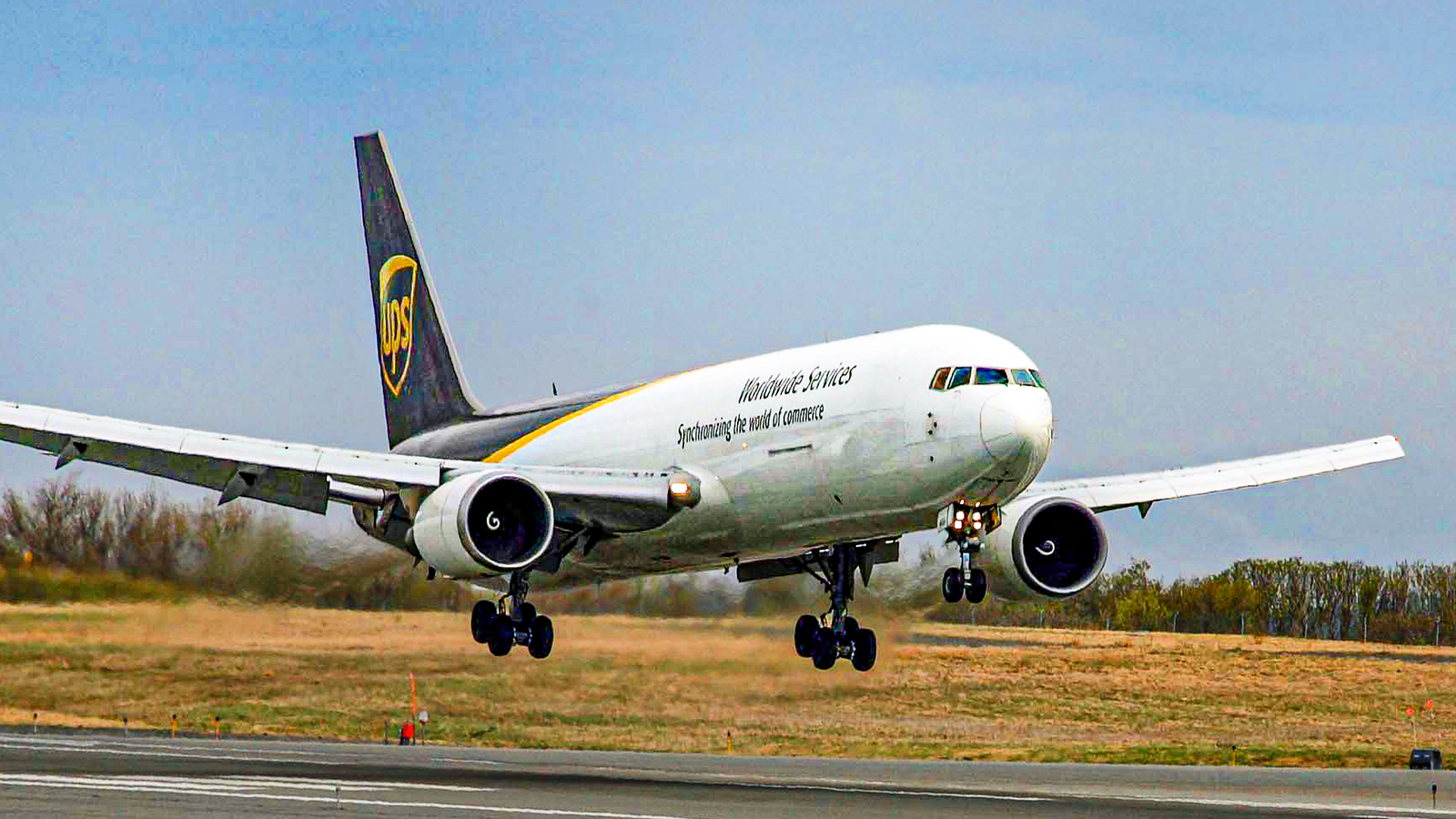
Published Nov 14, 2026, 7:00 AM EST Aaron is an aviation enthusiast and world traveler with a deep interest in aerospace history and technology. He has traveled around the world numerous times, often incorporating visits to aviation museums and historic aircraft collections into his journeys. A native of New Zealand, he is an expert in aviation and maintains a broad interest in a variety of other subjects. The Boeing 767 is unique among Boeing aircraft for its main landing gear sporting a 'toe-down' (or forward tilting) position. The front wheels make contact with the runway before the rear wheels within the main landing gear assembly. In Boeing parlance, the orientation is referred to as the 'truck positioner' (or truck tilt actuator), while in Airbus' terminology it's referred to as the 'bogie pitch trimmer.' The toe-down position is one of the easiest ways to visually identify a landing Boeing 767 from other Boeing widebodies, although not so much from Airbus aircraft, as some models have a similar configuration. Both Boeing and Airbus have switched the origination of the main landing gear within aircraft families depending on the requirements of the variant. Here is what to know about why Boeing designed the 767 (mostly) with toe-down landing gear and how that fits in with the wider industry. The 767's Unusual 'Toe-down' Design Credit: Robin Guess l Shutterstock The Boeing 767 has an unusual feature noted in the aviation community. It was designed with a conventional tricycle landing gear layout with a steerable twin-wheel nose gear and two four-wheel main landing gear bogies. When the 767 is airborne, its main landing gear bogies tilt forward in a toe-down position rather than the more conventional backward (toe-up) position. This is unique among Boeing aircraft. The Boeing 767 comes in several variants: the 767-200, the 767-2C (KC-46A), the 767-200ER, the 767-300, the 767-300ER, the 767-300F, and the 767-400ER. Boeing developed the 767-400ER in the 1990s as a stretched aircraft for a limited lineup of airlines. The -400ER was the first Boeing widebody aircraft that resulted from two fuselage stretches. The variant was ultimately unpopular, with only 37 examples being ordered by the two US-based airlines (Delta Air Lines and Continental), plus one testbed eventually delivered to Bahrain as a VIP transport. Boeing likely lost money on the program, although it never published the financial figures for it. The notable feature of the variant for this article is that Boeing replaced the standard 767 landing gear with taller, heavier 777-derived landing gear. This required a redesigned structure and deeper fairing. Consequently, the -400ER is the only 767 variant with standard backward tilting landing gear. The Two Benefits Of The 767's Landing Gear Credit: Ronen Fefer l Shutterstock The 767 has a narrower cross-section than other widebodies like the 747 or Airbus A300, being designed as a mid-sized airplane for seven-abreast seating (2-3-2). The novel design is often credited with solving multiple issues. One benefit often seen mentioned by pilots and mechanics on aviation forums is that the configuration allows the gear to fit into a smaller wheel well. Some describe it as a "tight fit" and the best use of limited space. The design avoids the need for large, drag-inducing blisters on the aircraft's belly. Another benefit was the Tilt Actuator Mechanism and how the aircraft lands. The tilt changes the aircraft's touchdown. The front wheels of each bogie make contact with the runway first, with the bogie then rotating level and the rear wheels settling. Some commentators say this helps to cushion the landing by spreading out the load more gradually and reducing stress on the landing gear. Airplane makers Toe-up main landing gear (aft/rear wheels lower) Toe-down (forward/front wheels lower) Level/neutral with no tilt Boeing aircraft 747 (wing gear only), 767-400ER (777-derived gear), 777, 777X, 787 767, 757 (mild tilt) 747 (center body gear only) Airbus A330, A340, A350-1000 (slight) A310, A350-900, A380 A300 The design comes with a de-rotation tendency, naturally pitching the nose slightly downward toward the runway on contact. This requires pilots to hold back pressure carefully during the flare in order to avoid a firm nose-gear slap. The advantages of the toe-up design were not enough for Boeing to retain it with other aircraft. It has not used the design for subsequent aircraft like the Boeing 777, 767-400ER, and 787. The Unusual Case Of The Boeing 757 Credit: Joseph Creamer l Shutterstock Almost all narrowbody airliners come with a single set of main landing gear wheels. Here, the Boeing 757 stands out due to being a large narrowbody designed to fill the mid-sized airplane gap. It is often categorized as a heavy narrowbody, sitting at the upper weight limit of narrowbodies—up to 255,000 lbs (115.6 t) MTOW on later models. Boeing's plans to develop the replacement New Mid-Sized Airplane, often called the 797, have not materialized. The Boeing 757's bogies tilt slightly toe-down during flight. This means that the Boeing 767 is, strictly speaking, not unique among Boeing aircraft, but it remains more noticeable. The 757's bogies are slightly toe-down at around 5° to 8°, which is just enough to align the truck with the narrow fuselage wheel well during retraction. By comparison, the Boeing 767's angle is typically around 15°–17°. It can also be noted that the Boeing 757 is closely related to the Boeing 767 widebody. It is useful to think of the Boeing 757 and 767 as fraternal twins developed in the late 1970s. They were designed to allow aircraft to enjoy interchangeability and minimal pilot training between types. The 757 has long been a favored aircraft on thinner transatlantic routes, although it is now being replaced by the A321neo. The Rise & Fall Of The Boeing 767 Credit: Michael Derrer Fuchs l Shutterstock. The Boeing 767 has been an excellent airliner, with Boeing selling around 1,380 examples. Over time, its comparatively robust and heavy design that has made it particularly useful as a freighter compared with modern composite material aircraft. However, this also gave it an economic disadvantage as a commercial passenger airliner, and Boeing replaced it with the cleansheet Boeing 787 Dreamliner. That composite-heavy aircraft offers around 25% better fuel efficiency. However, the Dreamliner did not replace the 767 as a freighter with the 787. Boeing continued to offer the 767, and companies continued to order it. In the end, it was stricter regulations that made the 767-300F infeasible as a freighter. The program is currently in the process of winding down (more below). The last of these freighters may continue flying into the 2050s or 2060s. The passenger 767 fleet is approaching the end of its passenger career with airlines having phased out earlier models and leading operators (e.g., Delta, United, JAL, ANA) phasing them out and/or ordering their replacements. Delta withdrew three 767-300ERs in 2025 and another one so far in 2026, with the remaining -300ERs to be divested by 2030. Japan Airlines plans to retire and replace its fleet with the A321neo by 2028. The Final Boeing 767 Deliveries Credit: Parkdolly l Shutterstock As of November 2026, Boeing has delivered 13 767-300Fs, leaving it with a remaining backlog of seven aircraft. Deliveries of the Boeing 767-300F freighter are fast coming to an end, although deliveries of the military Boeing 767-2C (KC-46A Pegasus) tanker are set to continue deep into the 2030s. The FAA provided an exemption from new emission restrictions for the Boeing 767-300F until 2033 under the FAA Reauthorization Act of 2024. The FAA only has jurisdiction in the United States, with the regulations in force elsewhere in the world. Consequently, Boeing sought to deliver all its outstanding orders for the Boeing 767 in 2026 ( regulations enter into force on January 1, 2027). Boeing's 2026 records show it delivered the two outstanding 767-300Fs to FedEx in April and May and 11 of the remaining orders to UPS between February and October. Now, Boeing's records only show seven remaining to be delivered to an 'unidentified customer'. These remaining orders appear to be for UPS (considered an open secret), with Boeing starting the year with eight units for unidentified customers, and that number is now seven. That aircraft apparently went to UPS. The order was placed in December 2024 and is likely to be the last set of commercial 767s to be delivered. Toe Down Is More Common With Airbus Aircraft Credit: Phung Quang Minh l Shutterstock Toe-down main landing gear is much more common on Airbus aircraft. Airbus models with toe-down landing gear include the Airbus A350-900, the Airbus A380, and the A310. With the A350-900, the four-wheel bogies tilt toe-down by around 9.3° in flight, allowing them to align cleanly with the ceiling of the center fuselage bay. This was flipped on the stretched A350-1000. The -1000 features a six-wheel bogie and has a slight toe-up bias. The A380 Superjumbo comes with a four-wheel wing gear bogie and six-wheel body gear bogies. Both of these bogies tilt down. The older A310 has a slight toe-down position on its main bogies, a departure from the mostly flat position on the earlier A300. Almost none of this conversation is relevant to the world's lineup of narrowbody aircraft, including the Boeing 737, Boeing 757, Airbus A320 family, A220, Embraer E-Jets, and Comac C919. This is because these smaller aircraft use a single-axle, two-wheel main landing gear configuration. Put another way, there is nothing to tilt up or down. Exceptions are the Boeing 757 (mentioned above), some Tupolev airliners (e.g., Tu-154), a bizarre custom order of Indian Airlines A320s (1989 to early 1990s) with custom four-wheel main gear bogies, and early jetliners. All the early jetliners were retired as scheduled passenger aircraft.
Here's How Boeing Killed 2 Birds With 1 Stone When It Built The 767's Gear Unlike Any Other Jet
Full Article
Original Source
Read the full article at Simpleflying →KhanList aggregates and links to publicly available news content. We do not host full articles from third-party sources. Always verify important information with original sources.