
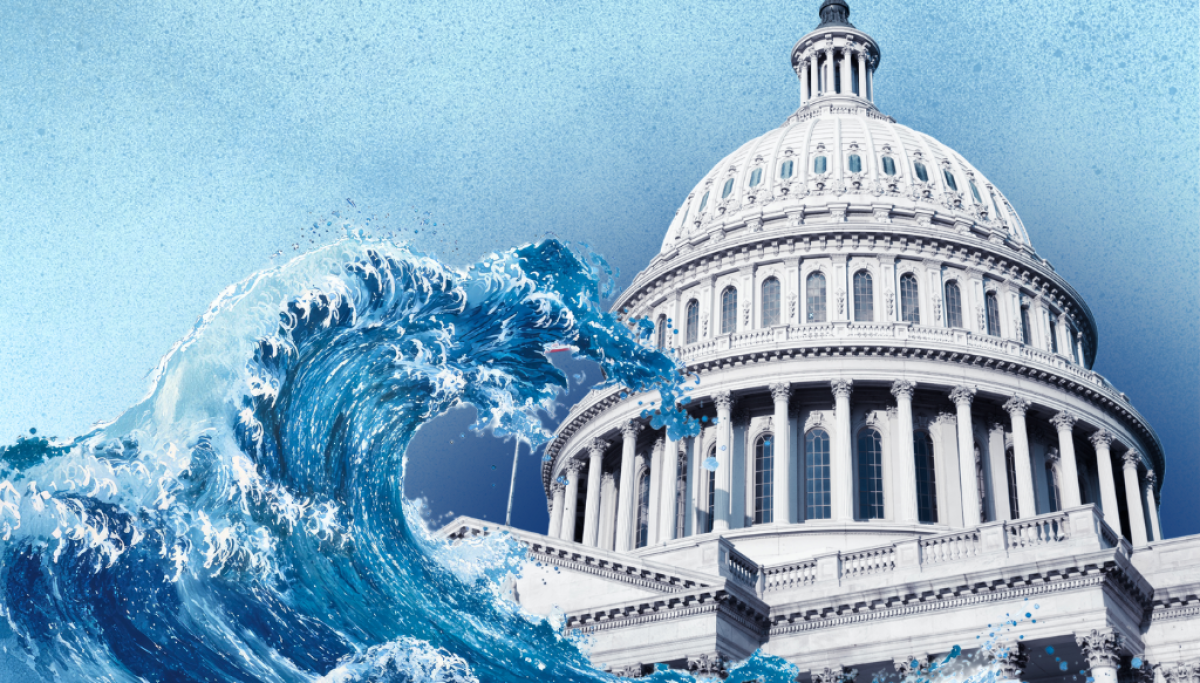
The blue-wave midterm election delivered a rebuke to Republicans and heightened expectations that Democrats will address the affordability crisis and growing wealth inequality in our “K-shaped” economy. But winning an election is one thing. Delivering on the expectations it creates is quite another — especially when the federal government is already spending far beyond its means.Democrats now face an uncomfortable dilemma that they were unable to address during the Biden administration. Voters expect relief from escalating living costs, yet traditional remedies of expanded subsidies, government programs, and redistribution may be increasingly difficult to finance — and without supply-side reforms, risk exacerbating the very problems they are intended to solve.Washington faces a nearly $2 trillion annual deficit, representing 6.2% of GDP, while federal debt held by the public approaches 100% of GDP. Interest expense consumes a growing share of federal revenues, particularly as interest rates rise, and neither party has demonstrated much appetite for the fiscal restraint needed to reverse this trajectory. And yet Democrats are advocating expanded healthcare subsidies, restoration of Medicaid funding, and an ambitious affordability agenda encompassing housing, healthcare, groceries, and energy. Where will the money come from? Higher taxes on corporations, investors, and wealthy households? More borrowing? Or pressure on the Federal Reserve to accommodate additional spending through easier monetary policy? Each presents difficult trade-offs.Higher taxes on investment and business formation can discourage capital investment, entrepreneurship, and job creation. Additional borrowing can put upward pressure on Treasury yields and private-sector financing costs, particularly when investors become concerned about Washington’s fiscal trajectory.And although lower policy rates may be appropriate to support productive investment in today’s K-shaped economy, monetary easing cannot create more housing, energy, healthcare capacity, or skilled workers. Nor can it sustainably accommodate expanding government commitments without risking renewed inflation and asset-price distortions.Indeed, continued deficit spending raises the specter of fiscal dominance, in which the government’s financing requirements increasingly constrain the Fed’s independence. Policymakers may eventually face pressure to tolerate higher inflation or suppress interest rates simply to keep federal finances manageable — potentially punishing the very households Democrats promise to help.Of course, Congress could offset new programs with spending reductions elsewhere, improve government efficiency, or pursue fiscal reforms that expand supply and competition. But each requires difficult political tradeoffs among constituencies expecting more benefits, not fewer. And therein lies the deeper political danger. The election may have united voters in frustration with high prices, but it did not necessarily unite them around the best solutions nor the sacrifices required to deliver meaningful relief.Democrats should not assume they have an unconditional mandate for expansive government intervention. Many voters simply wanted relief from inflation, tariffs, energy costs, and economic uncertainty — not a larger federal bureaucracy. Furthermore, Democrats must contend with a Republican president armed with veto power, making sweeping legislative changes difficult even with congressional control. The temptation may be to blame political obstruction rather than acknowledge the underlying fiscal arithmetic and seek bipartisan solutions.Complicating matters further is Democrats’ apparent eagerness to launch congressional investigations into the Trump administration. Congressional oversight is a legitimate responsibility, but will the new majority devote more energy to hearings, subpoenas, and political confrontation than to negotiating practical solutions to the affordability crisis? Voters demanding immediate economic relief may have little patience for two years of partisan spectacle that produces more headlines than results.It all seems destined for a familiar political cycle: promise more government intervention, find that resources are insufficient, resort to additional borrowing and bureaucracy, and then confront renewed voter anger when relief fails to materialize — with the inevitable partisan finger-pointing.TRUMP, XI, AND PUTIN MADE HISTORY. THE WORLD GOT NOTHINGThere is a better alternative. Rather than trying to redistribute prosperity through ever-expanding government commitments, policymakers should prioritize expansion of productive capacity through private investment, innovation, and the removal of regulatory barriers that constrain supply — particularly in the “three H’s” of housing, healthcare, and higher education, as well as AI and power infrastructure. But doing so requires confronting entrenched interests and accepting that government cannot legislate prosperity into existence.The blue wave has raised expectations for economic relief at precisely the moment Washington has diminishing fiscal flexibility and limited monetary room for error. Democrats may have won the election by constantly repeating the terms “kitchen table issues” and “affordability,” but now they must reconcile expectations with economic reality — and prioritize bipartisan solutions over political theater.Scott Martindale is CEO of Sabrient Systems LLC, an independent equity research firm and RIA.
Here’s a reality check on blue wave’s affordability promises
Full Article
Original Source
Read the full article at Washingtonexaminer →KhanList aggregates and links to publicly available news content. We do not host full articles from third-party sources. Always verify important information with original sources.