
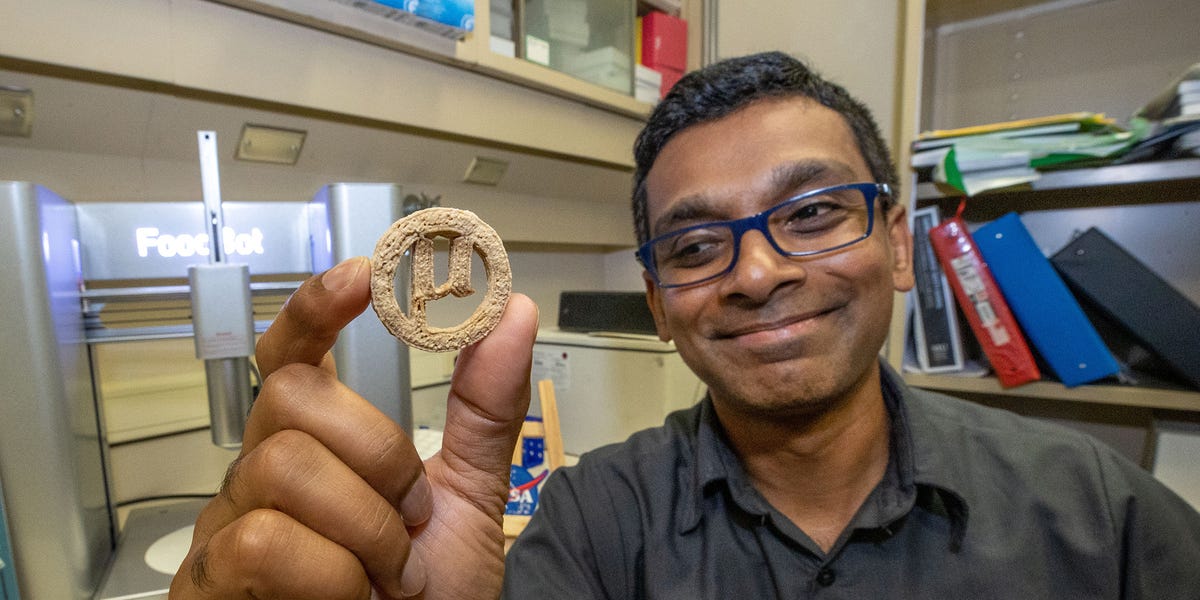
4 min readHere’s what you’ll learn when you read this story:Originally developed for NASA’s Deep Space Food Challenge, µBites (“microbites”) might be the eco-friendly answer for hunger, disaster zones, and astronauts taking off into space.µBites are literally made from plastic, but only after it’s broken down by a process involving oxygen and turned into a dough starter by microbes that metabolize into an edible substance.Genetically engineered microbes can now produce vanillin, making the cookies taste decent, and beta carotene, the hero nutrient in many red and orange foods.While many of us played with plastic food in our childhood, popping plastic toast out of a nonfunctional toaster or “baking” cookies in an oven that never actually heated up, plastics have become so pervasive that they’ve literally ended up in many things we do eat. Research has shown humans ingest between 78,000 and 211,000 microplastic particles every year. Then one scientist decided that clever chemistry could turn at least some waste plastic into actual food.Brainstorming alternative ways to create food that could provide nutrition for astronauts on future deep space missions, microbiologist Lahiru Jayakody of Southern Illinois University Carbondale came up with an ingenious idea for NASA’s Deep Space Food Challenge. Jayakody and his team figured out a way to break down waste plastics, such as water bottles made of PET (polyethylene terephthalate) and agricultural waste like corn husks and stalks. The smaller molecules that resulted from this breakdown were then fed to different strains of genetically-engineered microbes that morphed them into acids, fats, and proteins. After adding starch and fiber along with a sweetener, the resulting substance became a dough that the researchers 3D-printed into high-protein cookies—µBites.“It is becoming increasingly evident that developing novel, game-changing food technologies that enable a circular economy is necessary to safeguard the future of humankind,” Jayakody said in a study published in Trends in Biotechnology. He sees his creation as not only feeding astronauts who are light-years from home, but someday feeding disaster victims and addressing at least part of the problem of world hunger, which climate change is steadily worsening.Breaking down plastics and corn stalks for microbes to digest is possible through a process called oxidative hydrothermal dissolution (OHD). Plastic and other carbon-heavy substances like coal normally won’t dissolve in water. But that changes inside a sealed vessel of water heated far past its boiling point and pressurized so it stays liquid, with oxygen dissolved throughout. Under those conditions, oxygen begins snapping the carbon-carbon bonds that link their long molecular chains in a reaction called oxidative cleavage. As each bond breaks, oxygen bonds to the freed carbons, leaving behind small, lightweight molecules that dissolve easily in water. Because only water and oxygen are necessary for this reaction, which doesn’t require expensive reactors and produces only minimal CO2 as a by-product, it’s both economical and eco-friendly. The highest cost involved might be acquiring a 3D printer.µBites, pronounced “microbites” and appropriately printed in a test run as circles with the Greek letter µ in the middle for “micro,” could be feeding the future. No harmful catalysts or solvents are needed to engineer certain yeast strains like Saccharomyces cerevisiae and Yarrowia lipolytica to metabolize the carbon broken down by OHD, leaving a dense yeast culture that provides an excellent starter for cookie dough. Modified S. cerevisiae catabolizes the sugar cellobiose, breaking it apart into smaller molecules, while another does the same when fed ethylene glycol derived from plastic. Other programmed yeast strains, this time of Y. Ipolytica, Rhodosporidium toruloides, and Saccharomyces boulardii, which can produce food ingredients such as lipids and lactic acid, were involved in bioconverting other molecules from OHD.While this concoction was definitely edible, Jayakody was aware it had to taste halfway decent before anyone would voluntarily eat it. He collaborated with microbiologist Sandhya Jayasekra of Southern Illinois University Carbondale to create vanillin, the molecule that gives vanilla its distinctive aroma and flavor, from the same plastic-derived molecules that formed the rest of the dough. Microbes were also reprogrammed to produce beta carotene, the same nutrient found in carrots and sweet potatoes, which is turned into vitamin A by the body. The scientists recently offered a taste of their findings at the fall 2026 meeting of the American Chemical Society. They may not be covered in frosting and sprinkles like other cookies, but no ordinary cookie can survive a trip to Mars or turn a landfill into lunch.“Beyond outer space applications, the μBites system has the potential to improve terrestrial food production while positively affecting the environment,” said Jayakody. “In particular, μBites addresses three critical global challenges: food scarcity, plastic waste accumulation, and reducing the need for more carbon sources.”Elizabeth Rayne is a creature who writes. Her work has appeared in Popular Mechanics, Ars Technica, SYFY WIRE, Space.com, Live Science, Den of Geek, Forbidden Futures and Collective Tales. She lurks right outside New York City with her parrot, Lestat. When not writing, she can be found drawing, playing the piano or shapeshifting.
Here, Have a Cookie. It’s Made of Plastic.
Full Article
Original Source
Read the full article at Popularmechanics →KhanList aggregates and links to publicly available news content. We do not host full articles from third-party sources. Always verify important information with original sources.