
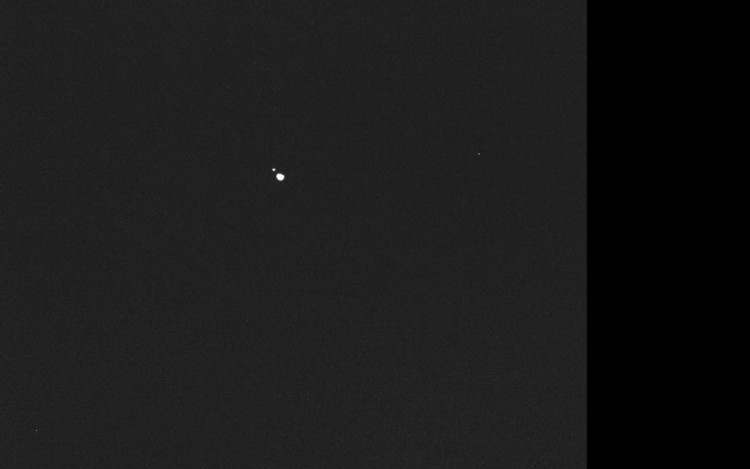
Planetary defense is a growing concern among the scientific community, as efforts have been made to design and implement missions meant to deflect incoming threats to the Earth well in advance. In 2022, NASA intentionally collided the Double Asteroid Redirection test (DART) planetary defense spacecraft into the smaller asteroid of the binary asteroid, Didymos and Dimorphos, with the latter being the smaller one. While the goal was to ascertain if deflecting an asteroid is feasible, how did this influence the geological characteristics of Dimorphos, and what can it teach us about planetary defense missions? This is the task of a brave robotic explorer known as Hera, which is a spacecraft mission led by the European Space Agency (ESA) in cooperation with NASA and the Japanese Aerospace Exploration Agency (JAXA). Hera recently sent back its first image of Didymos and Dimorphos, which orbit each other as they orbit the Sun, with the image revealing the two asteroids separated, as opposed to seeing a single dot. This comes after Hera was launched in October 2024 and is now about 1,280 kilometers (795 miles) from the well-known binary asteroid, the latter of which is about 197 million kilometers (122 million miles) from Earth. While the larger Didymos is estimated to be 780 meters (2,559 feet) in diameter, the much smaller Dimorphos is estimated to be about 151 meters (495 feet) across. “For the very first time we are seeing through Hera’s own eyes the very double asteroid system that the mission was designed and built for,” said Ian Carnelli, who is the ESA Head of the Systems Department and the Hera mission manager. “Our views will much grow sharper as Hera comes closer. We will unveil the first detailed images of Dimorphos – the first object in the Solar System to have had its orbit measurably shifted by human action – on 25 November [2026].” As noted, the goal of the Hera mission will be to conduct follow-up observations and data collection for NASA’s DART planetary defense mission. For this mission, the DART spacecraft intentionally impacted Dimorphos with the goal of ascertaining whether impacting an object could deflect it away from impacting Earth. The intentional impact occurred in September 2022 at 6.1 km/s (3.8 mi/s), resulting in not only slowing Dimorphos’ orbit around Didymos by 32 to 33 minutes, with the initial goal being at least 73 seconds. Thus, the mission was deemed a resounding success, and the researchers even observed an ejecta plume from the surface of Dimorphos as far as 10,000 kilometers (6,214 miles) into space. Aristic rendering of Hera approaching Dimorphos. (Credit: ESA-Science Office) Along with conducting observational analyses of the post-collision Dimorphos surface, Hera will also deploy two shoebox-sixed CubeSats named Milani and Juventas since Hera can’t fly that close to the surface. While Milani’s task is to perform a close-up mineralogical analysis of the DART impact site, Juventas will be tasked with using ground-penetrating radar to peer about 100 meters (328 feet) beneath Dimorphos’ surface to ascertain whether its interior is solid rock or a loose rubble pile which has been proposed by researchers. As noted, planetary defense is rapidly becoming a growing concern among not only the scientific community, but governments worldwide. This is primarily driven by our growing awareness of the number of asteroids in our solar system that cross Earth’s orbital path, but also the 2013 Chelyabinsk meteor that blew out windows and injured more than 1,500 people, primarily from broken glass. But with this concern comes how to address, and a combination of NASA’s DART and Hera missions are providing key insights into how to deflect potential asteroid impactors that could cause widespread death and destruction if one impacts Earth. What new insights into Didymos and Dimorphos will Hera and other space missions make in the coming years and decades? Only time will tell, and this is why we science! As always, keep doing science & keep looking up!
Hera Probe Sees Asteroid Pair Separately for First Time
Full Article
Original Source
Read the full article at Universetoday →KhanList aggregates and links to publicly available news content. We do not host full articles from third-party sources. Always verify important information with original sources.