
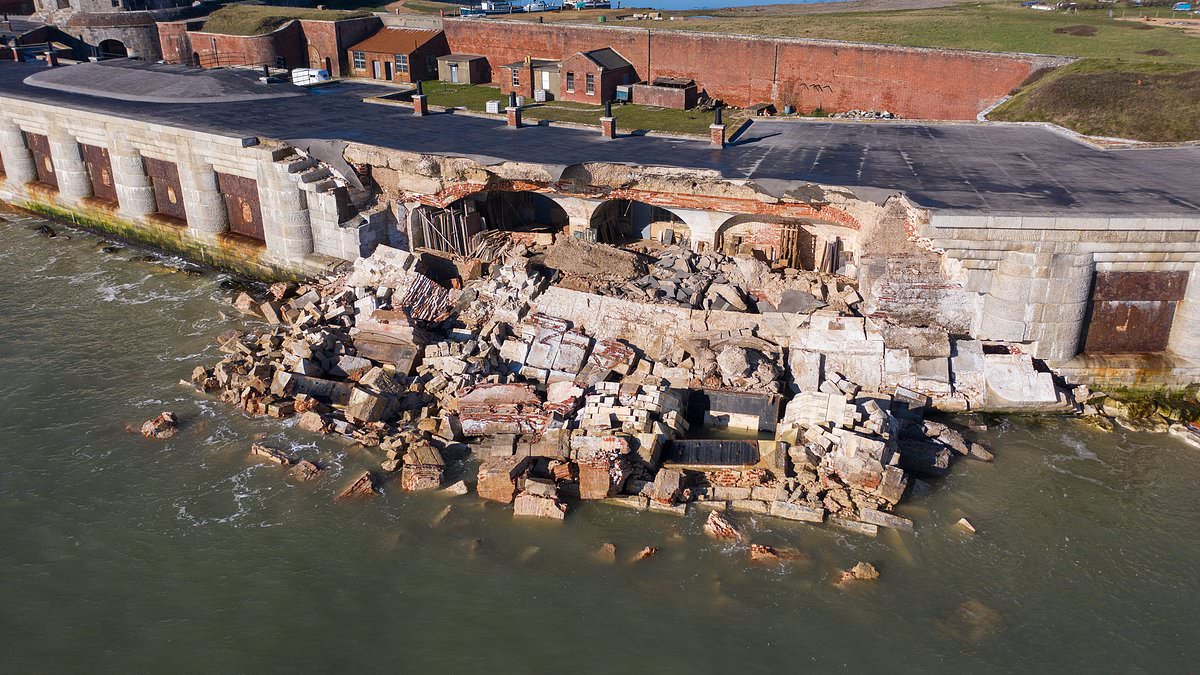
For almost 500 years, King Henry VIII's imposing fortress, Hurst Castle, has stood as an impenetrable bulwark over England's South Coast.But scientists are racing to save the fortress from a very different type of threat, as the rising tide threatens to swallow it forever.Built on a narrow stretch of sand called the Hurst Spit, centuries of coastal erosion have washed the beach right out beneath the walls.By 2017, the castle's foundations began to peek through the sand and, just four years later, the entire east-facing wall collapsed.As the underlying beach continues to wear away, the entire west wing has now started rotating under its own weight out onto the sand.Coastal modelling and 3D scans of the castle conducted by the site managers and English Heritage suggest that engineering works could buy Hurst Castle a few more decades.But those repairs would come at an estimated cost of more than £6million ($7.5million).Now, with funding in short supply, conservationists face a challenging decision: to invest millions in saving the castle for years to come, or to allow it to gracefully collapse into ruins. Scientists are racing against time to save King Henry VIII's Hurst Castle (pictured) before it collapses beneath the waves By 2017, the castle's foundations began to peek through the sand and, just four years later, the entire east-facing wall collapsed (pictured)Hurst Castle was built by Henry VIII between 1541 and 1544 as part of a chain of artillery fortresses protecting key ports along the coast.Situated in a strategic location on a remote shingle spit, Hurst Castle guarded the Needles Passage leading to the Solent, the port of Southampton and the growing naval base at Portsmouth.Unusually for a Tudor fort, Hurst Castle was kept in use and was greatly modernised in the 19th century to support Britain's defences during the Napoleonic Wars.Further upgrades came in the Victorian era as huge, armoured wing batteries were added to house a vast arsenal of anti-ship guns.The site even saw use during both World Wars after anti-aircraft guns were added, remaining in active military use until 1956.However, while those centuries of military use have turned Hurst Castle into a fascinating record of British history, they have also made it rather top-heavy.Its location also exposes the castle to powerful winds and tides that have been gradually undermining its foundations.Meanwhile, climate change has made the threat facing the castle considerably worse. Hurst Castle was built by Henry VIII between 1541 and 1544 as part of a chain of artillery fortresses protecting key ports along the coast English Heritage says that the wing collapsed just days before repair works were set to begin Based on Environment Agency data from nearby tidal gauges, it is estimated that sea levels will rise in the area by one to 1.5m in the next 100 years.Likewise, the increasing frequency of extreme weather and storms driven by the changing climate could seriously damage the already vulnerable structure.According to English Heritage, a single storm in 2014 displaced 100,000 tonnes of shingle from the Hurst Ppit overnight, reducing the height of the ridge by 7m.Today, the entire structure is at dangerous risk of collapse if nothing is done to undo the damage.Rob Woodside, a heritage expert working on the effort to save Hurst Castle, told Smithsonian Magazine: 'Eventually you'll have to start to close the western end, then the property entirely, on safety grounds.'Basically, you're in a process of ruination. You're going from a structure to an archaeological monument.'In 2019, English Heritage invested to stabilise the foundations of the west wing of the castle and to reinforce its sea defences. The castle was significantly modernised in the 18th and 19th Centuries, and was kept in active military service until 1956. Pictured: Hurst Castle in 1880 Experts believe the castle could be saved for years to come, but only with millions in new investment to protect it from the encroaching water The charity added 7,500 tonnes of shingle and repaired broken groynes, but storms soon removed the replenished beach, and the new barriers only seemed to channel aggressive torrents of water towards the foundations.Mr Woodside says that he originally proposed a long-term solution to keep the castle standing for about a century.Engineers suggested that dropping enormous boulders of granite into the water would break up tidal surges.However, these boulders would need to be shipped from Norway at a cost of more than £104million ($137m).A less ambitious plan, involving dropping smaller rocks at strategic locations along the surf line and costing £5.7million ($7.5m), was also proposed The question that remains is whether to start preparing for the castle's transition into a ruin, or pull together the funds to protect it for longer.English Heritage was approached for comment. Hurst Castle through the centuries When Henry VIII built Hurst Castle it was considered one of the most advanced fortresses of its timeBuilt by Henry VIII on the Hurst Spit in Hampshire between 1541 and 1544, the castle was intended to defend the Solent against the French and the Holy Roman Empire.The early castle had a central keep, three bastions and by 1547 was equipped with 26 guns.During the English Civil War, Charles I was detained here before his execution.By 1660, Charles II was on the throne and as the castle had fallen into disrepair, he considered demolishing it, but instead it was turned into a military base.Into the 17th and 18th centuries, Hurst Castle was used as a rendezvous for smugglers on the coast.Repairs were undertaken ahead of the Napoleonic Wars in 1803 and the castle was modernised to enable it to hold more advanced 24-pounder and 32-pounder guns.Hurst Castle formed part of the coastal defence network around the Solent during the First World War and Second World War.In 1956, the fort was decomissioned and is today run by English Heritage and Hurst Marine. Before the pandemic, the castle received around 40,000 visitors a year.
Henry VIII's Hurst Castle is sinking into the sea: Scientists race to save the 16th-century fortress as rising tides threaten to swallow it forever
Full Article
Original Source
Read the full article at Dailymail →KhanList aggregates and links to publicly available news content. We do not host full articles from third-party sources. Always verify important information with original sources.